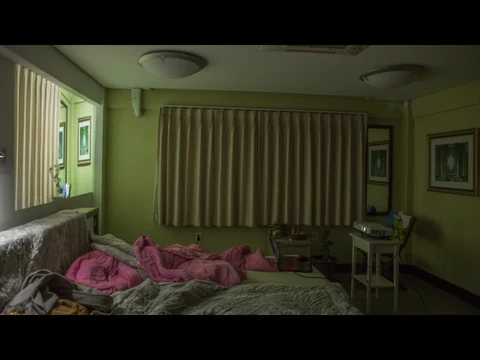
History
What passes from one place to another
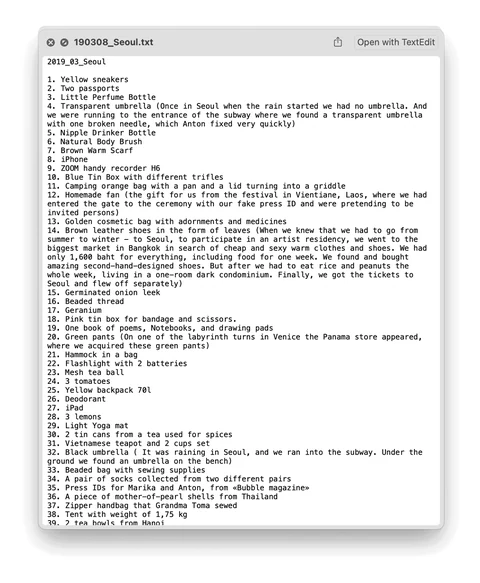
In the Seoul list of March 2019, a handmade fan from a festival in Vientiane appears alongside two bowls from Hanoi, Thai shells, warm shoes from Bangkok and the keys to the Geumcheon studio and dormitory. A voice recorder, wires, a piezo element, notebooks and a tablet are listed among clothes and food. In some entries, a thing acquires a history: how it was found, why it had to be bought, who gave it, what it made possible. In others, only its name remains. The movement between countries has already taken place, but can still be read within what the artists carry with them.
This is one thread in the history of Marika and Anton, who worked under the name Rabota. Another runs through ways of observing and talking: hearing the rhythm of cha cha cha through their backs and legs beside a small lake in Hanoi; receiving an answer to a question as a drawing of the planets' movements; trying to look at Luang Prabang before the habitual “I like it”; making out a low thud in a palm forest; arguing about what the pleasure of buying a down jacket means. The Seoul works will give some of these questions another form — a sequence of images, a loop of light, separate sound and video devices, a sound object made from the remains of a shirt. Not everything seen was intended for an exhibition, and not every conversation prescribed the next step.
“3.11.2018”; Diary; Image of a Human; Bangkok Media Ecology; Conversation (DOCX); The Seam (The Ball is God); Light in the Room #1; Jubilation.
In this history, research takes place both in movement and during enforced stops. Its conditions — other people's help, the possibility of eating and staying under a roof, the absence of a place for storage, access to a projector or a room — enter the work itself. But need does not guarantee discovery. The records preserve waiting for money, irritation, disagreements and attempts to reassemble the task they have set themselves. The later, coherent account knows that Seoul will follow Thailand; the diary and conversations do not yet know which of the decisions under discussion will take form.
“3.11.2018”; Diary; Image of a Human; Seoul conversation, 14 February 2019.
The word “Nonknowledge” came here from the preceding Bubble Opera, a year-long work with the distribution of events in time. The artists would later draw a distinction: the “Zone of Nonknowledge”, bounded by a calendar, had ended, while Nonknowledge remained a relation to events and things, a background from which to act. Understanding this shift requires more than replacing the name of one period with another. It has to be traced through specific observations, arguments, documents and modes of presentation.
Strategies and Anecdotes of Rabota; Text.
Vietnam. Sound, drawing, thing
After completing the year-long project and burying their things outside Moscow, Marika and Anton left for Vietnam. In the later account, their arrival in Hanoi begins with an acrid sunset and the smell of burning plastic. It is precisely the unpleasant smell that brings nostalgia: it recalls Kathmandu. Bridges, movement beneath the spans, cooking and burning plastic appear in a single observed space. The later account will connect observations of urbanisation and pollution with the emergence of media ecology. But this coherent formulation belongs to that later account; in the records of the movement itself, the material appears in more fragmented form, through sound, encounters, drawings and the need to organise everyday life.
Strategies and Anecdotes of Rabota; Text.
Authorial Comment
At Hanoi airport we were met by an acrid tropical sunset and the unforgettable smell of burning plastic, like in Kathmandu: strange, but something so nasty can also bring nostalgic feelings. Concrete bridges directed the movement of the river; beneath the spans everyone was moving endlessly too, burning plastic, roasting chickens. We stood at the very top and watched the lights.
A later account by the authors. Strategies and Anecdotes of Rabota.
History
In the diary “3.11.2018”, Hanoi first appears as a brief record of sound: “Tyrannical / cha cha cha by a small lake / understanding Every ‘cha’ with the bones of the back and legs”. It records a specific way of listening: the body recognises the rhythm; it passes through the back and legs. These lines preserve what would disappear from an ordinary list of places: the city's effect is felt through the body.
Diary entries — “3.11.2018”; Diary.
The artists travelled to Quan Lan island with two Americans, Bryan and Matt from Los Angeles. The encounter continued on a partly abandoned beach, where they found container bungalows with large windows. The surviving entry describes not only the encounter and the accommodation, but a moment when conversation literally changes the work: over a meal, their companions draw the movements of the planets and the Sun; this conversation becomes the basis of a concept for a commissioned project. A question receives an answer through drawing, and the drawing passes into a concept.
Diary entries — “3.11.2018”; Diary.
Authorial Comment
We were going to Quan Lan with two guys from LA: Bryan and Matt. Became friends on the way and together found a great place on the island: a partly abandoned beach, container bungalows with enormous windows, four people within a 16 km radius — that's us. One evening we were sitting in a café, we'd borrowed about $10 from them, were eating, and they, answering our question, were drawing the movements of the planets and the sun in our system, after which this conversation became the basis of the concept for our commissioned project. These guys work ~~for NASA~~ for Elon Musk, one builds solar panels...
Quan Lan, late 2018. Diary entries “3.11.2018”.
History
Another sequence is recorded nearby: a small teapot, two little cups, a Japanese notebook with a lighthouse, two pens; gas canisters cannot be found; small islands block the entire horizon. The landscape is compared to paintings on Chinese vertical scrolls. A purchase, the absence of necessary fuel and a formal visual observation occupy the same paragraph. A practical connection between collecting and research can already be seen here: the crockery makes living possible, the notebook allows the recording to continue, and the view between the islands becomes material for comparison.
Diary entries — “3.11.2018”; Diary.
The entry about the boat repeats a detail also retained in a short Facebook post: the driver steers with his feet. Later, in December 2020, the artists would develop this episode into an account for another exhibition — about two empty chairs of a nonexistent king and queen, supposedly standing in the US Senate. In that text, the story is explicitly described as one of their companions' “tall tales” and used to discuss an empty place. This is a significant later return to the encounter.
Facebook post about the boat from Ha Long — Facebook posts.
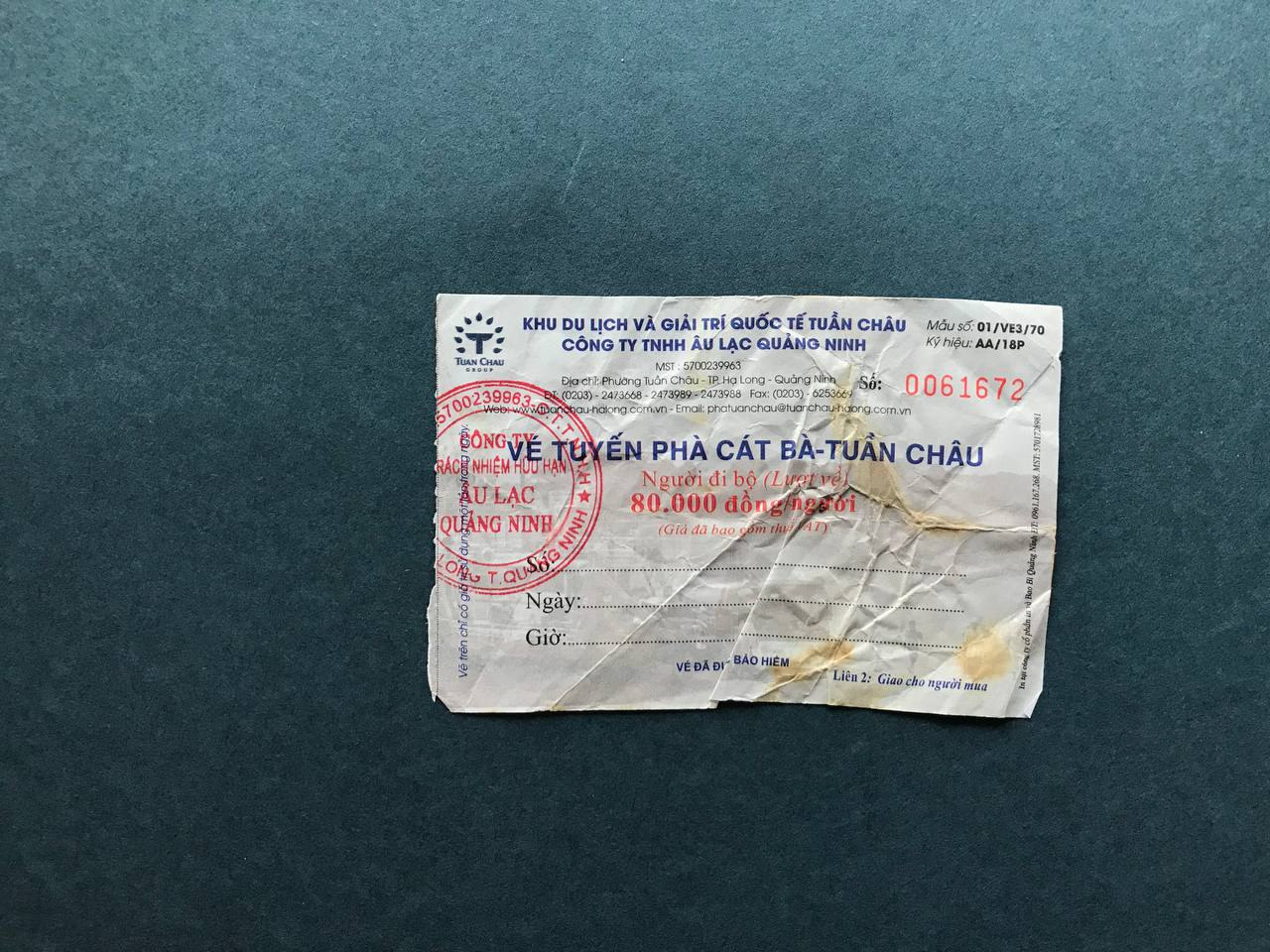
A later selection of material traces included a ticket captioned Quan Lan ticket. The route printed on it is Cát Bà — Tuần Châu. The artists visited both Quan Lan and Cát Bà; the later caption appears to have conflated the two island episodes. The ticket is undated.
Ticket image, The Asian Drift Display; The Asian Drift Display.
In the entry for 29 November 2018, two bowls for rice and tea are bought on a street in old Hanoi. Their first described use is very specific: half a Korean pear is held between the bowls because the artists are still wary of insects. The Seoul inventory would later include “2 tea bowls from Hanoi” and, separately, a Vietnamese teapot with two cups. This connection through objects allows work with an everyday thing to remain part of the history without declaring every purchase a planned part of an exhibition.
“3.11.2018”; Diary; Seoul inventory.
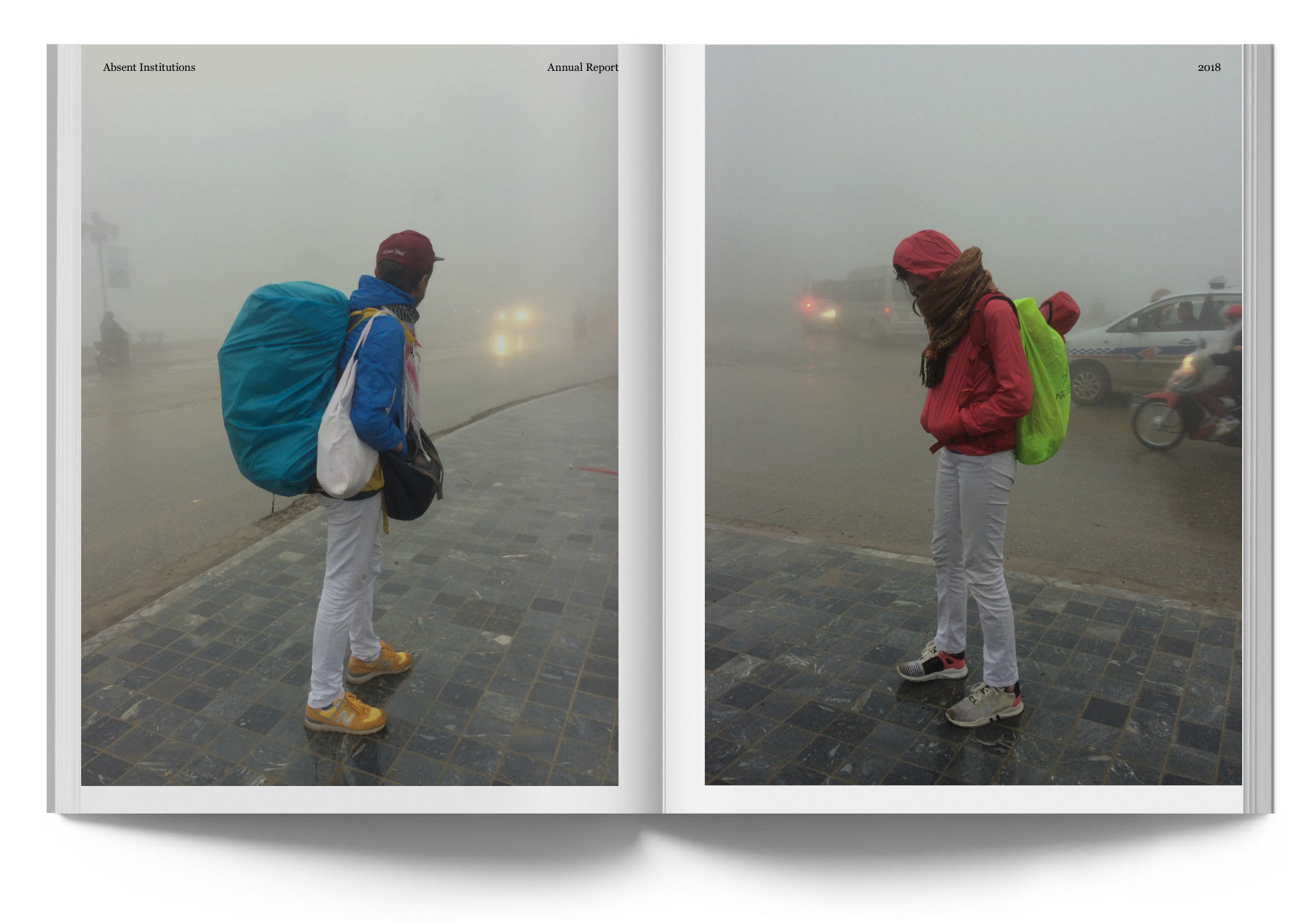
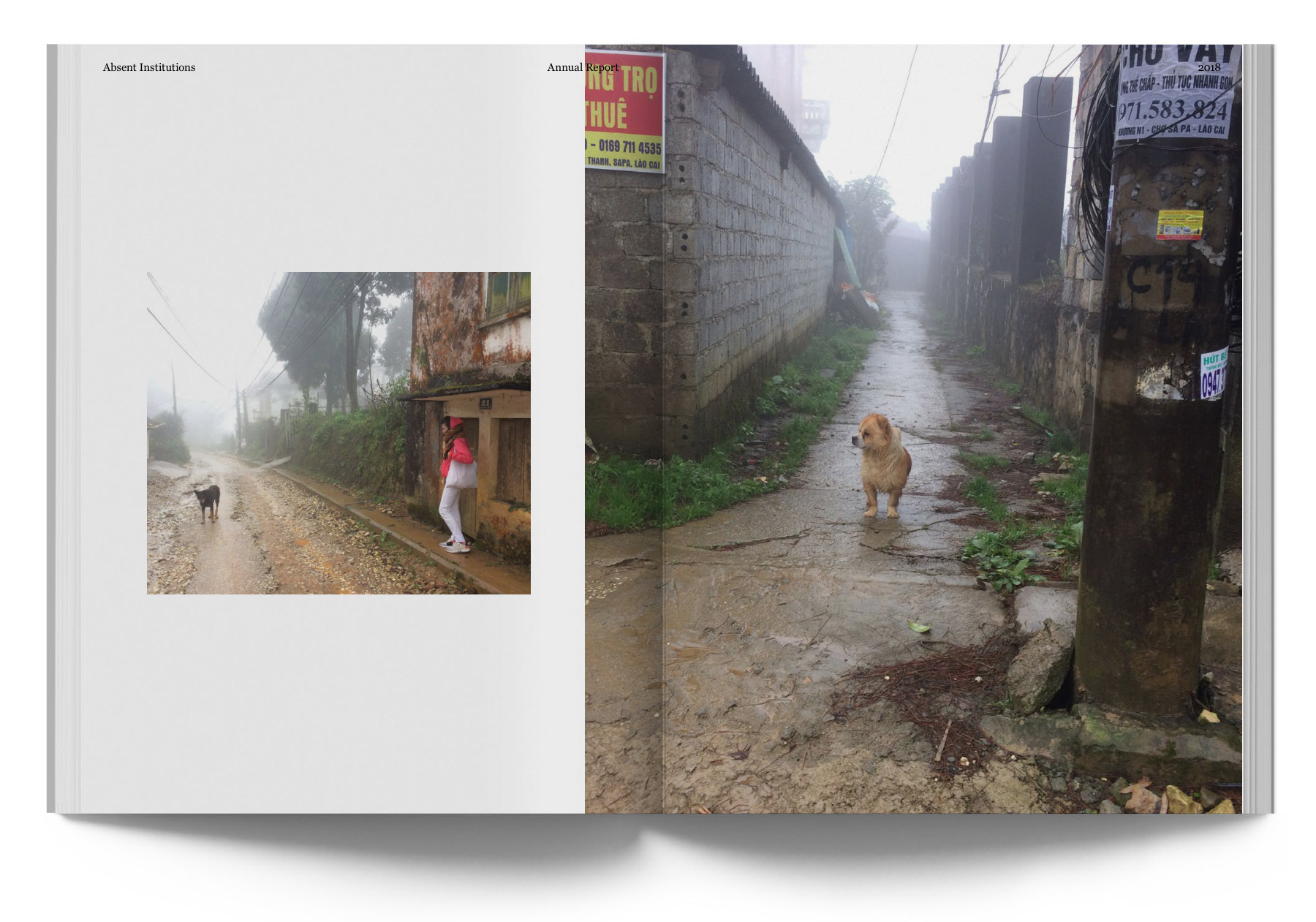
By 9 December, the diary places the artists in Sapa: they climb a hill above the town, then sit under blankets and try to dry their things. “Fog, and +7.” The next line is a plan to take the bus to Luang Prabang the following day, at 18:30. Northern Vietnam here does not support the idea of an uninterrupted tropical summer. Damp clothes and cold bring back the question of the body, its limits and the things it needs, with the same material precision used a few lines earlier to list bowls and pens.
Diary entries — “3.11.2018”; Diary.
Laos. Roofs, an unfulfilled expectation and the possibility of acting
The entry for 12 December is already connected to Luang Prabang and Mister Kee's house. The yellow villa rises above the village; the artists report having left the town almost immediately after arriving the previous day and plan to visit it by moped. The January conversation that returns to the Laos episode names Ban-Siplip and Mr Kay's little house.
“3.11.2018”; Diary; Tropa Laos; Conversation (DOCX).
Mister Kee becomes a conversation partner in an entirely ordinary account: he explains what happens to a banana plant after it bears fruit. Almost immediately, the entry introduces the phrase: “Nonknowledge needs you to create a meta-object.” Further down: “The nesting of Lao roofs / resembles the essence of time, / the emergence of thought.” The leap from plant to object and from roof to time belongs to the diary itself.
Diary entries — “3.11.2018”; Diary.
An entry marked “16.” continues the Laos section. The artists had met a monk the previous day and set out at 3:30 in the morning to attend the service with him. In the diary, mountains producing clouds, architecture, early morning and the distinction between a phenomenon and a personal judgement appear side by side.
Diary entries — “3.11.2018”; Diary.
Authorial Comment
The mountains give off moisture and produce clouds. Yesterday we met a monk, and already today at 3.30 we set off to their morning service. Luang Prabang — as an architectural and landscape phenomenon — is a total trip. Put another way — in looking, “you” or “I” appears, and it starts: “like it”, “don't like it”. And the phenomenon is outside that.
Diary, December 2018. Diary entries “3.11.2018”.
History
The question here concerns a way of observing. How can an encounter with what one sees be preserved before it turns into a judgement of one's own taste? How can one leave a situation in which architecture and landscape serve only as a reason to say “I like it”? The diary phrase does not yet answer these questions through a system of terms. It allows us to see that work with perception is already unfolding in a particular place: during a journey, an early visit to a service and a view of the town. Nearby, the monk's age, his knowledge of English and his reading in Pali are noted; the temple is also understood as an opportunity for education.
Diary entries — “3.11.2018”; Diary.
Several weeks later, in the conversation “Tropa Laos”, the artists recall what happened in Mr Kay's little house: they were waiting for something, the expectation was not fulfilled, and precisely this unrealised prospect seemed to them a form of fulfilment. They try out a word: sbycha (“coming-true”), dobycha (“a catch”), sbyvanie (“coming true”). An objection immediately follows: Nonknowledge requires will; ceasing to act threatens dissolution and the loss of meaning. Here, a failed plan becomes an occasion to investigate freedom of action, not a rule that every impasse must be productive.
Tropa Laos; Conversation (DOCX).
Authorial Comment
— Laos. A conversation about Nonknowledge. Look! — Yeah, there's something here. Bangkok, Thai waffles. Green dots. Laos. The village of Ban-Siplip. Mr Kay's little house. We're remembering what that moment was, when we were expecting something and that expectation didn't come true. And it seemed to us that this very impossibility of coming true was the fulfilment of the expectation. That this was sbycha. Dobycha. Sbycha. Sbyvanie. So any moment can be called that same kind of moment. — And Nonknowledge itself wants you to exercise your will. Otherwise it will all just drain away. — No, it's just that entropy begins. Entropy is when you stop acting. Entropy is when the reverse of reduction happens: from something simple towards ever more infinite complication and falling apart. — Ah, postmodernity? — Not postmodernity. It's the same at the level of the psyche: things lose their meaning, and a merely animal or plant existence begins. Everything is immersed in Nonknowledge and held up solely by will and these figures, these “stagings”. Speaking from our point of view — not a “human” one in general, but ours.
Tropa Laos, recorded in Bangkok, January 2019. *Sbycha* (“coming-true”), *dobycha* (“a catch”) and *sbyvanie* (“coming true”).
History
The conversation goes on to distinguish between the possibility of stepping back from one's own world and the capacity to act again. “Path” becomes the name for an organised course of thought and life: one can see the path already laid down and choose another. Bubble Opera serves as their first example of such an extended construction, but the new task is formulated separately — to assemble a new meta-object with a point of focus in the next issue of the magazine. They argue about whether the issue should be called Recollection, whether it begins with Bubble Opera, where to show the burial of things and what exactly ended with the calendrical “Zone”.
Tropa Laos; Conversation (DOCX).
Against this background, a comparison between artist and monk emerges. One speaker describes a sustained dwelling in Nonknowledge; the other objects to this model as prescribed behaviour. Their own working formulation emerges from the argument: the artist steps out into Nonknowledge in order to act autonomously.
Tropa Laos; Conversation (DOCX).
Finally, Laos entered Seoul through a thing with its own history of events. The Seoul inventory includes a handmade fan given to the artists at a festival in Vientiane. The inventory recounts how they entered the ceremony using their press cards, pretending to have been invited. The Bubble magazine press cards themselves appear nearby in the same inventory. The fan retains a specific intersection of hospitality, an invented institutional role, access and a gift, rather than an abstract “influence of Laos”.
By early January, the diary places the artists in Ban Krut. The moving sequence of towns and islands gives way to the repetition of the same days. “How do you begin to think creatively?” asks an entry after two weeks there. In the Thai entries, the question of the difference between the expected course of events and what happens unfolds within an extended stay in one place: through accommodation, food, debts, conversations and attentive listening to the surroundings.
Diary entries — “3.11.2018”; Diary.
History
Ban Krut: staying in one place
By early January, Marika and Anton were already living in Ban Krut. The diary entry for 1 January says that two weeks there had passed very quickly; nearby, it records a desire to leave tangled thoughts for a “joyful field of possibilities”. Finding a position from which to work is compared to finding a suitable chair, table and place to sit and write. In this formulation, thought depends on how the day is arranged and where the body is placed. What follows is a very specific daily dish: onion, garlic, chilli, cabbage, parsley, tofu, pineapple, coconut milk and rice. Research has a table, food and a recurring routine.
Diary entries — “3.11.2018”; Diary.
In the entry for 8 January, the typhoon has ended; the sea is still dirty and rough, and the owner of the house gives therapeutic massages. Tum brings a cold coconut and two fruits on a twig. Their taste is recorded through several divergent comparisons: jasmine, Chinese pear, meringue. The same excerpt says that the artists have had no money for about a week, that they are eating and staying at Tuana's on credit, and are waiting for payment for a commissioned project and news from Seoul. Tuana is the healer's daughter and the host with whom the artists stayed; Tum is the family's servant. It is Tum who brings the coconut and fruit, while Tuana helps them stay and eat on credit.
Diary entries — “3.11.2018”; Diary.
This dependence on help determined their ability to stay and work. Later, the artists would describe their host as a local healer, recount the rice and fruit his patients brought him, and speak of a month and a half of “productive despair”. The diary adds debts, waiting for money and the care of particular people to this later image. The retrospective account knows what follows, while the entry of 8 January is still waiting for a reply from Korea.
Strategies and Anecdotes of Rabota; Text.
Within these recurring days, a detailed investigation of what can be heard emerges. The entry for 12 January traces the awakening of the place: it is still dark at around half past five; at six, a flock flies past with sharp cries and opens the “forest-swamp choir”. The windows look out onto a palm forest. Beneath the ground-floor kitchen is a small, overgrown swamp; before sunrise there is humming, clicking and chirping, and after sunrise everything quietens. Attention holds the sequence and the changing density of sound.
Diary entries — “3.11.2018”; Diary.
The next episode begins on the terrace, at a round table with a fan. Behind the music from the speaker and the groans of patients who have come for a massage, a loud, low thud can be heard. When the thuds begin to recur roughly every ten seconds, the artists peer into the forest; Anton notices a monkey and they go to look. The source of the sound becomes visible: men are harvesting coconuts with trained monkeys on long leads. The entry moves from an unidentified sound, through repetition and directed attention, to an observable action.
Diary entries — “3.11.2018”; Diary.
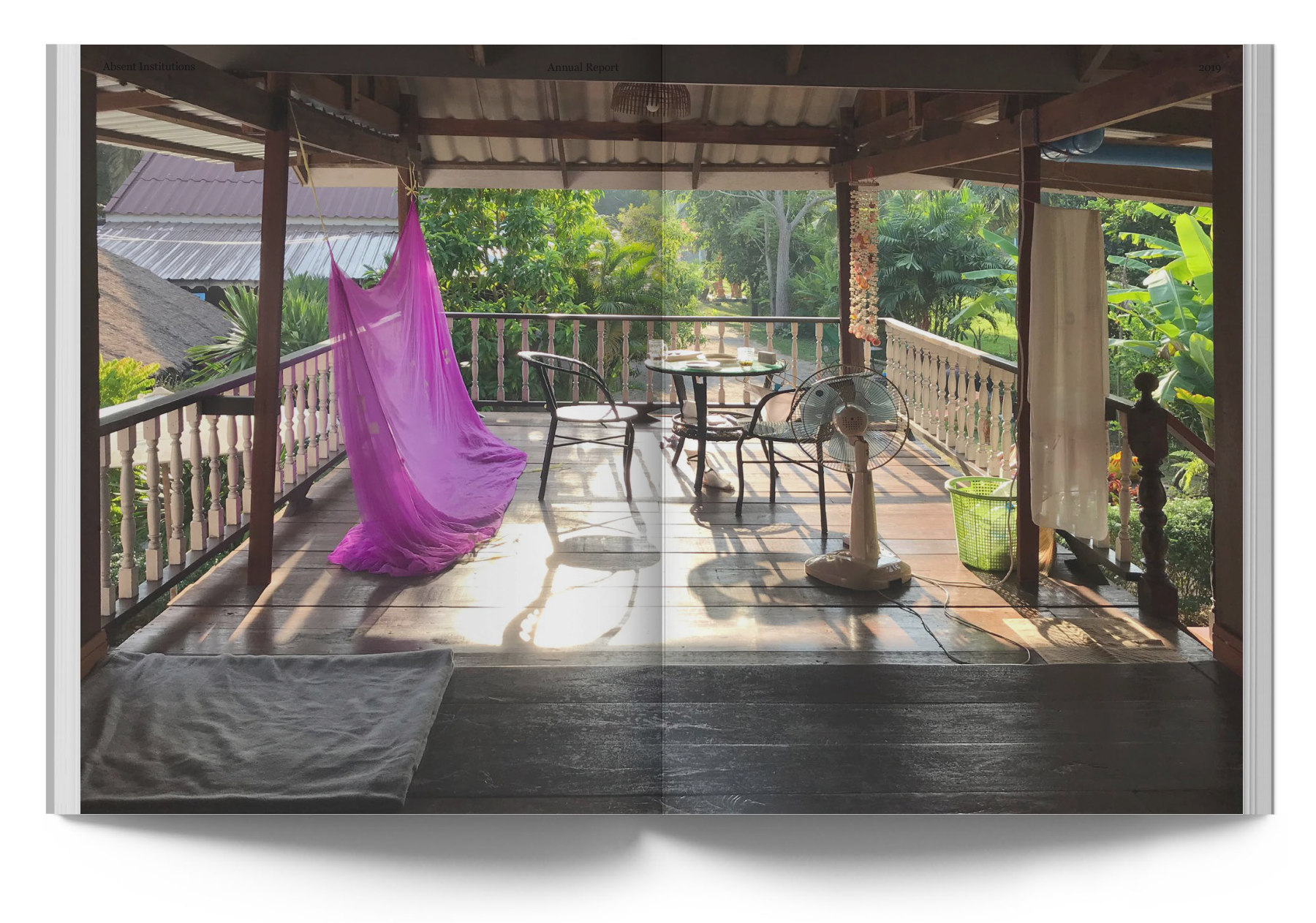
The conversation “Image of a Human” gives another form to the same work. It begins with place and condition: “We're sitting in Ban Krut”, then the date is corrected from the fifteenth to the sixteenth. Yesterday there was money, but it was paid for accommodation. The speakers discuss how one place, the same food and visits to the same beach change perception. The comparison with monastic life immediately meets an objection: it is more interesting to discuss their own life than an unfamiliar monastic experience. The argument keeps the research close to what is actually happening.
Authorial Comment
— Marika says that for now we're feeling this thing about infinity within a limit on our own skin. Because we're in the same place all the time. We eat the same food every day, but there's some kind of movement deeper, wider, a spreading out somewhere. — And this is exactly the thing that's unfolding — infinity within a limit. — It's very interesting. Interesting how our perception starts to be limited to one place, to some one recurring day. This recurring day, at the same time — it isn't the same day. Because it repeats, and we repeat the same food, going to the beach, all of this unfolds into some kind of infinity, a very varied one. — I just thought: yesterday that woman asked me, “How have you been living here for a whole month? What are you doing here?” I thought that when your perception is limited by something, it sort of knows there's something else, but it isn't in a hurry to get there, because it exists in one place. — When your perception isn't limited, it starts rushing about and doesn't know how to settle itself. — Well, yes. Well, yes. And that's exactly the point of monastic life: you get a limited space, limited by the fact that you shorten your will and give it away. Let's say you clothe your will in this suit of obedience. So there's some person who's sort of responsible for what you do, and through this they sort of limit your will, and you actually become free. You're sort of turned inside out. — I'm interested in talking about our life. I don't know what monastic life is. — Why are you getting angry straight away? — I'm not angry. I'm just interested in thinking about what we have, rather than some monastic life somewhere out there. — Because all I know about Francis of Assisi is that when he walked, he was alone, he was more of a monk than the Franciscans who followed him and created a sect. — So that's a direct example of how any monastic organisation is already a second level above actual life.
Marika and Anton, Ban Krut, 16 January 2019. Image of a Human; continuation.
History
The conversation goes on to develop a specific artistic task: how to depict a person through the world they gather around themselves. Things, their arrangement and the ways of holding them are considered as manifestations of the person gathering them. A proposal immediately follows to narrow the formulation to the “image of an artist”; the reply clarifies that what is at issue is an artificial model of the world. This is a working discussion of the limits of their own task, with responses and corrections.
The sequence of the research period and its realisation also matters in the conversation. Towards the end, the speakers recall a text in which the first part of the work takes place outside institutions and the practical part inside them. They then decide to revise this division and propose doing both parts in one place. The proposal records a desire to reorganise the conditions of work. Seoul will offer the possibility of talking, reading and assembling installations at the same time.
Bangkok: what can act without us
The late-January section of the diary moves the action to Bangkok: there is money for travel, a wait for a Korean visa, a rented condominium, work on a presentation through the night. The entry for 25 January says that Anton worked until five in the morning and, after a short sleep, left to collect the visa. Work on the presentation, accommodation and arrangements for the next move occupy the same day.
Diary entries — “3.11.2018”; Diary.
In late January, the conversation “Bangkok Media Ecology” takes up the conditions of working in Bangkok.
Its first problem is how to communicate with others while remaining focused on their own work. The artists try to regard their not fitting into existing systems as an independent political position. But naming autonomy is not enough: an object must be created to which another person can connect. World Autonomous Residency, the magazine and the joint position of artist and curator are discussed here. They seek the contours of this subject and propose getting to know it “through conversations, intuition and reflection”. The conversation itself carries out the proposed method.
The question of consumption immediately finds an example in their own life — a white down jacket they bought, and the joy of finally finding it. The possibility of reducing consumption encounters the need for clothing. The speakers return the question to themselves: what is actually needed for life, what keeps them wanting to acquire and discard, how their relation to what they already have changes.
Authorial Comment
— So this problem needs to be put forward so that someone can think about it. — We've put this problem forward for ourselves: why do we consume, what does it mean to reduce consumption, what does minimal even mean? — Here… well, you can reduce consumption, you can keep reducing consumption. But if you just keep reducing it, you'll feel you're not consuming enough of something. That means you've got something wrong, haven't thought something through. — No, here it's not so much about reducing consumption as switching from consumption to contemplation. — But still: take us, for example, we decided on a white down jacket. We bought this white down jacket. — When we were buying it, I was super happy that we'd finally found it. I mean, we're still consuming. — Well, no, we're not consuming it in that sense. That's not that kind of consumption. Consumption, I think, is different from meeting life's needs. They're different things. — But to have life's needs, you have to ask: what are life's needs for you? — No, well, in principle a person always knows what their needs are. The only thing is that there are false needs. — False needs, yes. Let's not talk about everyone, about people in general, because, well, to hell with them. Let's think about ourselves.
Marika and Anton, Bangkok Media Ecology, dated 23 January 2019. continuation.
History
Placing this conversation beside the Ban Krut diary reveals different ways of working with attention: the repetition of a day at the beach, an argument about a purchase, and the preservation of traces in photographs and notes. The purchase of a down jacket prompts an argument over whether the joy of a found thing should be considered consumption or the satisfaction of a need.
When the conversation turns to the medium of World Autonomous Residency, notebooks and photographs are named. A note saying that “the door sings” is offered as an example of what already remains from the work. The reply qualifies the scope of the claim: this is an artistic object within the residency. They are trying to find a form in which observation and life can address others.
Here, too, the difference from Bubble Opera's year-long score becomes particularly clear. The speakers recall proportional schemes of time and space, but do not agree to schedule the next event in advance. They propose working out the order from what has already happened. They suggest calling the stage of the portfolio then designated “Nonknowledge” “Fog” — connecting it to the indeterminacy they continue to experience.
Authorial Comment
— We came up with a scheme for demarcating time and space — these proportional schemes of ours. — But they work for working on a project, not on a residency. — But a residency is a project. — But you won't be able to… We decided that for the autonomous residency we don't predetermine events. — We can, once we have these events behind us, like Tbilisi, for example… — That's what you're already doing, constructing schemes in the portfolio. — Yes, but I construct it intuitively, it fits itself into these systems. — So that's it, it has to be constructed intuitively after the fact. — But it is constructed after the fact, into some… — Well, it's just not that we have “13 November, a seventh”, and we have to make an event there. No, it's nothing like that. — I'm saying these forms don't work here. — Well, okay, they don't work with a specific date, I agree. — What works here is some kind of… — Generators, maybe? — You see, this fog: we're still sitting in fog. So this fog — it's the main thing in our trip. — Because this fog was there in Ban Krut, this fog… and then to get some cash there… — Yes. — So actually, not Nonknowledge — this period should be called fog, rather than Nonknowledge in the autonomous residency. — Just as there's moving, there's fog. — And do you not say “Nonknowledge” at all? — No, we have Nonknowledge in Bubble Opera, we have a magazine about Nonknowledge, about Nonknowledge. — And the stage in our portfolio called “Nonknowledge” should be called “Fog”.
Bangkok Media Ecology: proportional schemes, unplanned events and “Fog”. continuation.
History
The discussion then turns to reassembling the portfolio: selecting ordinary photographs, preparing sequences without text, returning to old things and journeys. They propose keeping the portfolios already made. They want to make a new selection to present the residency, retaining the portfolios already assembled for another occasion. The future form is still under discussion, while the existing documents continue to live alongside it.
A week recorded after consumption
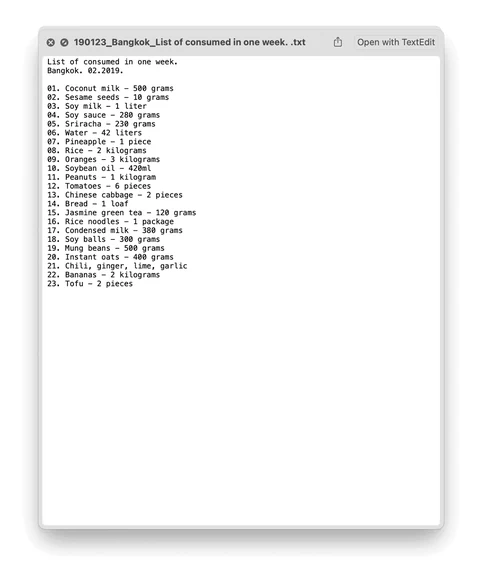
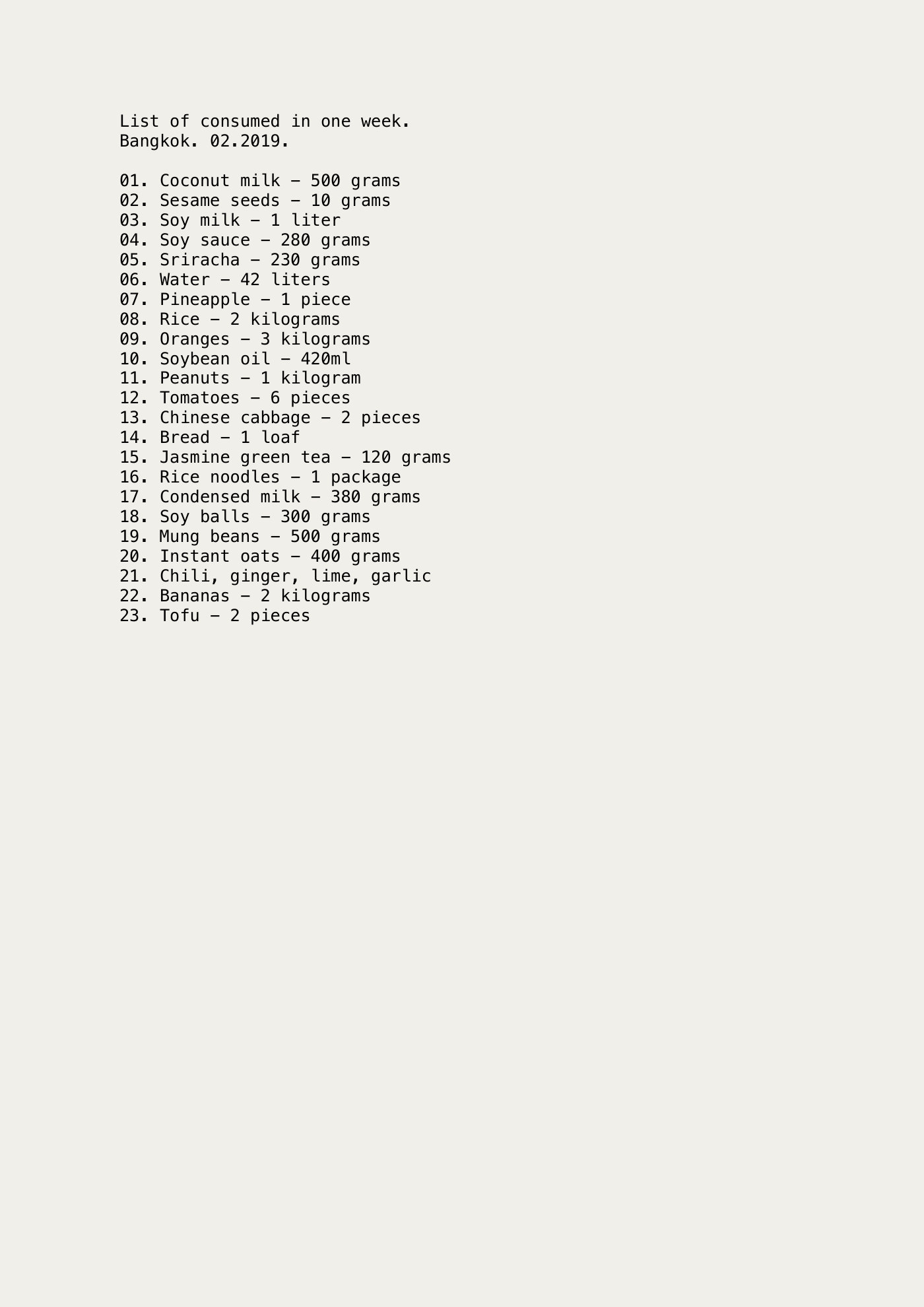
The index work Bangkok List shows another way of retaining lived time. It contains twenty-three entries: forty-two litres of water, two kilograms of rice, a kilogram of peanuts, three kilograms of oranges, coconut milk, sauces, tea, tofu and other food. The week is recorded through what was consumed. The list is signed “Bangkok. 02.2019”.
The same set of items appears in Russian at the end of the field diary. The list and the conversation about contemplation each hold the question in their own way: what is needed for life, and what form can attention to what has already happened take?
“3.11.2018”; Diary; Bangkok List; One-page PDF; Text file.
Later, in Seoul, another inventory will appear — of things currently possessed. These lists differ in what they count: one retains the quantities consumed, the other presents what remains with the artists now.
From summer into winter
The change in conditions is clearest in the history of the shoes. In the Seoul inventory, the entry for brown leather shoes in the form of leaves expands into an account of the transition from Thai summer to Korean winter. The artists go to Bangkok's large market for warm clothes; there is enough money for the purchases and very little food. The good shoes are more than new possessions: they carry the history of a necessary change of clothing before another place of living and working.
Authorial Comment
Brown leather shoes in the form of leaves (When we knew that we had to go from summer to winter - to Seoul, to participate in an artist residency, we went to the biggest market in Bangkok in search of cheap and sexy warm clothes and shoes. We had only 1,600 baht for everything, including food for one week. We found and bought amazing second-hand-designed shoes. But after we had to eat rice and peanuts the whole week, living in a one-room dark condominium. Finally, we got the tickets to Seoul and flew off separately)
Brown leather shoes, item 14. Seoul inventory.
History
The account retains the joy of the find, a week of rice and peanuts, the dark one-room apartment and the separate flights. In the Thai entries they wait for Seoul and arrange a visa; the Seoul inventory retains the origins of the things they brought. Once there, objects continue the journey — and at the same time the keys to the Art Space Geumcheon studio and dormitory appear, providing the possibility of staying and working for a while.
History
Seoul: the possibility of staying and the need to make something
In Seoul, what changed first was the arrangement of everyday work. There was a place to stay for a while, a studio and the possibility of arranging access to technical equipment. This did not mean that Marika and Anton already had a finished project that only needed assembling. In the conversation of 4 February 2019, they returned to their earlier discoveries and asked how to open them again: a drawing that had once recorded a sense of movement and sound had not exhausted the mechanism they had found. Other means were now required — those of installation, exhibition and technology. The turn “Well, now we have the opportunity!” was followed by the reply: “Well, we're working them out. The question's been asked — the answer hasn't come yet.”
The conversation of 14 February gives a sense of what remained to be worked out. Marika and Anton discussed the artist's relation to the institution, the difference between a musician playing and music appearing, design and the freedom of artistic form. Their familiar lack of a place emerged within the discussion itself: heavy material objects cannot be produced without storage, a permanent studio and a place for which one can be responsible. Hence the attention to drawing, text, photography and video. But turning to these media did not yet provide a finished form; they had to understand exactly how these would work.
The work in Seoul continued the Thai conversation quite literally. In the same recording of 14 February comes a reminder: “We do need to use what we came up with in Thailand” — still photographs interspersed with video projections of windows. An argument follows over whether these can coexist with graphic stripes and squares, whether layering them turns everything into rubbish. The next possibility is to have only one photograph in the exhibition: an account of it, a description of the things depicted, a reconstruction of the place and social surroundings, music written specifically for that photograph. These are still several competing solutions.
Authorial Comment
— This is more a kind of nonknowledge connected with NOT knowing: you don't know something, and you need to find it out. — I get it, do you know what the difference is? Art is when you start with the first stone, then two stones, then three stones. And in design you start with three stones straight away! Everything's given to you from the start. — The meaning of the word nonknowledge is different. In art, Nonknowledge denotes fullness. Nonknowledge as fullness. And each piece of knowledge splits this fullness. And creates the body of the work. But in design, nonknowledge is the absence of knowledge. It's something that needs to be found out. Like indeterminacy. — Which needs to be found out. — Which needs to be determined. Like the absence of something needed. So, uh… in principle, yes?... In principle you can work with art on the basis of social material, you can work according to this principle.
Marika and Anton, 14 February 2019: two meanings of nonknowledge. Seoul conversation, 14 February 2019; continuation.
History
A work does not have to illustrate a conversation
On 1 March, the conversation returns to an object that “doesn't shout anything in itself” and opens up through contact. A significant qualification appears here: the possibility of getting down to work does not mean an obligation to realise everything said. One voice states directly that doing is a different activity, and that realising conversations is uninteresting. The other objects to the very demand to think about an “art object”: philosophical ideas, literature, a seam on shoes, a scheme of six stones are interesting, but producing a thing to meet such a demand is not. That same day, they were planning to test projections. The possibility of working within four walls was accompanied by irritation at a month spent inside them.
This lack of agreement matters for understanding what follows. The Seoul objects should not be read as successive illustrations of a theory developed during the journey. Conversation, manual assembly, filming and public presentation move at different speeds. Sometimes a conversation opens a possibility; sometimes it gets in the way of starting work. Idea, photograph, device and room still have to meet.
A ball heard and seen differently
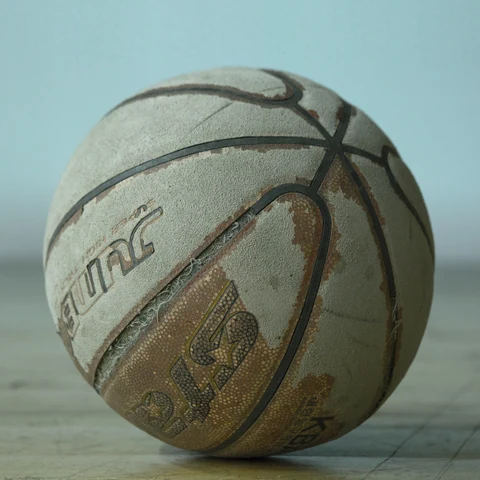
One such realisation begins with a found thing. In their account 2019 Ball, Marika and Anton recall retrieving a battered basketball from the Anyangcheon River on Anton's birthday. Shortly before, they had said that basketball was what they lacked for a normal life in Seoul. The ball was so beautiful that they photographed it in detail from every side and made a film about how it works as an object of consideration.
Ball.
Authorial Comment
We got this shabby ball out of the Anyangcheon river on Anton's birthday. Just before we talked about the fact that basketball is what we lack in Seoul for a normal life. The ball was so beautiful that we took detailed pictures of it from all sides and produced a short film about how it works as an object of phenomenological consideration.
Marika and Anton on finding the ball. Ball.
History
In the independent work 190301, the ball's sound and image were installed on separate devices. In the documentary photograph, a monitor stands directly on the wooden floor; it shows a close-up of the ball's worn surface. A separate sound device is placed behind it, with wires running between them. Here it is possible not only to recognise the object from its image, but to notice the work perception performs in joining what is seen and heard into “the same ball”. The physical ball remains the third term of this relation: neither sound nor image exhausts it.
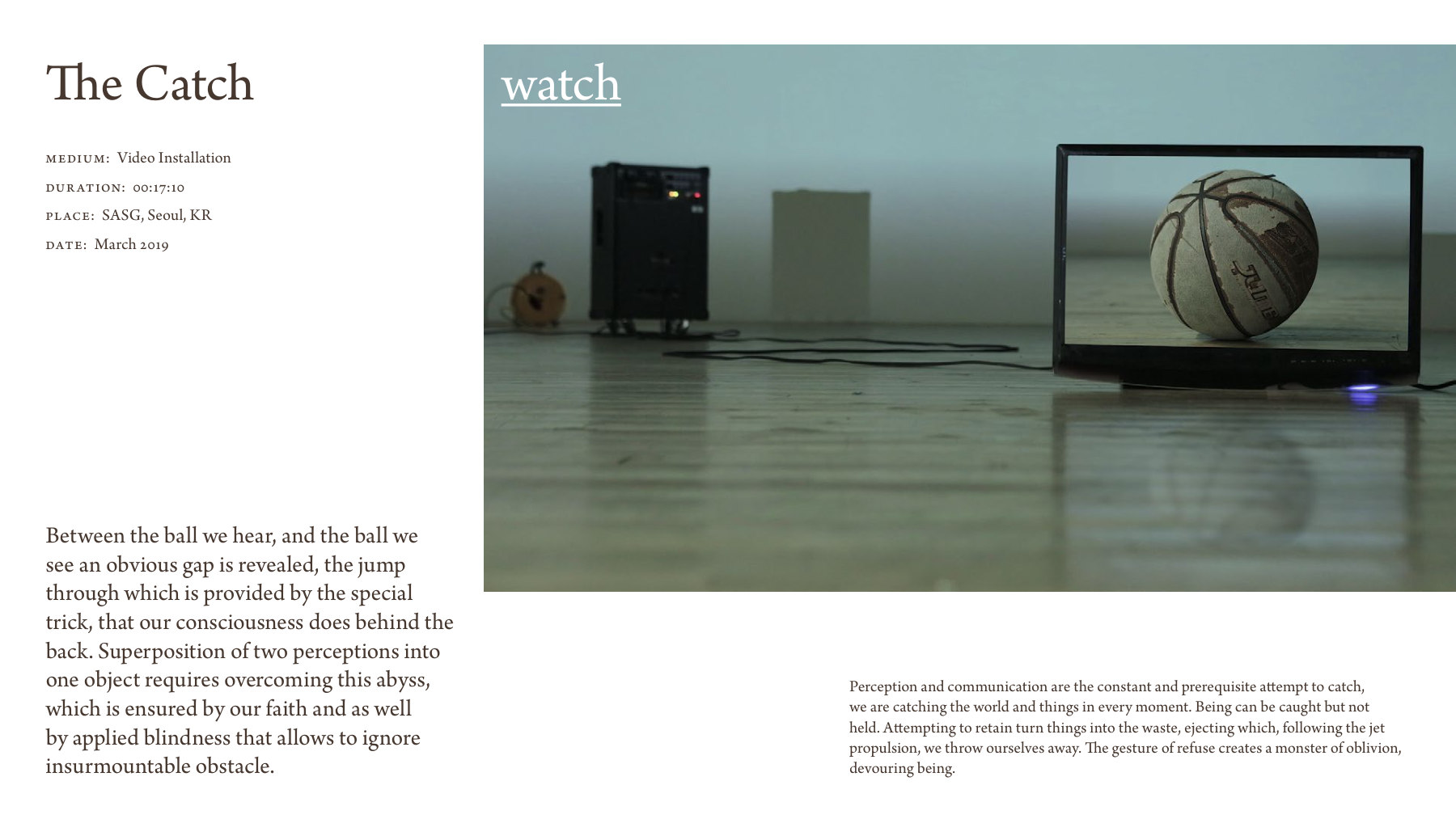
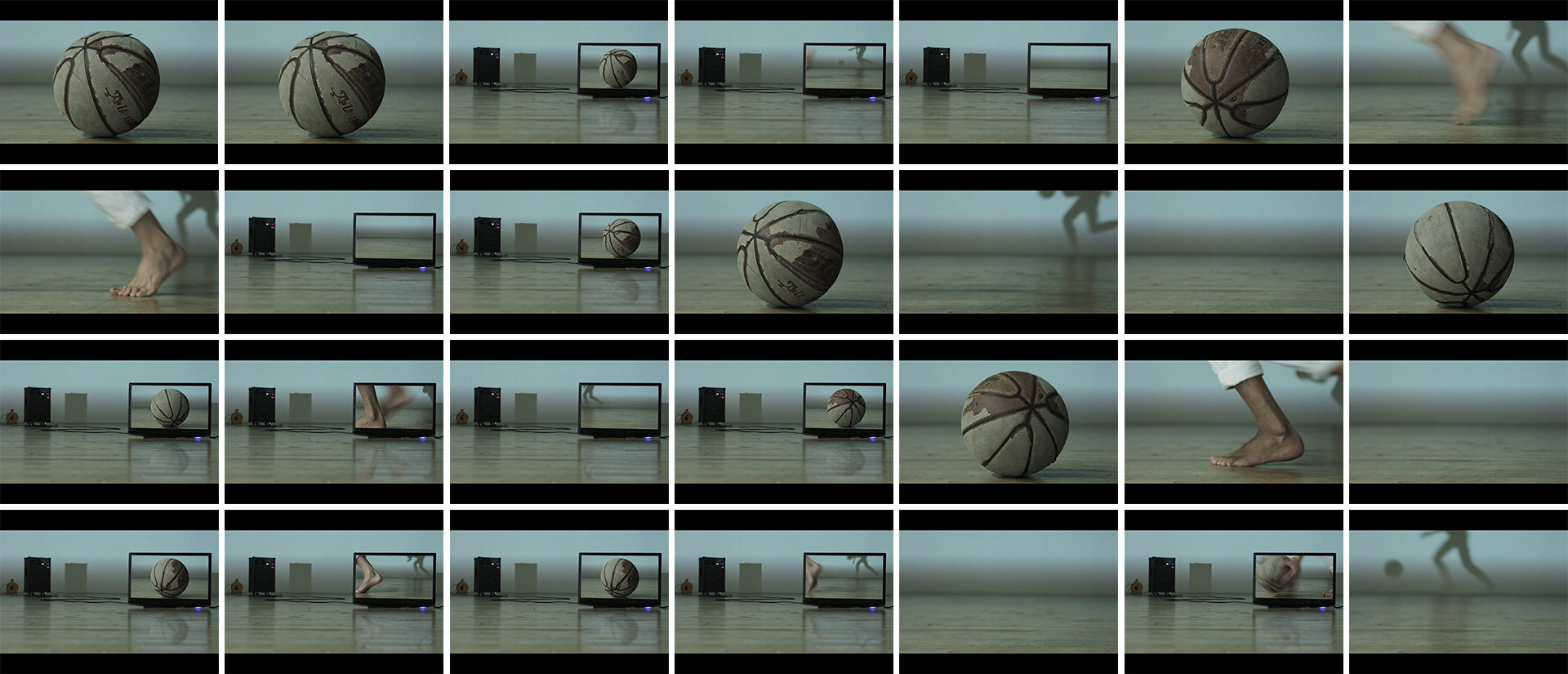
The portfolio title The Catch brings the same problem into focus from another side — as an attempt to grasp the world. The work appeared under the titles The Catch, The Seam and The Ball is God at different stages of its history.
Light passing through things
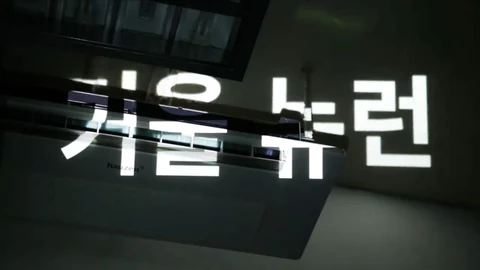
Two other independent Seoul works are dated a few days later. Light in the Room #1 is a video and light installation dated 4 March 2019, a loop lasting 1:17. A word or text first becomes a projection, illuminates a material surface, is recorded by a camera and is then projected again. The sequence passes through thought, digital code, light, object, camera and new light. The image carries a trace of a particular surface and another moment in time.
The artists describe collecting such recordings in a forest, a city, a boat, an interior, on a road at night — wherever darkness allowed the projector to create a place for filming. The words filmed in different places were then edited into a text for projection in a living room. Filming and presentation, separated in time, are joined by light on the wall.
Light in the Room #2, dated 5 March, develops the same set of questions differently: the room appears again wherever conversation, thought, darkness and projection coincide. It does not have to be transported as a finished object. A practice with few things takes spatial form each time under new conditions.
The March conference and its open-ended preparation
For Marika and Anton, the conference was a distinct medium. On 4 February, they discussed returning to what they had not fully opened up in Karlsruhe: a conference capable of holding emptiness without filling it with obligatory speech. They proposed projecting Nonknowledge at a large scale, using photographs of their own things, changing the usual meaning of branding. The familiar advertising form was to have no product to point to. But this, too, was not a final design: the conversation retains an argument about three columns, the rejection of a superfluous Use it and a separate proposal to keep Use it as a general medium for the conference.
In another Seoul conversation, the preparations sound even more concrete: will there be a tent, will they sit at a table, will a stone hang and Samotryas objects lie there, how can the “focus on the conference” be retained or removed? A turn about the need to make a video on the table brings everything back to filming and manual work. They have to prepare the material and go to the residency office to ask whether the letter has been read. Several alternatives were still competing.
In Rabota Speech, prepared for the residency, research is named as the first stage of the stay. The temporal scheme Opera operans appears again: time is to be divided using an overtone system. Beside January's refusal to schedule events in advance, this document preserves another way of organising the work, set out as a proposal. The next item is a closed performative lecture by invitation at PS333 around 15 March: a conversation about the internal workings of the practice, with the expectation of feedback. Plans then include a separate sound experience in the lecture room, an Open Studio with video, an open performative installation in homage to Nam June Paik, and an electronic issue of Rabota Journal. Details were to be posted in a box by the door of Studio 18.
The Media Rave Conference trailer gives the March invitation specific form. The words March 15, 3 pm, SASG, PS333, media-rave, conference appear successively on food in a refrigerator. The announcement already uses the material world of everyday life as a screen: light falls on milk, vegetables and fruit, and the message is read through their volumes.
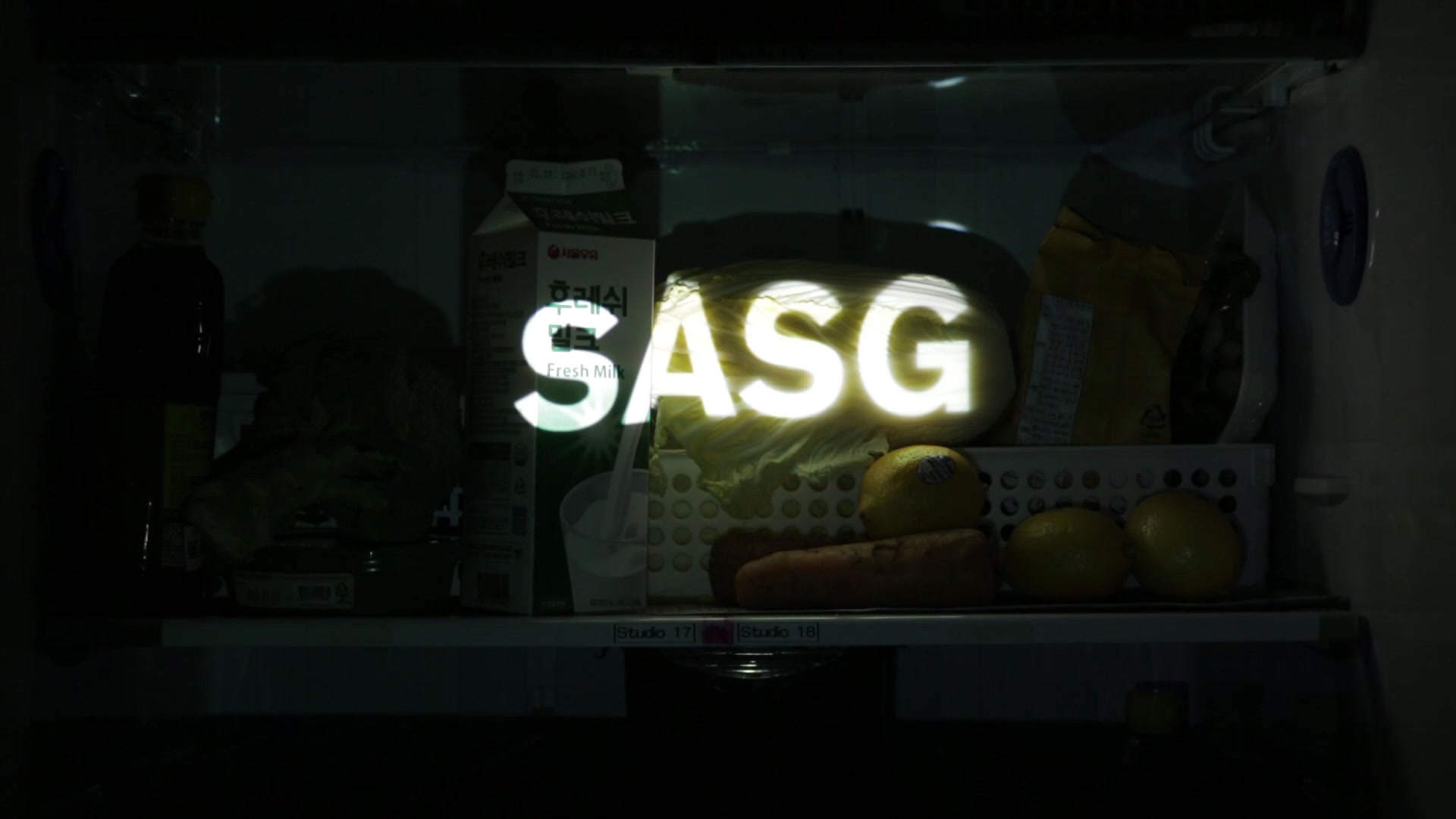
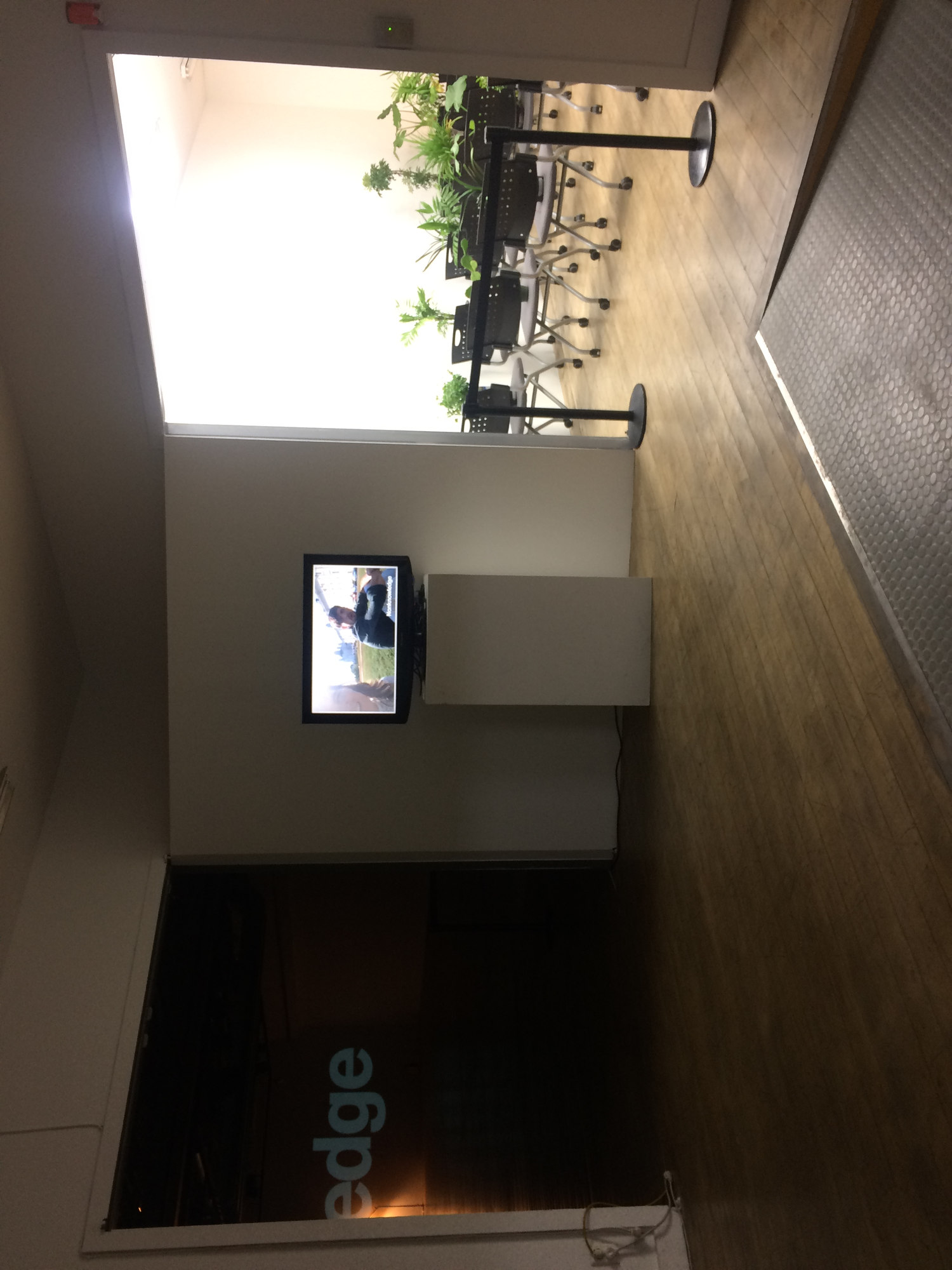
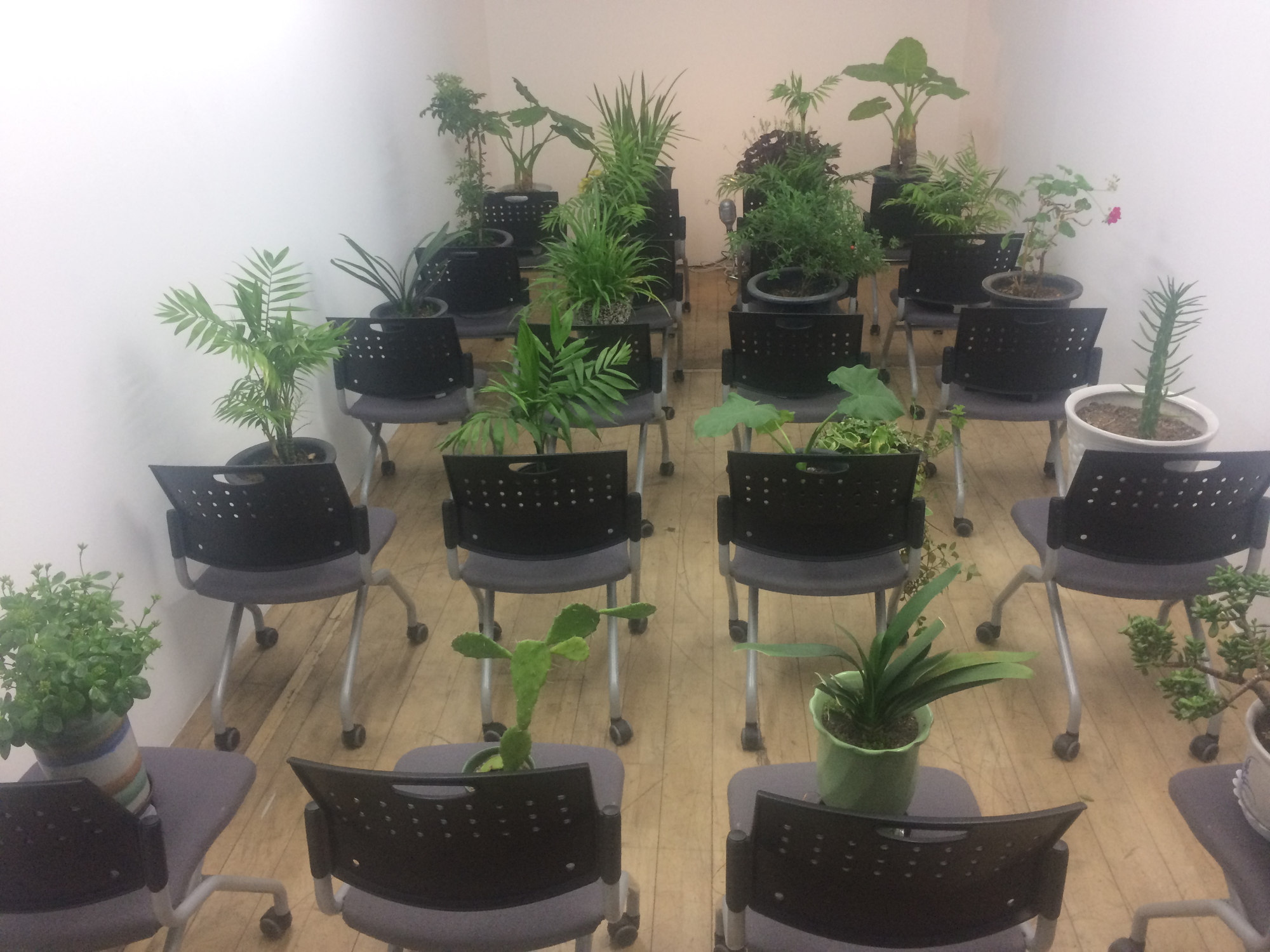
Photographs from 15 March 2019 show the entrance to a space with a working monitor and an illuminated room; rows of chairs occupied by potted plants; and two figures in front of an enormous light inscription showing part of the word Nonknowledge. Two spaces of viewing emerge: a small screen at the entrance and a projection across the whole wall; objects, chairs and plants appear alongside people.

An undated photograph shows people gathered around a table with food; behind the table a monitor displays Nonknowledge.
A thing outside history and another attempt at filming
In the conversation ending with the words “The tenth, yes? Or the eleventh of March, '19, Seoul”, the discussion of waste turns towards what is thrown away together with a thing. Wrappers, found images and scraps hold more than useful information about their former purpose. The artists argue over whether to speak of rubbish, recycling and reuse or of details that fall out of an overly direct history. The word “rubbish” itself ceases to satisfy them.
This conversation does not end with a philosophical formulation alone. They return to a video already filmed with their own bodies and decide to try shooting it again: combining bodies with scraps, objects, drawing; moving a narrow torch beam through the darkness. They already have a camera, and the beam can be narrowed by taping over the torch.
Authorial Comment
— No, this question of throwing rubbish away — it's an ontological question, a question of your decision. It's not a question… We're not talking about a question… It's just become automatic already. It's not a question of some physical action! Though it's certainly connected! It has to be connected with physical action. And naturally, if you understand that there is no rubbish, you'll behave differently with things too. It doesn't mean you won't have a wastepaper basket in the form it has now, and you won't throw bits of paper into it. But you'll understand that it isn't rubbish. That this bit of paper, say, is passing through some particular… — Stage of its… of its life. — Stage of its existence.
Marika and Anton, 10 or 11 March 2019, on what it means to stop considering a thing rubbish. Seoul conversation, 10 or 11 March 2019; continuation.
History
W.A.R.: several ways to place life in a hall
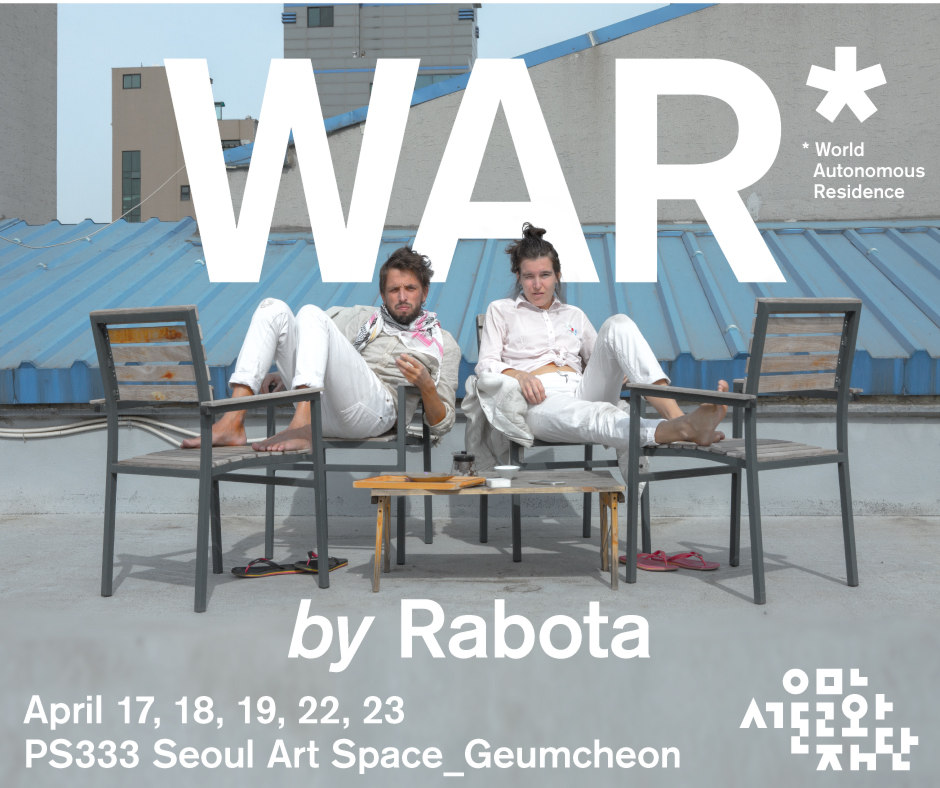
The exhibition W.A.R. in Seoul at SASG took place in April 2019. The poster invites visitors to PS333 on 17, 18, 19, 22 and 23 April.
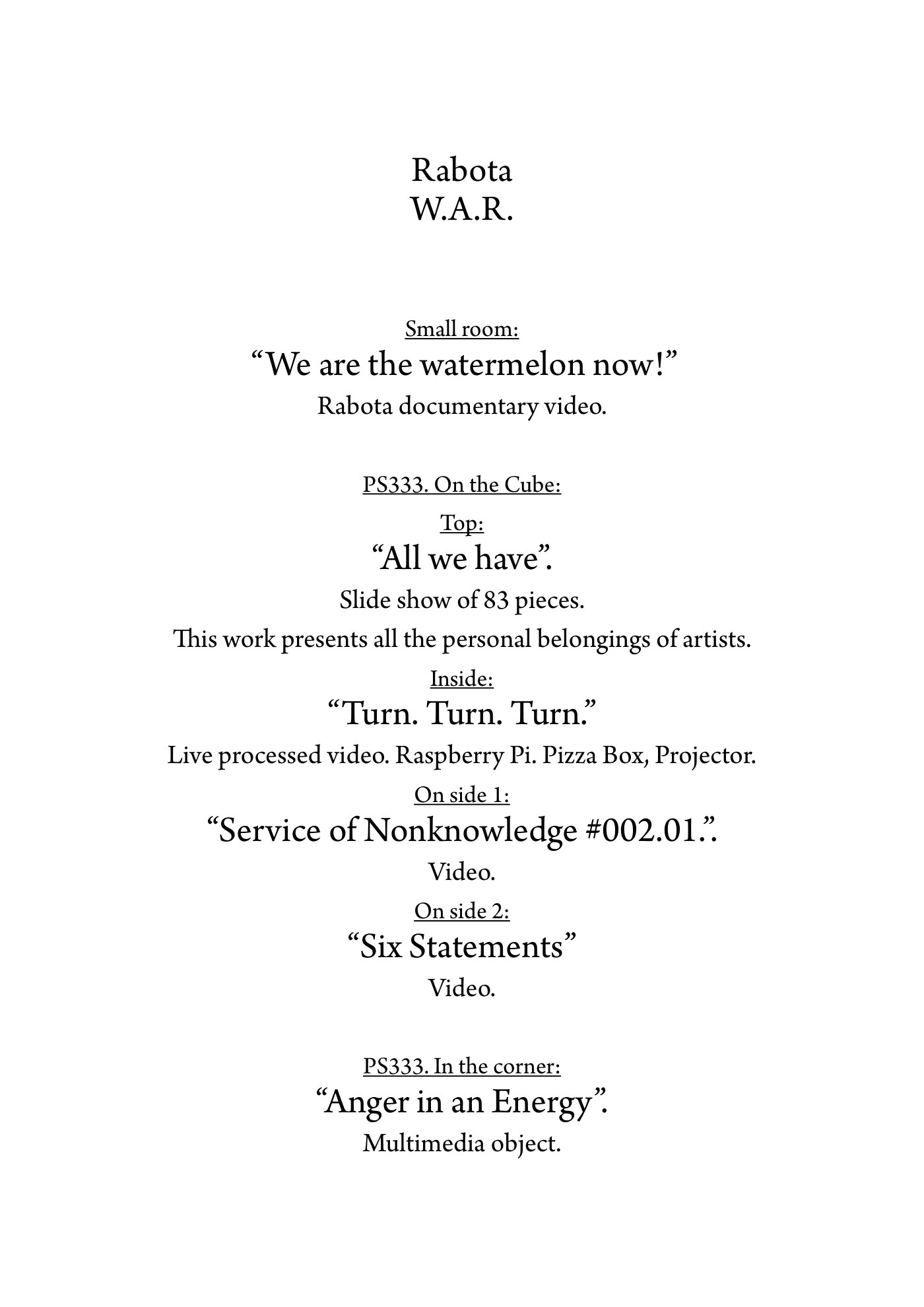
The exhibition has a more complex arrangement than the two well-known works All We Have and Jubilation. Its short text expands the title as World Autonomous Residency and speaks of an ongoing artistic process given the possibility of being presented in the PS333 hall. A separate exhibition sheet lists the small room, the top, interior and two sides of a cube, and a corner of the hall. A single room is distributed among several modes of image, document and sound.
W.A.R. in Seoul at SASG; W.A.R. in Seoul — announcement; Rabota at PS333; W.A.R. list of works.
The surviving poster announces 17, 18, 19, 22 and 23 April and the location PS333, Seoul Art Space Geumcheon. Marika and Anton are shown on a roof at a low table with tea; in this document, W.A.R. is expanded as World Autonomous Residence.
In the small room, the sheet places the documentary video 160228 II — an already existing independent work about an earlier drift. In the conversation of 4 February, the authors themselves noted that the film had become stronger for them after the appearance of a new text, the theme of work and the autonomous residency. This is a later rereading of an early work within a changed practice.
W.A.R. list of works; Seoul conversation, 4 February 2019; We are the Watermelon Now!.
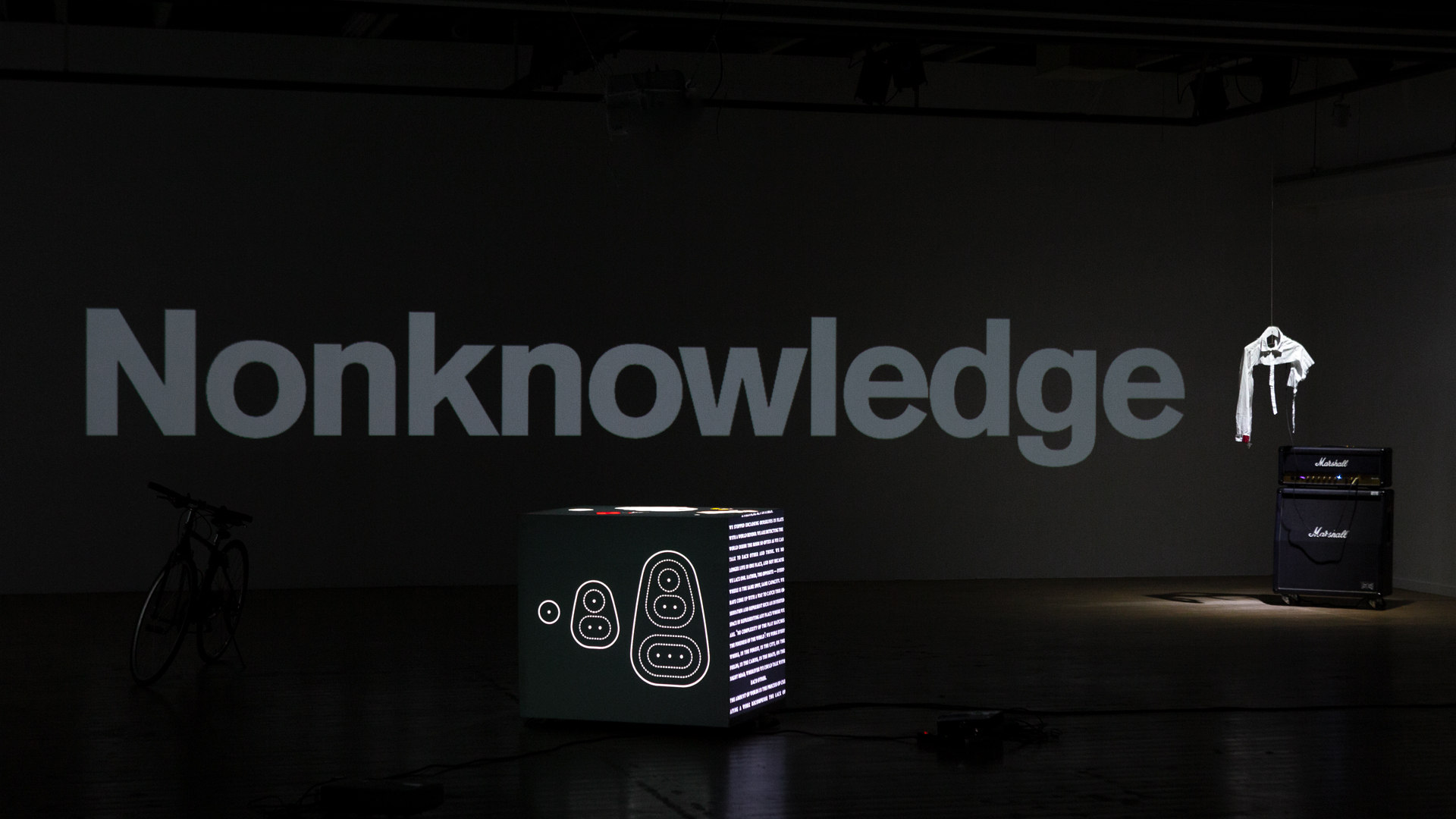
The exhibition sheet places All We Have on the cube's upper surface. The slideshow presents 82 photographs of the artists' personal belongings. Inside is Turn. Turn. Turn., live processed video; its description lists a Raspberry Pi, a pizza box and a projector. The apparatus of the image is not hidden behind a notion of immaterial video: a pizza box stands alongside a microcomputer and projector in the list of means used to process it. One side of the cube is assigned Service of Nonknowledge #002.01, the other Six Statements, both designated as video. In the corner is a multimedia object under the historical spelling Anger in an Energy.
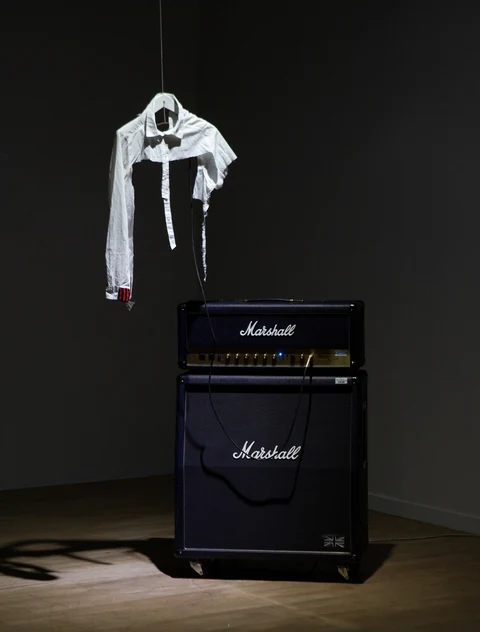
The general photograph of W.A.R. shows a large Nonknowledge on the far wall, a bicycle in shadow on the left, an illuminated cube and, on the right, the remains of a white shirt above two Marshall units. A projection of multicoloured things occupies the top of the cube; a diagram of rounded forms and dots appears on its front face, and text on the right.
All We Have and the Seoul inventory
In All We Have, all their portable possessions take on a new appearance: 82 photographs of things are intended for sequential projection onto a table. A thing is separated from its weight, but does not become immaterial: its appearance requires light, a surface and the time in which one image replaces another. The work dates to February 2019.
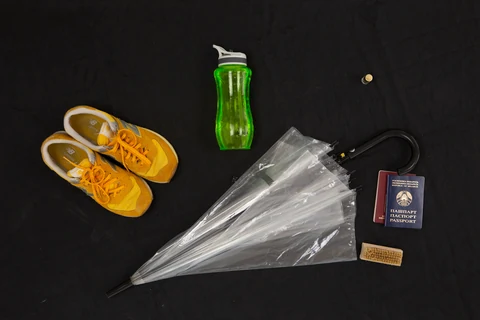
The Seoul inventory allows the origins of several things to be read. The handmade fan was a gift at a festival in Vientiane, which the artists entered with press cards, presenting themselves as invited guests. The list retains two tea bowls from Hanoi and two Hanoi windbreakers, a piece of mother-of-pearl shell and a large shell from Thailand. Things passed from the earlier journey into the current set, but some had already acquired a Seoul history: a broken transparent umbrella was found while they were sheltering from the rain at a metro entrance; Anton quickly repaired its rib. A separate entry lists the keys to the Geumcheon studio and dormitory.
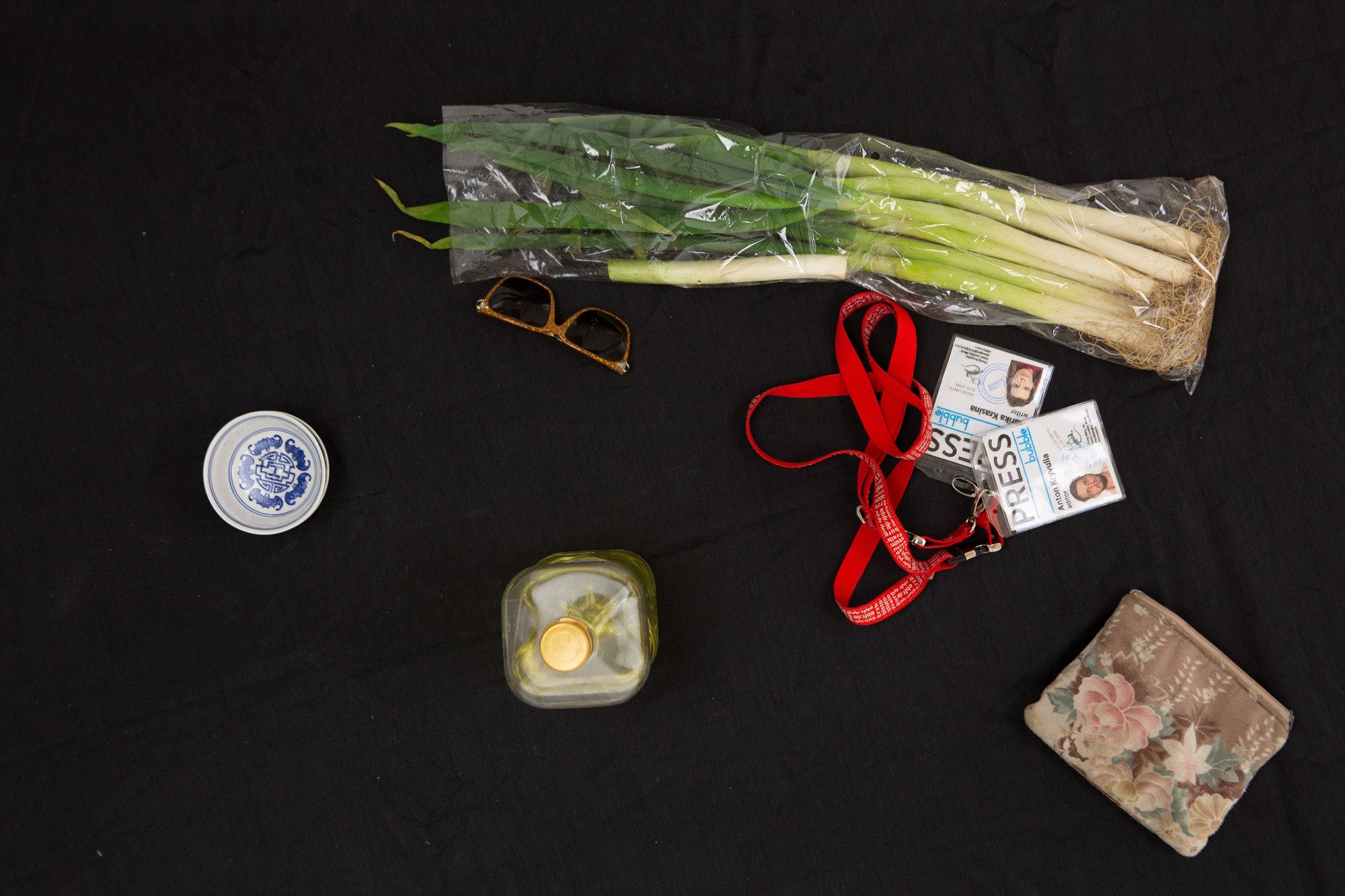
Alongside them are rice, tomatoes, oil, tea, sprouted plants, clothes, a tent, a voice recorder, an iPad, wires and a piezo element. The inventory does not separate the means of production from food and self-care. At the same time, its 83 entries need not be 83 single, indivisible objects: “two passports”, “three spoons” or a set of clothes count as one line. The list and the slideshow work differently. In the list, things receive names and sometimes stories; in the projection, successive appearances.
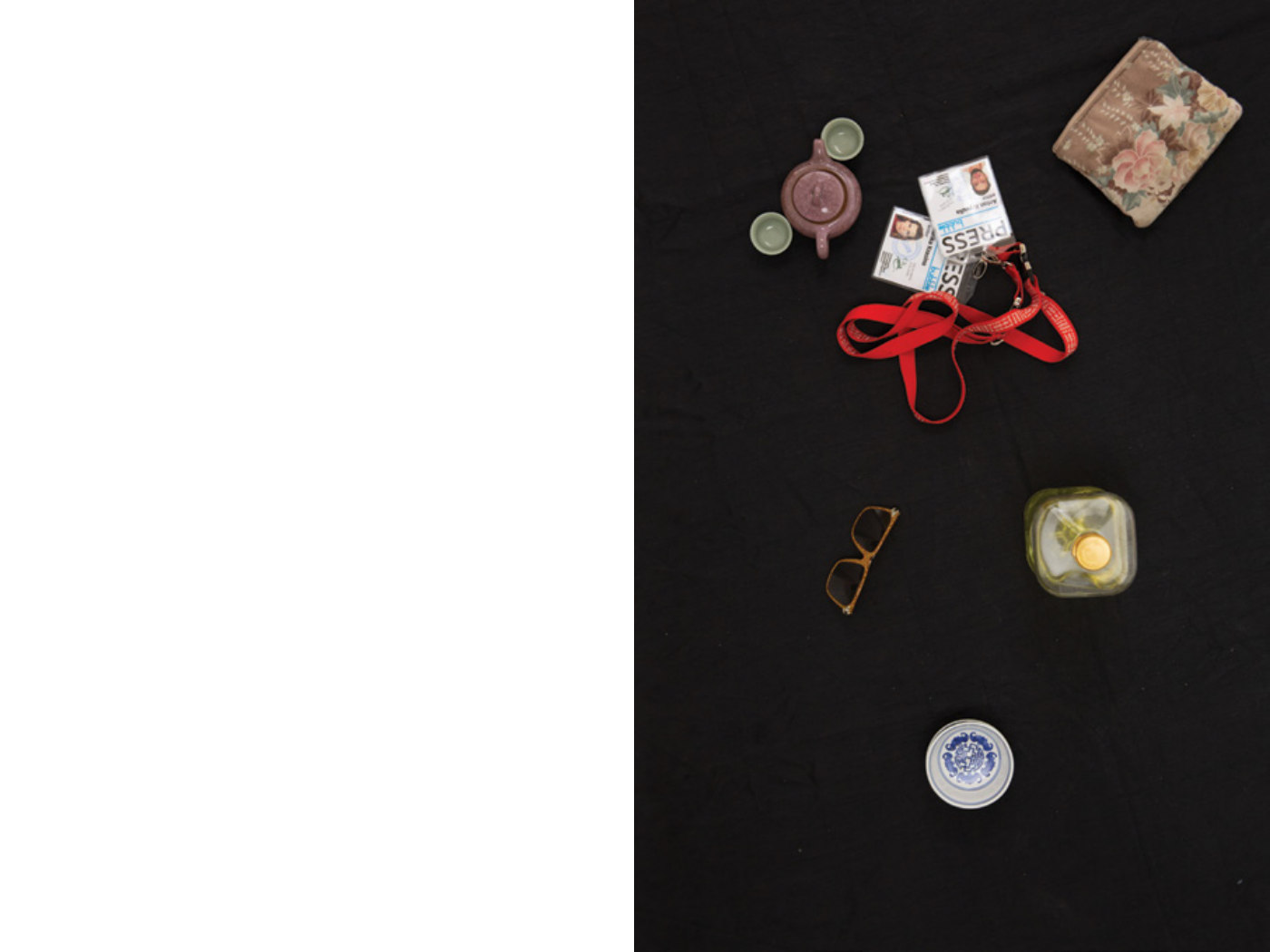
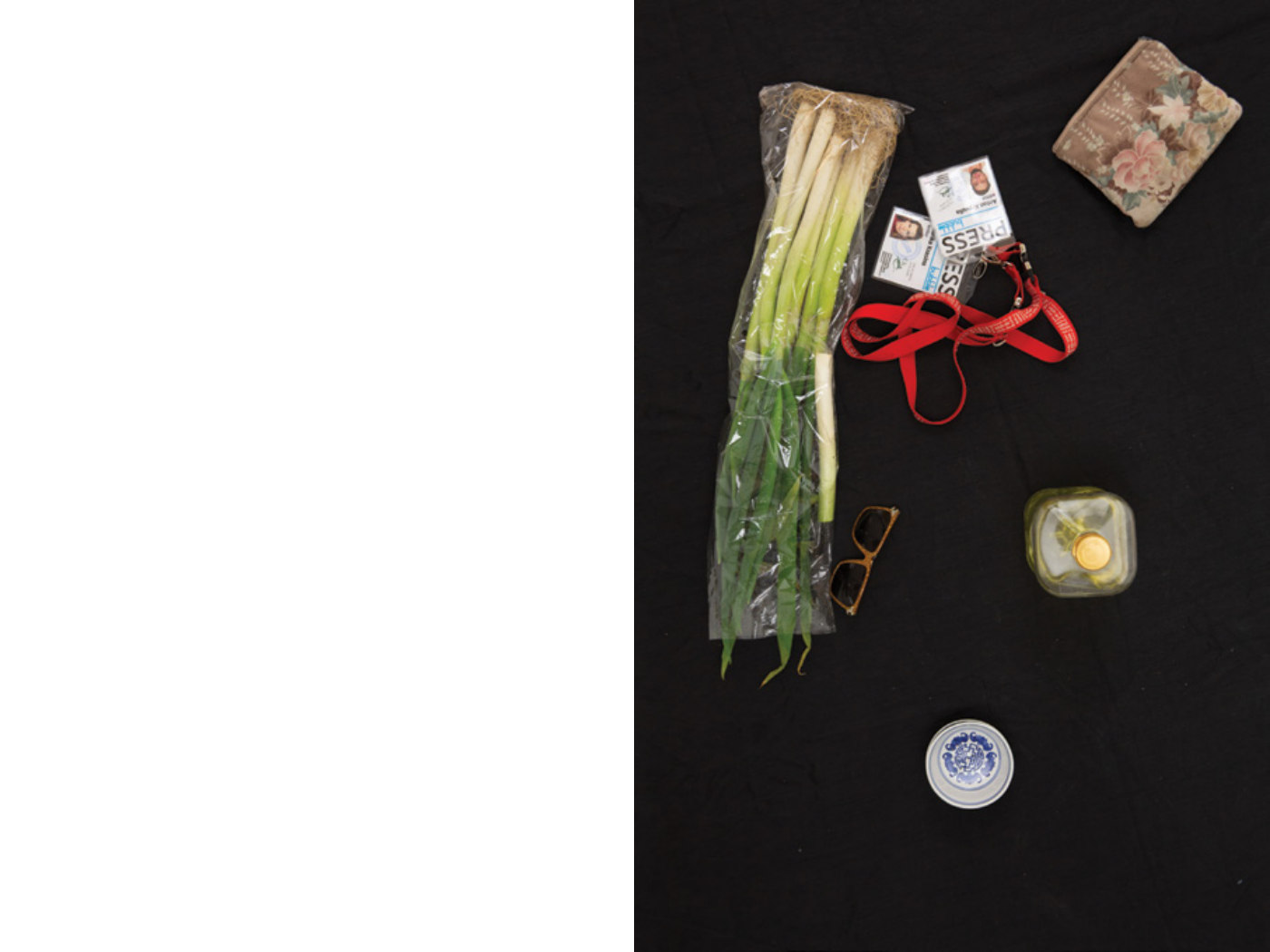
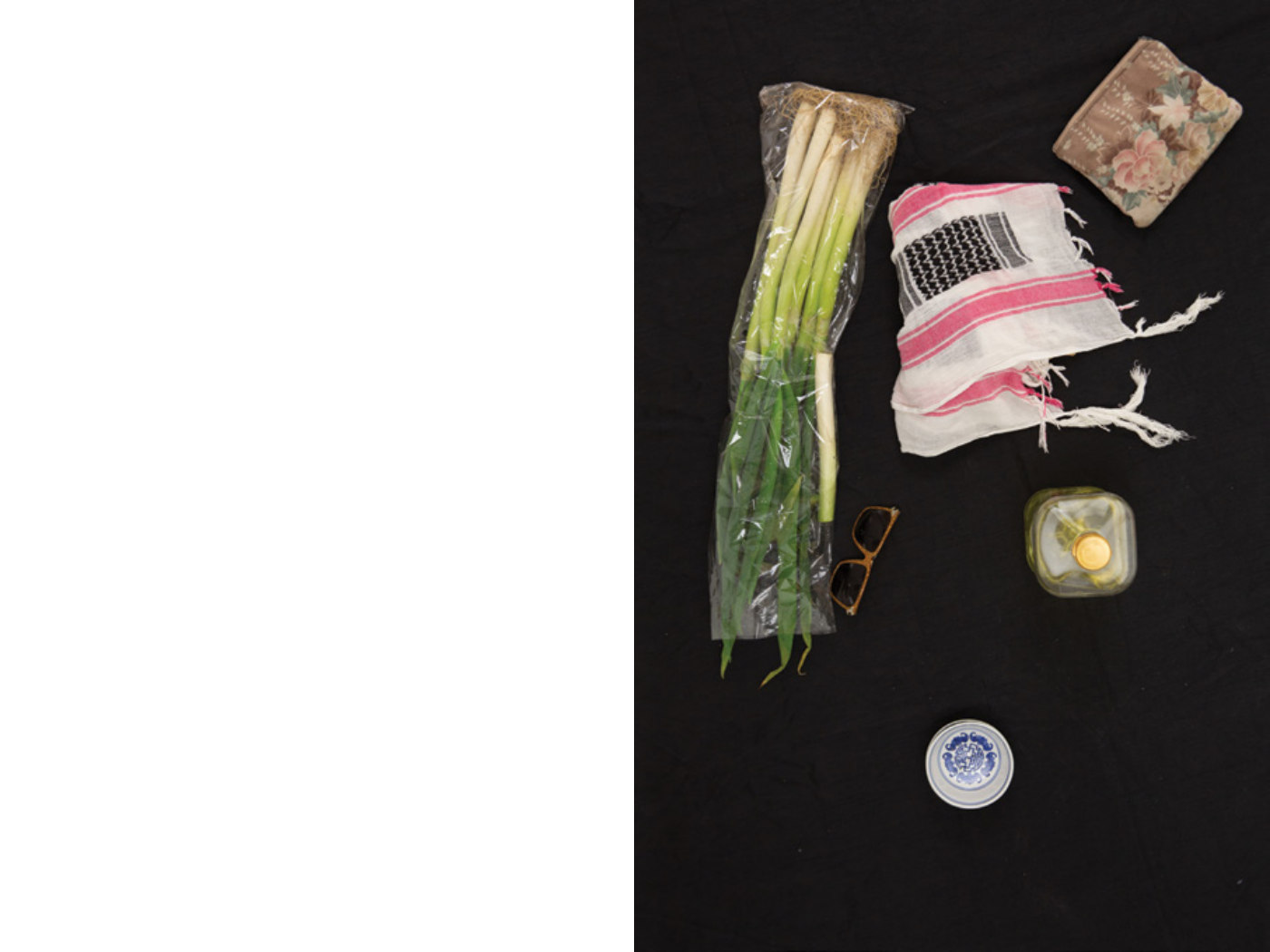
In an individual image from All We Have, greens in transparent packaging, glasses, a small vessel with a blue pattern, oil, press cards and an object in floral fabric lie against a black background. Looking at neighbouring pages of the surviving book makes the way the set changes visible. On PDF p.37, a teapot with two cups is still present; on p.38, greens take its place; on p.39, a scarf replaces the press cards. The other objects maintain a recognisable field. Repetition makes the substitution perceptible — a similar operation of attention had already been discussed in Ban Krut.
The book records the sequence across 86 PDF pages.
Jubilation: the shirt's further life
190421, or Anger is an Energy, holds another duration of a thing. In Seoul, Marika's period began, and there was no money even for basic necessities. A shirt was cut up for menstrual cloths. The artists took food from the refrigerator of other artists living at the residency. The shirt, already deprived of its original function, becomes a weak, sensitive sound object. Its remnants do not end its history: in the Seoul image, they are positioned above sound equipment. The title promises jubilation precisely to that of which little remains.
Jubilation; Jubilation — Anger is an Energy, 20 April 2020; Rabota Portfolio 2019.
Authorial Comment
The weak and sharp sound object was made from the shirt, that was cut into pieces for medical purpose. Sometimes we didn't have money, sometimes for a long time, we have to use things for other purposes — to make bandages from the shirt, for example. Not much remains of the shirt, but it does not lose courage, jubilating and some kind of immortality. In fact, this work has a second title: Anger is an Energy (by the PIL's song). Once again we were feeling alienated from everyone and everything. As always, the only way is turning our anger into the power for transformation. Was installed a year ago in Seoul Korea.
Published on 20 April 2020, recalling the Seoul installation one year earlier. Jubilation — Anger is an Energy, 20 April 2020.
History
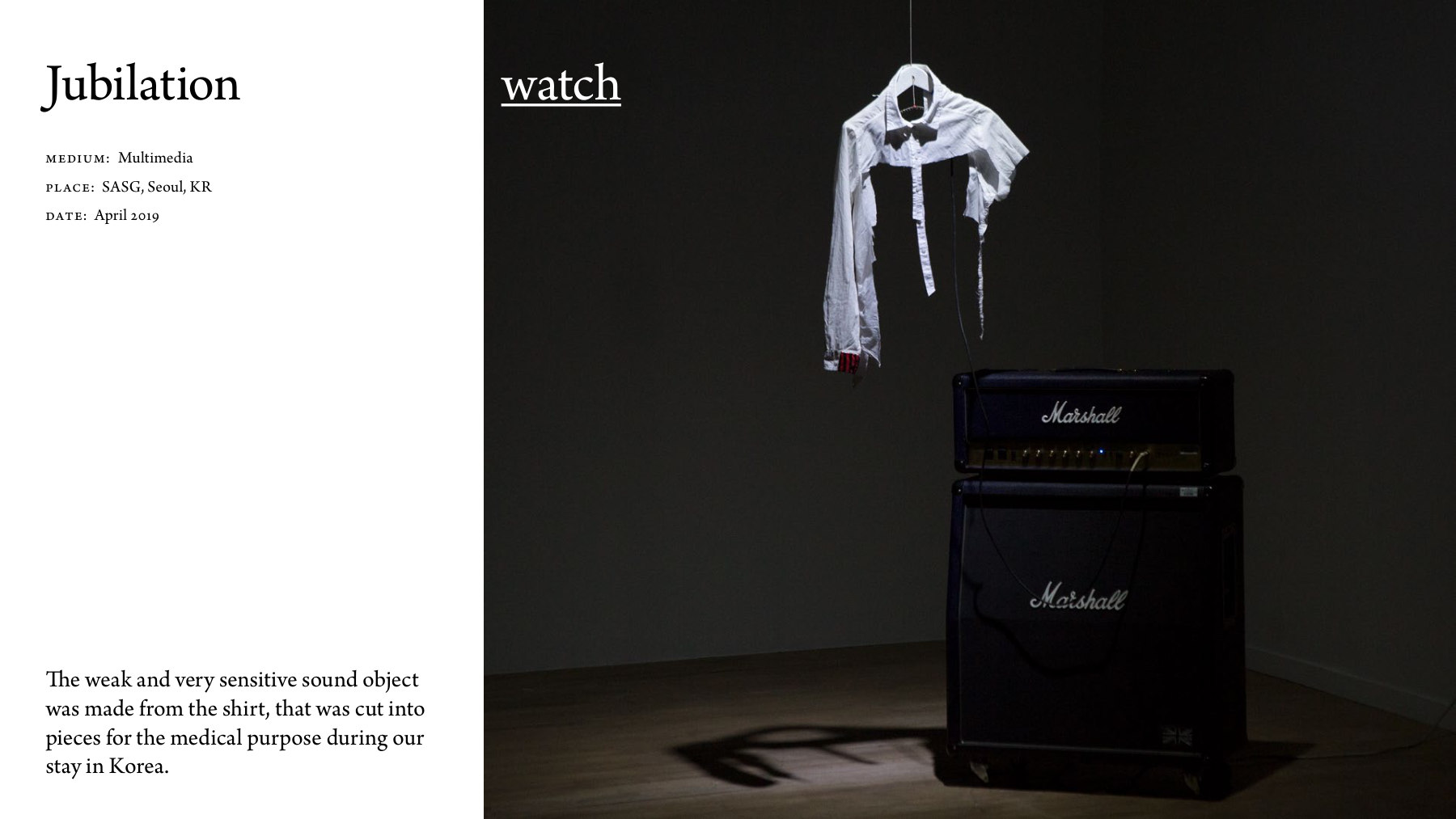
In this alteration, the thing's former function is not erased: the visible cuts continue to speak of the shirt and its use for cloth bandages. Its presentation in sound adds another mode of existence.
Jubilation is dated 21 April 2019. The authors connect the Seoul shirt work with the broader conception of Jubilation / Opera Operans. In the text 2019 Jubilation, they propose six events, studio development and a future generative stage spectacle. The particular outcome of this text is formulated simply: the main result of Jubilation should be the creation of music.
Theory recognising what has already been lived
The Seoul records give specific dates to some readings: Latour is discussed on 14 February; Shestov, Piatigorsky and Mamardashvili are named in the conversation of 10 or 11 March. An undated letter among the Seoul documents compares Bataille and Nicholas of Cusa, attempting to overcome the opposition between order and Nonknowledge.
Seoul conversation, 14 February 2019; Seoul conversation, 10 or 11 March 2019; Research letter.
Authorial Comment
After a month and a half of productive despair, the situation unexpectedly resolved itself with an invitation to the SASG residency in Seoul, and this was our chance to get out. In Seoul we had the opportunity to quietly turn to theoretical research into Nonknowledge, to search for its traces in the history of thought and art. As usually happens, it turned out that what had opened to us as an experience of revelation was not only a current theme in the history of philosophy, but a central theme in the philosophy of art. In Seoul we discovered the work of Nicholas of Cusa, Georges Bataille, Giorgio Agamben, Jacques Rancière and other authors who had addressed Nonknowledge directly or indirectly. Our practice found itself inscribed in a theoretical frame after the fact. At this time we began consciously using the apparatus of the Aesthetics of Nonknowledge in our artworks.
A later account by the authors. Strategies and Anecdotes of Rabota.
History
This retains a significant direction of the whole transition. The Vietnamese and Thai observations need not be the result of reading philosophers whose names enter the later explanation of the practice. In Seoul, what has already been lived acquires new means of differentiation, while new equipment, found objects and space prompt questions that did not exist in finished form before the arrival. The ball, shirt, loop of light, inventory and cube do not add up to a report on a successfully completed journey. They make several specific ways of continuing the work already begun available.
Related Works