History
The project took a year of work and life as its material and divided it according to musical proportions. Institutional interventions, conferences, sound actions, journeys, conversations, and work with personal belongings unfolded within that span. A protocol held the project together: it connected events of different scales and durations, set out the relations between them, and left room for what could not yet be known. The first major public actions took place at HfG and ZKM; the subsequent period of drift carried the project beyond the institution. The artists’ project description; December 2017 announcement.
The title refers to an empty speech bubble in a comic: the visible outline of an utterance with no utterance inside it. The artists understood this Bubble as a medium without content, a graphic counterpart to a thing, a thought, or an event. For them, “opera” also retained the sense of work and labor. The year in which the work took place became the artwork, while musical relations made it possible to bring a brief sound action, a gathering lasting many hours, and six months of open-ended activity into a common frame. The Bubble Opera Story; Conversation, 11 June 2018.
A Year as a Score
The year was divided in the ratios 1:2, 1:3, 1:4, 1:5, and 1:7, drawing on the proportions of the overtone series. Events were scheduled at the resulting points. The artists related this method both to music and to the proportional layout of a book: time was to be treated as a material that could be given structure. The December 2017 announcement describes an entire year of life and events inside the HfG/ZKM building as contained within a particular object, the Cucumber of Time. Alongside this continuous, partly hidden process, four major public events were planned. Public performances marked the opera’s major junctures; what happened between them remained part of its duration. The Bubble Opera Story; Initial announcement.
The protocol also determined how each event was entered. Taking Six Stones on 6 January 2018 as the present makes the Tools of Disclosure conference of 15 December 2017 its past, while Samotryas on 29 January 2018 is still to come. At the next point, these relations shift: the former present is retained as a background, a new event happens now, and an unknown future opens ahead of it. Seen from outside, the diagram makes the whole sequence visible at once; a participant lives it from a particular “now.” Nonknowledge here is tied to one’s actual position within time. Conversation, 11 June 2018; Samotryas event record.
The model grew out of earlier work with two stones found on the bank of the Danube and a matrix of six. Successive presentations of groups of one, two, and three objects brought out relations between a thing, its repetition, and the representation of it that persists. Transposed into time, the matrix offered a way to consider how an event emerges against the background of its predecessor. The Cucumber of Time pictured these accumulating layers while keeping a region of the unknown open. The Bubble Opera Story; Working presentation, pages 3–4.
Although the number six appears in descriptions of the project, the sequence of actual events remained open. In June 2018, discussing how to present it in a film, the artists themselves stop insisting on six points: a seventh appears, Mannheim is considered as an eighth, and “unplanned cucumbers” enter the picture. An event could unfold a dimension of its own and alter the initial conception of the whole. Conversation, 11 June 2018, passages 0044–0056.
The working text names three forces within the opera: Noise, Suspension, and Repetition. Noise signifies chaos, an empty place, or a gap; suspension singles out an object and grants it autonomy; repetition presents, doubles, and multiplies it. Their interaction between Nonknowledge and knowledge produces instrumental functions called Tools of Disclosure. In the events, these relations take spatial and material form: a gathering returns to itself through a delayed broadcast, personal belongings are literally suspended, and sound appears and disappears. The protocol therefore describes ways of acting as well as relations between dates and durations. Cucumber of Time working text, pages 28–29.
The Year’s Protocol in Images
The Rabota Bubble Opera presentation connects the overall form of the year with a series of photographic sections. On page 3, events share a single timeline running from 27 October 2017 to 27 October 2018. Musical relations appear as waves; below them, the same sequence unfolds as a three-dimensional Cucumber of Time. Six sections follow, bringing together photographs, short texts by the artists, and links to video and sound. Original presentation, 24 pages.
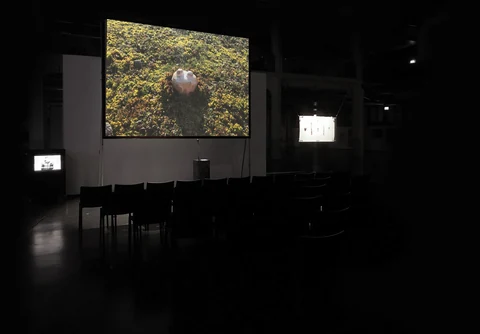
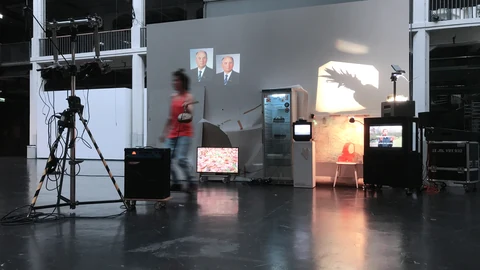
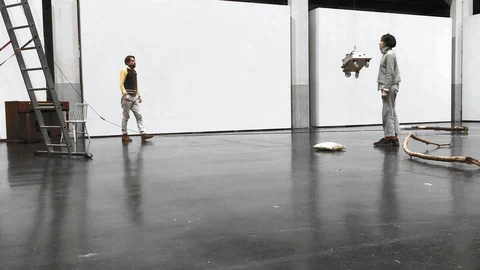
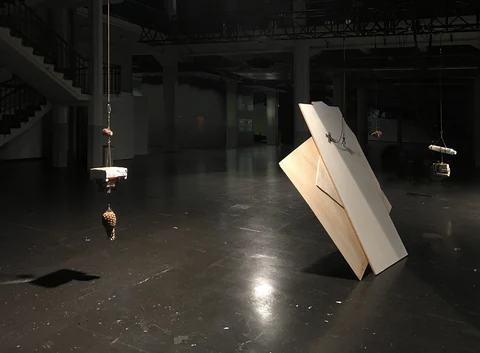
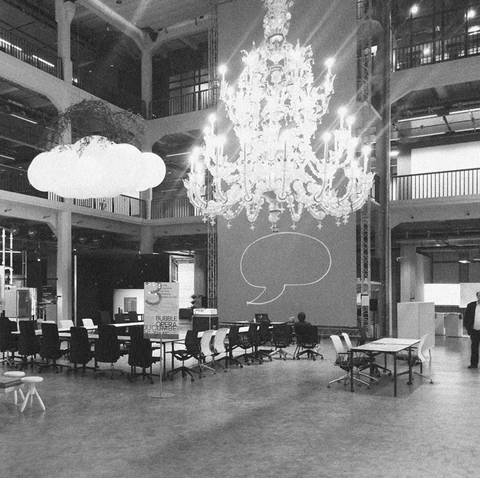
The sequence moves through the opening, the conference, the suspended belongings, sound actions, research on the road, and the burial of possessions. Wide views of halls give way to the construction of individual objects and photographs of actions. Living spaces then enter the frame, along with clothes, a backpack, and things gathered before departure. The protocol holds this heterogeneous material within a single movement through the year. The photographs show how public events, everyday life, and work with personal belongings participate in the opera’s duration.
Opening the Bubble Opera — PDF pages 5–6.
Tools of Disclosure / Suspended Conference — PDF pages 7–11.
Six Stones / Media-rave Corrida — PDF pages 12–15.
Samotryas — PDF pages 16–18.
Nonknowledge / Research — PDF pages 19–20.
Recollection — PDF pages 21–22.
Life as Material
In the artists’ account and the surviving text for the film narrative, the explanation of proportions is interrupted by an episode from the project’s prehistory. Stranded in Barcelona without money, the artists spend a night in the zoo treating themselves for scabies. The sprinklers switch on. Their clothes hang from the trees, and on an empty, illuminated patch of ground they draw on a large sheet with ink and palm leaves. Beside this account is an inventory of stolen possessions: brushes, a computer, keys, notebooks, jewelry, copies of Common Body, lectures by Mamardashvili, and a herbarium. In a few lines, the inventory brings together daily necessity, memory, work, and its material traces. The Bubble Opera Story; Surviving subs text.
These earlier episodes belong to the history of the material with which the opera would work. Extended travel had reduced the artists’ possessions to what they could gather up and carry. In Karlsruhe, those same personal belongings were suspended from strings, connected to software, and brought into a public action. In a working conversation, the artists insist on their double condition: they remain their belongings even as they become part of an artistic construction. An object’s biography persists alongside its weight, resistance, and new function. Working conversation 180100; Six Stones.
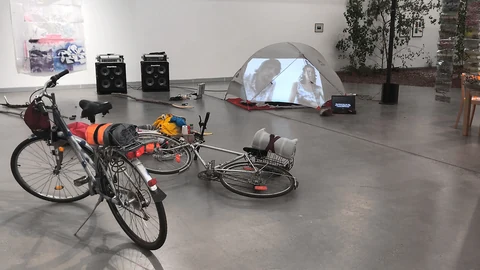
Here the protocol takes on material substance. Limited means, the road, a place to sleep, and the loss and storage of possessions all help shape the events. Later, in Mannheim, the journey to the exhibition space would itself become a film, the film’s running time would determine the performance’s duration, and the tent brought along on the trip would become a screen. Metamorphosis.
Tools of Disclosure
Tools of Disclosure Conference took place at HfG/ZKM on 15 December 2017. A purpose-built wall divided the space in two. On the conference side stood a lectern and microphone, an instructional video, and a display case of Fids—the tools of disclosure around which the announced subject was organized. Behind the wall were a refrigerator, a kitchen, a sofa, and a television. It was here that the gathering, conversations, eating and drinking, and the separate Tools of Disclosure performance took place. Conference installation; Performance.
In a later account, the artists connect this adjacency of conference and living space to their own daily life. They were living inside the immense building: pitching a tent on a remote stairwell at night, using the communal shower in the morning, eating at museum events, collecting bottles, and cooking on a small gas burner. The domestic life concealed within the institution was given a place in its public space. Disclosure, the artists’ retrospective account, 2023.
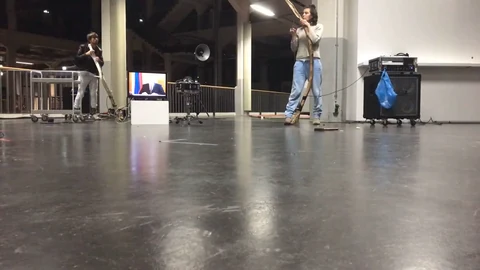
The artists described the front as the space of a conference that never begins. Living activity took place behind its formal facade. Yet a working channel connected the two sides: events behind the wall were continuously broadcast online and returned, with a slight natural delay, to the screen and sound system of the empty conference. The event lasted from morning until midnight. People, their exchanges, the image, and the broadcast delay formed a single spatial construction. Cucumber of Time working text, pages 26–27.
The conference apparatus became the subject of the action. Its architecture, equipment, expected speech, and promise of a beginning remained in place, while the gathering itself happened on the other side of the wall. This gap between the apparatus of presentation and life as it unfolded was one of Bubble Opera’s central experiments.
Andorra
For much of Bubble Opera, the artists were living in Germany illegally. Their access to the institution did not settle their right to remain in the country.
Authorial Comment
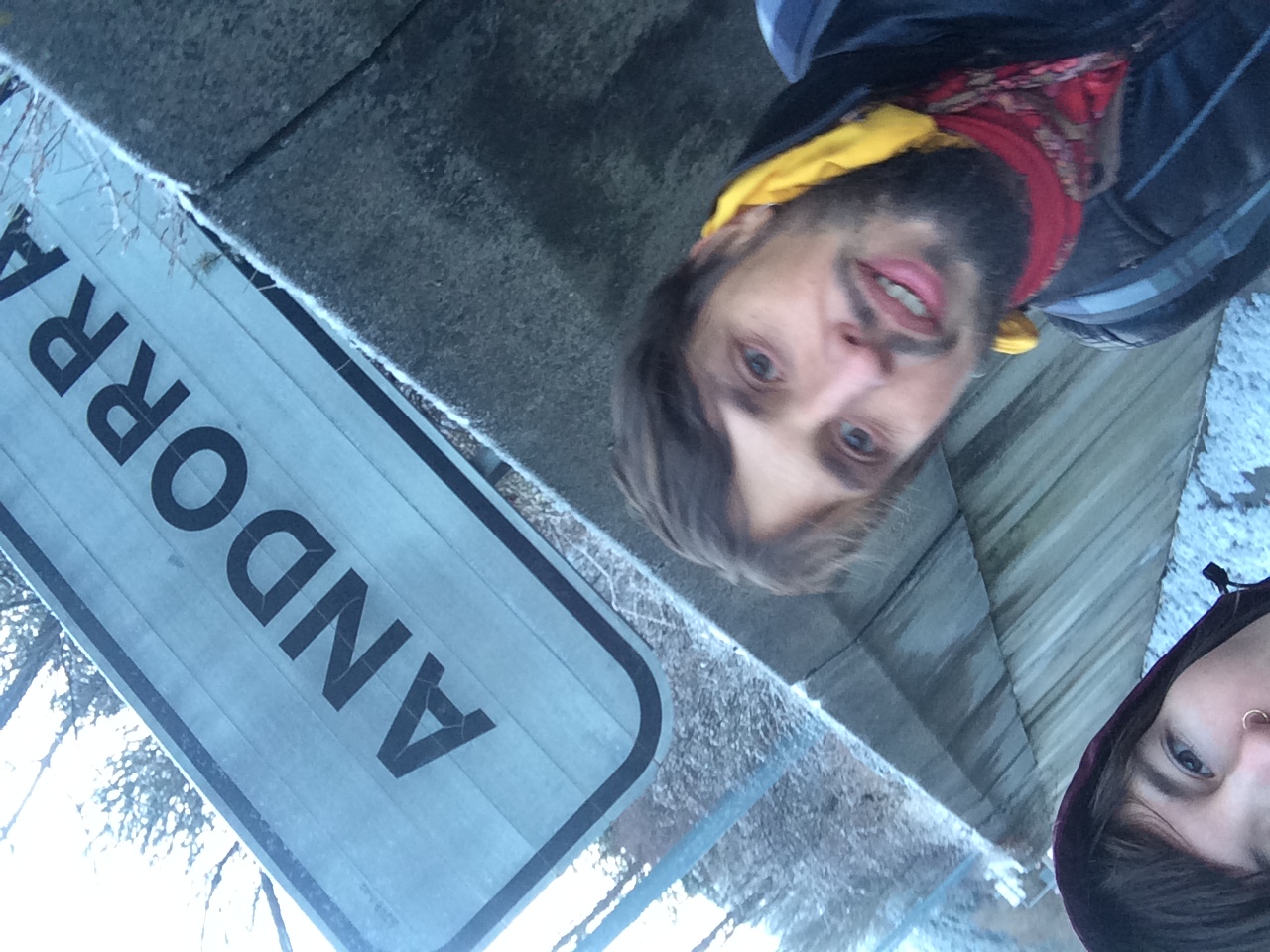
First we had to solve several matters: our official status in the building and the visa. HfG was the school where Boris Groys had taught and where Sloterdijk had been rector; genetically and administratively it was connected to ZKM and occupied the same building, so that one could think the school was, if not an exhibit in the museum, then certainly one of its departments. To infiltrate HfG was to infiltrate ZKM. We caught Professor Bielicky in the ZKM lobby, showed him our drawings and asked him to help us obtain the status of guest students — a hybrid position without powers or rights, but with keys to the building. The second problem was a visa that allowed us to remain in Germany for no more than ninety days. We solved it by travelling to Andorra — those who know will understand — and could now remain semi-legally in Germany until the visa expired completely.
— Marika Krasina and Anton Kryvulia, *Strategies and Anecdotes of the Rabota Group* (existing English version).
History
Immediately after New Year 2018, before Six Stones, they traveled to Andorra to “suspend” their Schengen visa. As they recall, they remained in Andorra on paper while returning to Germany to continue the opera.
Authorial Comment
The horses went down the steep path; stones poured, there was frost. The Spanish border guard put a stamp in our passports, and we went further to the territory of Andorra, to the nearest stop, take the bus back to Spain. Next — the plane from Barcelona. Back in Karlsruhe in illegal status, we began establishing a performative installation in a large hall of the museum. We hung our things like a load on strings, connected the wires, adjusted the software.
— Marika Krasina and Anton Kryvulia, *The Bubble Opera Story*.
History
Six Stones
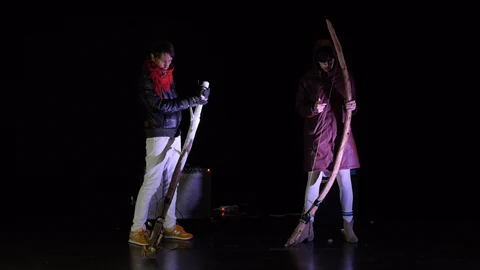
Six Stones, performed at ZKM on 6 January 2018, explored the relations between things and time across a large hall. The artists’ personal belongings were bound into groups and suspended from six strings. Their weight supplied the tension; the strings’ vibrations fed into custom software and affected sound drawn from a library Marika and Anton had assembled over years of travel. The physical weight of their possessions met the sonic traces of their lives. Six Stones.
Moving on wheels, the artists engaged the strings with a paper hammer, a thin hose, a chair, an oar, a stick, and other objects. They called the action a corrida: it involved movement, collision, sound, loss of balance, and the breaking of suspended structures. According to a later account by the artists, it continued through the day, with two breaks for repairs. The working text distinguishes two stages: a media-corrida and an interactive installation in which visitors could act on the multimedia objects themselves. The artists’ commentary on Six Stones; Cucumber of Time working text, pages 22–23.
The protocol now had consequences that demanded an immediate response. A string had to be tensioned, a damaged structure repaired, the movement and resistance of things encountered. The event could continue only through this work. The material also retained its personal stakes: the suspended belongings were still the things the artists used in their lives.
In the discussion of the film, Six Stones is proposed as the point of the present: first show what happens to things and bodies, then bring back the preceding conference and introduce the sound event still to come. The temporal model could thus be presented through a concrete action and the artists’ own voices. Conversation, 11 June 2018, passages 0026–0040.
Sound Actions and Interventions
One of Bubble Opera’s sound events was Samotryas / Poverty and Glory, held at HfG, Karlsruhe, on 29 January 2018. The video work Poverty and Glory belongs to this action, not to the project’s opening on 27 October 2017. In descriptions of Samotryas, the instrument and the sound it produces form a single art object, installed in space through an action. A branch, two stones, two nails, a steel string, and a contact microphone make up a monochord assembled anew each time. Its use is inseparable from the room’s particular acoustics and the presence of listeners. Poverty and Glory; Samotryas, 29 January 2018; Description of the instrument.
Within the same field of experimentation, Mapping Paradise, on 29 December 2017, brought together fragments of a branch, a stone on a string, and an electric organ. Activated together, they produced a musical situation in a museum hall. Eltsyn Drive, on 14 February 2018, took political speech as its material: Boris Yeltsin’s New Year’s address was connected to a drum. The artists’ formulation—an attempt to make Yeltsin play the drums—describes a literal operation on a media recording. Mapping Paradise; Eltsyn Drive.
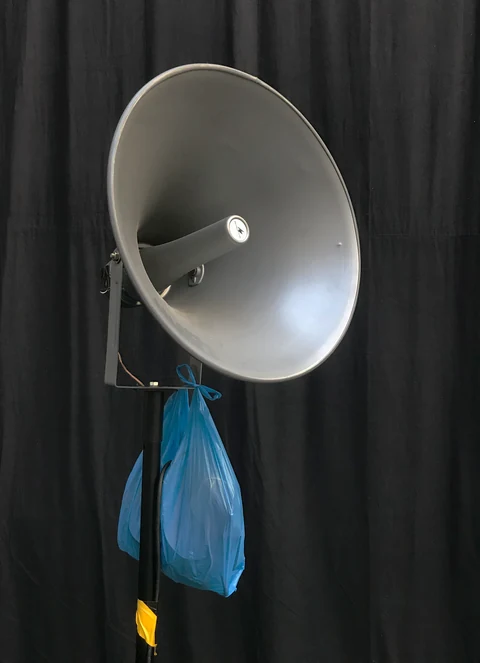
The loudspeaker intervention in a ZKM corridor, known as Oracle / Throat, worked differently. For two weeks, the device periodically repeated the phrase “We use your ears and your eyes now!” The project description relates its operation to the time a visitor takes to pass from one part of the museum to another. The use of someone else’s attention is announced at the very moment it occurs: the visitor hears the phrase as it enters an ordinary museum route. The artists include this episode in their account of Bubble Opera alongside the conference and sound actions. The artists’ project description; Oracle / Throat event record.
Cucumber of Time as a Public Event
Media Rave Conference: Cucumber of Time took place on 16 February 2018 in OpenHub, within the Open Codes exhibition at ZKM. The model linking the Bubble, the event, and time became the subject of a public action. Moscow-based critic Egor Sofronov participated; Optimist, a choir of older women from Elektrostal, joined over Skype. The announcement brought together the choir’s remote performance, two opera arias in the form of scientific papers, and a presentation of the Cucumber of Time. Conference materials.
The surviving working text reveals the scope of this presentation. Scientific explanation gives way to a fictional history devised by the artists, involving Vasily Zvezdochkin, nesting dolls, time capsules, and a portable black hole. Political figures enter as interchangeable operators; in one scenario, introducing Putin a second time closes the system on itself and the “cucumber” collapses. The text contains cues for transitions to videos, drawings, and New Year’s addresses. Mock scholarship, jokes, political recordings, and diagrammatic work become elements of a stage language. Cucumber of Time working text.
The model was presented together with the circumstances of its telling: voices, a screen, remote participants, an institutional space, and the format of a paper. The encounter between different people and modes of speech enacted the heterogeneity the project sought to hold within a shared temporal structure.
Nonknowledge Zone and Metamorphosis
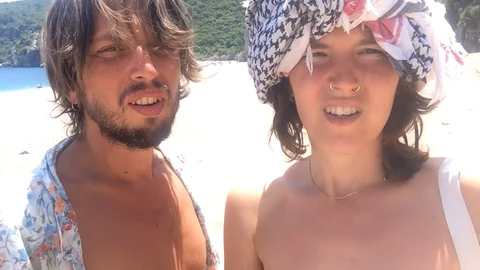
The six-month Nonknowledge Zone began in April 2018. The artists describe it as research and drift through the ancient cities of southern Turkey, Attica, Sicily, Rome, and Russian medieval art. The period had a set duration, but its particular content remained open. Working with Nonknowledge became a matter of travel, observation, conversation, and trying to understand what arose along the way. The artists’ project description; Nonknowledge Zone.
A major public episode in this expanded field was Metamorphosis, at Port25 in Mannheim on 19 July 2018. The artists traveled from Moscow via Greece with almost no money, filming the journey and bringing the things they had used along the way. On entering the exhibition space, they left their belongings on the floor and pitched a tent. Filming ended with their arrival in that same space. Anton immediately edited the footage on site, and the film was projected onto the tent. Metamorphosis; Drift, a text by the artists.
The film’s running time—43 minutes and 23 seconds—determined the length of the sound performance. The journey acquired a measurable form and became the temporal score for the event in the exhibition space. The tent remained part of the actual journey while carrying its image. The film’s last moment coincided with the place where the audience stood: the recording approached its own present. Metamorphosis.
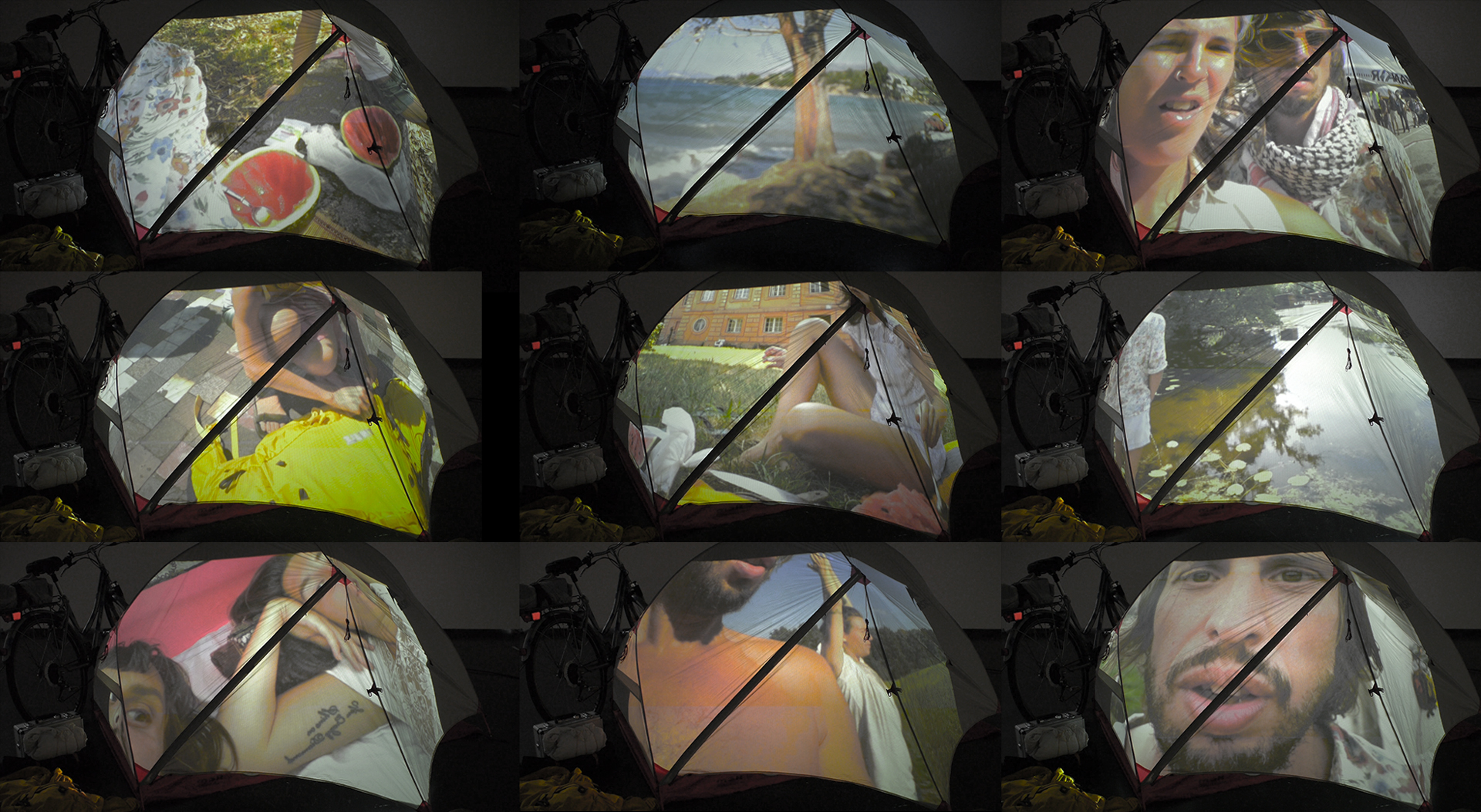
The independent video work Nonknowledge Zone is assembled from unsuccessful attempts to speak about Nonknowledge. Its editing preserves breaks, pauses, and the inability to finish an utterance. This material asks for attention on a different scale: after spatial installations and public gatherings, what remains is speech that never arrives at a settled formulation. The artists have established 24 October 2018 as the date of the video work and the end of this phase. Reflection on its ending continued beyond that calendar boundary. Nonknowledge Zone.
Gathering the Opera: An Ending That Continues
The project presentations set out a large-scale gathering: the entire year and its accumulated scenes were to be brought together in a single day. A virtual set, a constructed multimedia heap of rubbish, instruments retrieved from it, and numerous performers would occupy a shared stage. Sonic Fire was developed to organize the sound: simple one-string instruments would sound together, interspersed with successive solos. Participation by people without formal musical training was built into the proposal. This strand of Bubble Opera survives in the presentations and working texts as a project. Working presentation; Cucumber of Time working text.
One version proposed hiring around a hundred people without musical training, including Syrian refugees. They would build their own one-string instruments, rehearse, and give a concert in a square or hall in central Karlsruhe. Participants would receive a minimum hourly rate and could take their instruments home. The title One Day Job connected the orchestra to a day’s labor: performer, hired worker, and instrument maker became roles within a single action. The artists questioned who counts as an artist or musician, proposing that the paid work of people usually excluded from cultural attention become the city’s central artistic event. A scene on this scale remained a proposal. Cucumber of Time working text, pages 32–34.
The end of the year did not yield a single, definitive form. In the fall of 2018, leaving Moscow with nowhere to store their possessions, the artists buried their belongings in a field near Mozhaysk. One version of their project description calls this episode Recollection and places it after the period of drift. The things were later dug up and entered other works. The material remainder of the year continued to demand action. The artists’ project description; Account of the burial and subsequent recovery.
In a 2022 conversation, Marika and Anton return to Bubble Opera as a project whose ending is still going on. Nonknowledge Zone, intended to last six months, had, they say, exceeded its allotted time. Its documentation produced a collection and an archive connected to Annual Report and the video series Surfers of Apocalypse. They propose bringing this material into action again: exploring how an archive can become a performance, and how a performance can become a way of making an archive. About Bubble Opera, 2022.
The idea of a mass-participation finale changes in the same conversation. Instead of hiring a large number of performers, the artists discuss working with volunteers and the public, citing the later Six People actions. The question of how to gather the opera returns through new material. Protocol, events, and documentation continue to pass into one another: a planned form guides the work, what happens changes it, and the traces left behind make another action possible. About Bubble Opera, 2022.
Related Works
Works within Bubble Opera