History
The recorded conversations are between Marika Krasina and Anton Kryvulia.
The plinth. Mänttä, 23 February 2020
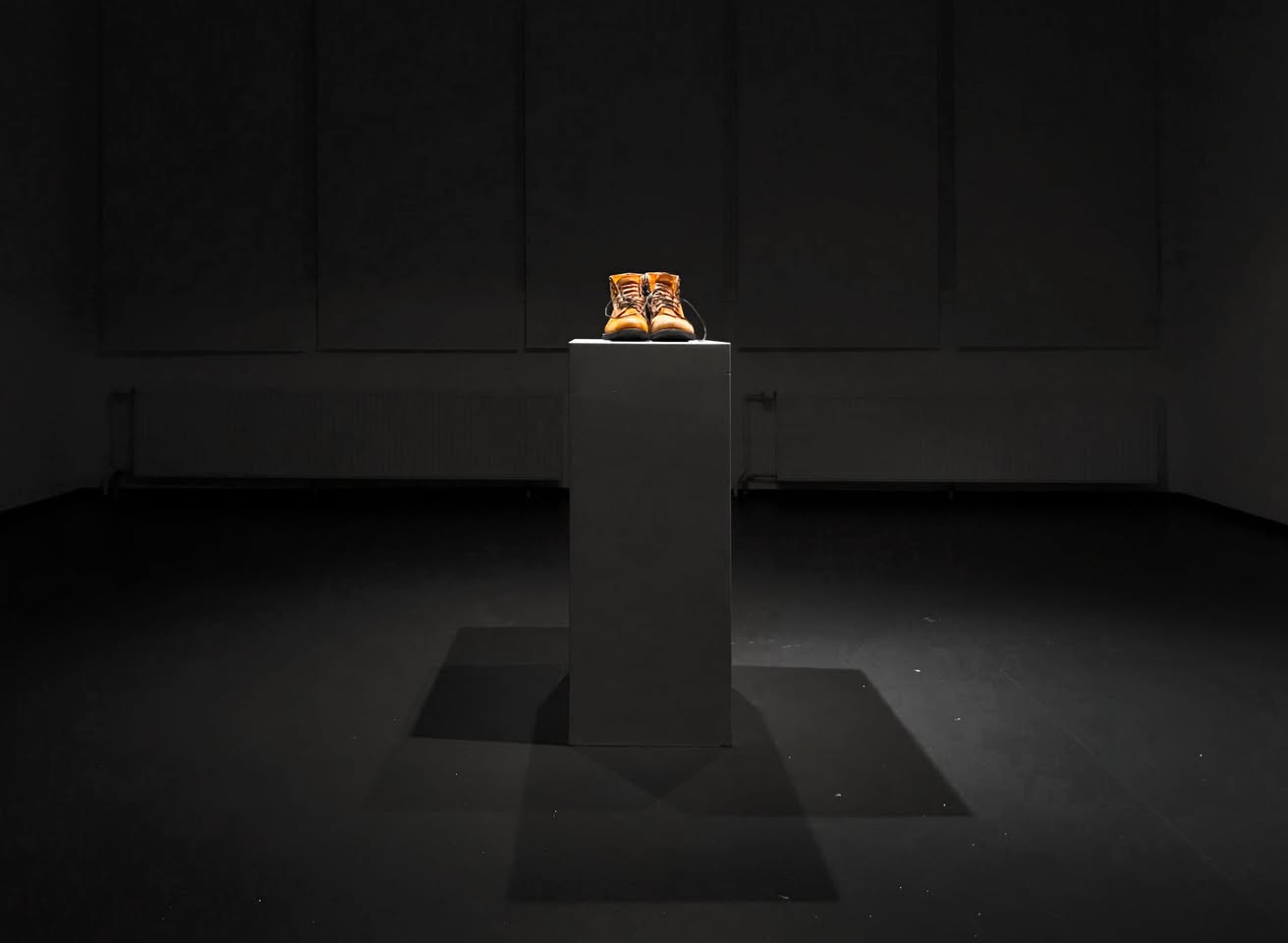
A pair of Anton’s boots stands on a white plinth in a darkened room. Beside them are a text projection and a camera. The work is called Whatever. A post published by the artists that day explains: the place is occupied by boots now; next time, something else may occupy it.
The place presented here cannot be seen separately from what occupies it. The boots make it possible to notice and hold this place, but do not exhaust the work. A longer historical text describes their function as that of an ersatz object: to create the material conditions in which an empty place can be preserved and passed on. This minimal presentation is reached through research made up of far less simple circumstances: living as a couple, having no permanent studio, conversations in the rain, personal belongings, drawings, files and attempts to address another person.
Across the early conversations, the task changes: to notice an ordinary thing; to let another person see it; to preserve the place of this encounter; to arrange conditions in which it can happen again.
Process becomes content. April 2019
On 14 January 2019, in a conversation after visiting Rome, the artists discuss how to approach people and how their own practice relates to national and artistic contexts. Bubble Magazine is considered as a way to present the work and continue correspondence, as well as a magazine in its own right. A comment about the absence of a suitable institution receives the response: “an institution is what we create.” The artists decide to build the conditions of communication through their own work, without waiting for full integration into an external organisation.
In spring 2019, the “office of Nonknowledge” already exists in conversation, but does not yet amount to premises, a schedule or an established institute. On 28 April, Marika Krasina and Anton Kryvulia discuss a situation in which research has no predetermined object. Questions of organisation and interaction, and things encountered by chance, cease to be a supporting background and come to the foreground. One participant calls this a “media inversion”: what normally serves as a container for the work becomes its content. The other takes up the thought and clarifies it: the office is now about the working process itself, about chance things, “about what is usually considered secondary.” How to make this reversal visible to another person and give it a lasting form remains an open question.
Authorial Comment
— We’re here discussing the office of Nonknowledge. […] — And instead of being a container, a medium serving some idea… — …they undergo a media inversion. — They become the content. — So our office stops being “about something”. — It becomes about itself. — About the working process. — About chance things. — About what is usually considered secondary. — And this is precisely what suddenly turns out to be the main content of life.
Marika Krasina and Anton Kryvulia, conversation of 28 April 2019.
History
At first, the word “office” names a reversal in the organisation of attention. A work with no predetermined object discovers its own course as its object. The interaction of two people, questions of organisation and chance things become content precisely because they are no longer assigned only a supporting role. This April formulation contains neither the Finnish room nor the February boots. It contains an operation through which a supporting circumstance can come to the foreground.
It draws on work with Nonknowledge already begun. In “Politics of Nonknowledge”, conversation is a condition of two people’s labour, and the belongings they carry with them are material that temporarily becomes art and returns to use. “Aesthetics of Nonknowledge” investigates the distinction between medium and content, and the possibility of showing the operation of the carrier itself. The initial practical question is how to single something out while remaining open to what else it may turn out to be.
Authorial Comment
We turn our things into an art object (Ready Made) and then return them to everyday use. Their life as art objects is momentary and solemn; they do not become a product, are not subjected to commodity alienation (Entfremdung).
Marika Krasina and Anton Kryvulia, “Politics of Nonknowledge”, on personal belongings.
“In the act of creation, the artist institutes a universal empty place that can be occupied by any object.”
Marika Krasina and Anton Kryvulia, “Politics of Nonknowledge”.
History
In the working version, the empty place has already received a verbal formulation. The history of its presentation is therefore not the history of the concept’s first articulation. The conversations of 2019 reveal the difficulties that arise when this formulation meets a thing, a carrier, another person and a place of display.
Foros. Surf, a tent, a warning sign
Surf is audible in the recording made on 31 July in Foros; the participants indicate that they cannot yet find words for the work under discussion. They propose to “unfold this silence”, speak of a “crack” and test what an artist can do with what philosophical silence leaves unsaid. They consider a photograph of an empty corner at home, a warning sign, lamps and photographs of their own things. They call the idea “The Architecture of Silence”.
The proposed carriers are very concrete: an empty corner at home, a sign, a lamp, a photograph of possessions. Silence requires some form of presentation, but any presentation risks replacing it with its own content. If a sign is put up, what will it point to? If a thing is shown, will the openness for the sake of which it is shown remain visible?
Storm waves and rain on the tent can be heard in the next recording; the speakers try to remember the date. In a conversation about McLuhan and Bibikhin, the distinction between medium and content becomes a working tool. A concern is voiced that visible content conceals the operation of the medium, followed by an objection: they will have to work in different media in any case. April’s “media inversion” now leads to a further question: how to present the operation of the carrier itself when attention is captured by what is depicted or written on it?
Authorial Comment
— Well yes, we had that marking with the arrows. — So this is, sort of, the second method. The second method. And... the second method, and it would be good to do it like this — the critical method and the method of pointing back, so they could somehow come together. […] — But we need to bring the viewer in, give… them… help. — We need to bring them up to speed.
Marika Krasina and Anton Kryvulia, conversation in Crimea, August 2019.
History
Later in the same recording, two approaches are discussed. One is to show the operation of the medium critically; the other is to indicate Nonknowledge indirectly, through signs and markers, without placing a ready-made object at the centre. The proposal to combine these approaches meets an objection: if markings are placed around “Six Stones”, they will be read as marking the stones themselves, rather than the absent centre. Elsewhere in the conversation, the speakers argue about the difference between a mysterious everyday scene whose history the viewer does not yet know and an object that remains open even with full knowledge of its conditions. “Six Stones” serves as the example: the argument turns to number, form and the minimum conditions of a geometrical figure. This boundary between “I don’t know yet” and “my knowledge does not exhaust it” is not settled by an agreed definition; one turn explicitly recalls that the artists have not previously spoken to the public about this mathematical aspect of the work.
A conversation is recorded in Foros Park on 12 August. One participant, recovering from illness, recounts a dream about perceiving an object before its instrumental function becomes fixed. The other asks how to return to this perception and remain in it. An exercise is proposed in response: to defer a final judgement, to avoid replacing the thing with its usual name or use. At the end comes a demand that, after being used artistically, things should “remain themselves” and return to their original state. A September conversation about trainers that continue to be worn and are used again after filming tests the same question on a particular object.
In these conversations, Nonknowledge ceases to be a simple absence of information. A mystery can be solved; here, the search is for conditions in which knowledge of a thing does not close it. The tent, the sound of water, illness, pauses and the attempt to remember the date enter the recording alongside the reasoning. The participants are not outside the media situation under discussion: they listen, record and try to give form to what escapes definition.
Photographs taken on 17 August document work with sound. In one photograph, the camera looks down on a large weathered tree trunk, a taut line, a device and a person beside the tree; in another, hands hold a stone against the tree, while a sound device with a cable lies in a cavity. The photographs show the recording of the track “19 01 09” / “190109”, later included in the album *Music of Nonknowledge (241110)*. In the history of the Office, the series documents work with found material and a sound device before the premises in Mänttä existed.
Sound recording in Crimea — photograph 1 · Sound recording in Crimea — photograph 2
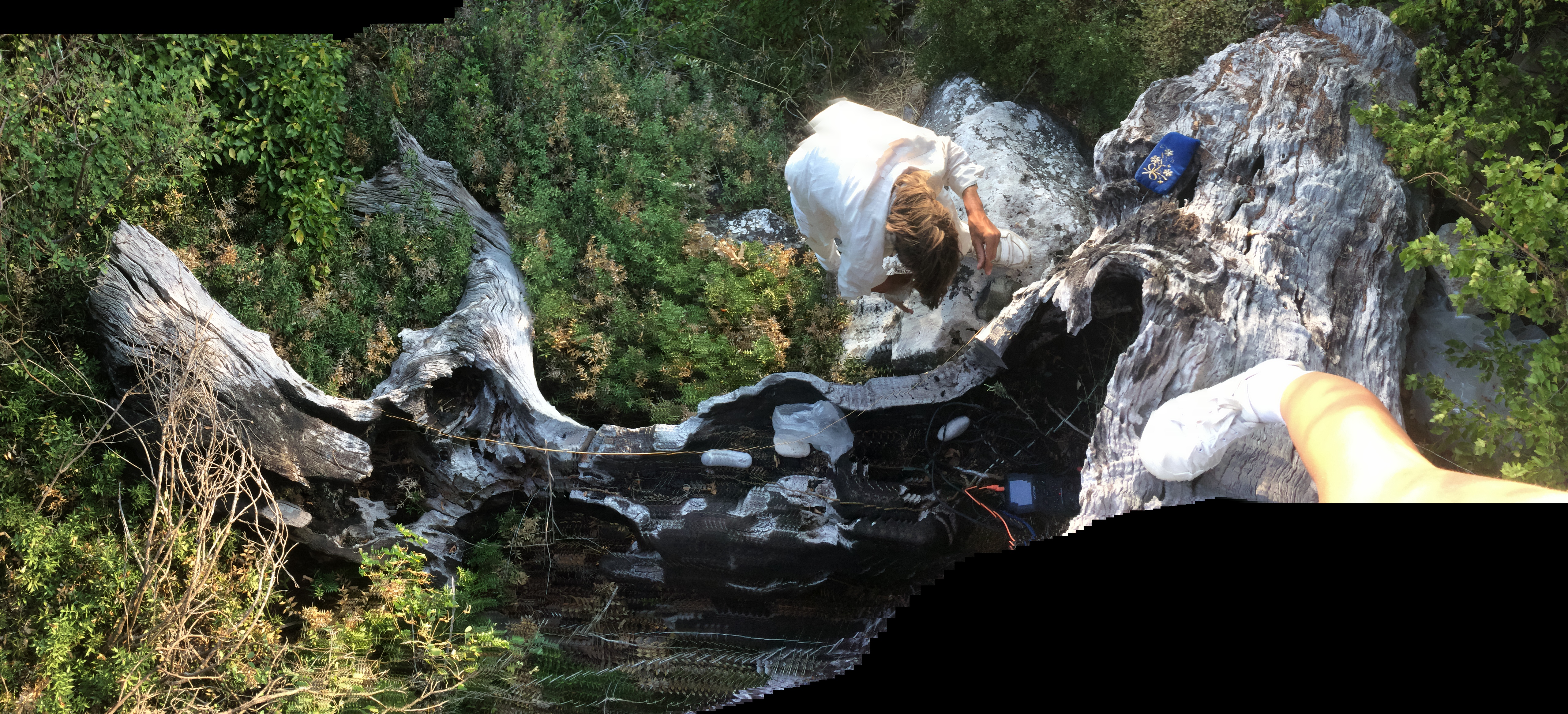
Stone, wood and a sound device return the discussion of the medium to a material action.
Durykino. Two pairs of shoes and someone else’s glass
The September “conversations by the lake, at our parents’” take place in Durykino, on 2, 3 and 7 September. The work’s scope cannot be conveyed by the single term ready-made: things, their traces, the viewer, drawing, a book of conversations, light, music, exhibition space, the language of a research application and the conditions of living together are all examined here. The earlier “Index of Buried Things” describes things buried in Durykino in 2018; it is a prehistory of the place and of taking inventory.
Conversations in Durykino, September 2019 · “Index of Buried Things”
The conversation on 2 September takes place by the lake; the recording also notes the need to feed small fish three times a day. The main working question concerns the artists’ own things: what happens to trainers if they continue to be worn, are taken to a residency, filmed and then used again? The thing, a photograph, a possible scan and an account of its movements turn out to be different traces. One voice identifies the conversation between the two of them as the artistic practice, “which we make visible to others”; the other points out that the two worn-out pairs of shoes remain artefacts. The discussion turns to notebooks and paintings not yet examined; the recording ends as they move to look at them.
In the second recording that day, the artists try to explain the research to other people. They speak of the truth of a simple thing, a drawing and a sound, and of the need for a room and a projector where they can watch films and talk to those who come. Their own inventory of 83 objects then becomes an object of observation: the things are finite, change, and can be shown in a video collage or slide show. The conversation moves to a shirt as a possible portrait, a towel from Karlsruhe, and the question of whether to take a few objects and unfold their histories instead of presenting a general portfolio. The inventory shows the development of relations between an object, a biography, an image and a public explanation.
Things already have time: they wear out, get lost, change owners, return to use. They therefore cannot be replaced entirely by an image or an inventory. A photograph records an appearance; a story brings back movements; the shoes being worn continue to change. The artists are trying to determine which of these forms can be made accessible to someone who has not taken part in their lives.
The third recording makes the simplest gesture into a test. Is it enough to notice someone else’s glass, or must the artists suspend it, set it apart, give it a story? One participant sees the proposition “this is an art object” as changing the status of an everyday thing; the other asks whether a viewer can follow the same path without a text and a particular kind of “programming”. The museum enters the discussion. The suggestion that the viewer is already “in some kind of museum space” meets the objection: “But we don’t define art through museum space.” The dispute concerns the artistic act’s dependence on the place of display: can a person single out a glass or some berries from everyday life in the same way as they would at an exhibition?
Authorial Comment
— Well, they can, but for that they need us to perform some action, a gesture, when we suspend them, for example. — I think no action should be performed on them at all. — Or just put them apart from the others. — An action… — You do somehow take them out of everyday life. — You take them out through your perception. You take them out by noticing them, by marking this as an object. This is already happening, otherwise these photographs wouldn’t work.
Marika Krasina and Anton Kryvulia, conversation in Durykino on 2 September 2019, part III.
— So it turns out they’re already in some kind of museum space, this viewer. — Well, not necessarily. Why in museum space? But we don’t define art through museum space. — We don’t. — So where did it come from in your thoughts? — Well, they have to see these berries somewhere.
Marika Krasina and Anton Kryvulia, conversation in Durykino on 2 September 2019, part III.
History
The glass makes a difficulty visible that can be compared with the February installation. Is a thing singled out by the artist’s gesture, a person’s perception or an existing frame of display? The speakers try all three answers without bringing them into agreement. The museum appears in the argument as a possible condition of visibility.
This gives rise to the task of conveying the conversation itself. One voice proposes that the turns can be considered already attached to the things; the other asks how such a private conversation can be made accessible to someone else’s experience. They consider, in turn, a recording playing beside the glass, a written text, audio, video and a direct discussion of the object in front of a camera. There is no decision yet. The recording does, however, formulate an important temporal relation: the work is being created “right this minute”, and its present can synchronise with the “now” of someone watching or listening later. The future archive emerges here as a problem of carrier and access.
Authorial Comment
— Just, what is it in terms of media, do you mean? Just turn on a recording that will play around the glass? — Well, how then? I don’t know how. We’ve talked about it, you see, this is already a matter of artistic inventiveness. […] — Maybe that’s how it should be, there’s a table, we’re sitting, here’s the glass, we’re talking about it. — We’re sitting? — Well, now. — At the exhibition? — No, a video like that. Discussing this very glass here. — Well, if we have a video like that, yes. Right now we have audio, right now we’re actually recording. I think we need to understand that we’re creating our art now, at this very moment.
Marika Krasina and Anton Kryvulia, conversation in Durykino on 2 September 2019, part III.
History
For a moment, a possible video and the audio recording in progress stand side by side. A future form of presentation is still being chosen, but the conversation is already taking place and being preserved. The distinction between the work and its preparation becomes a problem within the work itself: if what is happening now has artistic significance, what carrier will allow someone to encounter this “now” later?
On 3 September, dialogue gives way to a brief written formulation of a “phenomenology of the viewer”. The artists propose making their own “inner viewer” a test for another person’s gaze; the strangeness of simple things at an exhibition can open up in another person a recognition of their own strangeness. The text returns to “Six Stones”, to the unexpected value of the negligible and the complexity of the simplest thing. It records the position of that day, but does not cancel the previous day’s question of how, precisely, another person will come to the thing.
On 7 September, the working term “Hard Core” introduces the question of presenting their own vulnerable situation without decoration. Two pairs of shoes “on your best plinths” are proposed as the furthest reduction of an exhibition; the speakers then note that, without a book of recorded conversations, the shoes may remain unintelligible. They argue over whether the book should grow continuously or the material should be selected afresh for each situation. Different ways of marking out the space emerge: fragments of photographs and speech on the walls, printouts, drawing over them, rolled-up and illuminated paper, music they have recorded themselves playing quietly in the room. The speakers test some of the proposals and reject them as the production of unnecessary objects. These proposals explore carriers of the conversation and conditions for the viewer’s entry.
The shoes on the plinth acquire a proposed accompaniment: a book, fragments of speech, light, drawing, quiet music. Each addition promises to help perception and at the same time creates a new object requiring explanation. The conversation advances through these costs. Compared with the February installation, these proposals involve much more accompanying material.
In the second conversation on 7 September, they compose a letter about a year of research support. When Nonknowledge is the subject, an answer cannot be guaranteed in advance; a lack of interest from exhibition and market institutions, and the costs of constant moves, make it difficult to concentrate. Here they say explicitly: “the aesthetics of Nonknowledge — that’s the subject.” The two of them have to formulate, record and return to a thought in order to have a language of their own; they discuss the existing online magazine and website, the need for help, and a place that would allow them to “somehow institutionalise ourselves”. The conversation distinguishes the desire for autonomy from the need to cooperate with external institutes.
Authorial Comment
— We need to concentrate, to find a possibility, well, so that we can actually, in principle, move this whole thing with Nonknowledge forward, and the artistic work connected with Nonknowledge; how can we... I mean, the aesthetics of Nonknowledge — that’s the subject.
Marika Krasina and Anton Kryvulia, conversation in Durykino on 7 September 2019, part II.
History
This need had already received a practical formulation in an application for a year-long studio at BACKLIT, dated 5 September 2019 and signed by Marika Krasina on behalf of the Rabota group. There, dialogue is named as the basis of the research process; the first phase of the work consists of travel, conversations and the development of concepts, and the second of realisation in cooperation with art institutions. The main part of the process is described as “in the format of office work”. Before the Finnish residency, office work is already a practically conceivable form.
Application for a year-long studio at BACKLIT, 5 September 2019
Filettole. Rain, the second floor, a disappearing conversation
In a separate September recording, “Hip Hop”, the artists compare action with musical work on a carrier. A conversation about the sample and moving a stylus across a record ends not with a new classification of art but with practical questions of money, invitations and filming: “We need a video camera, so that it’s always with us.” This recording connects the discussion of mediation with the need for a permanent documentation tool.
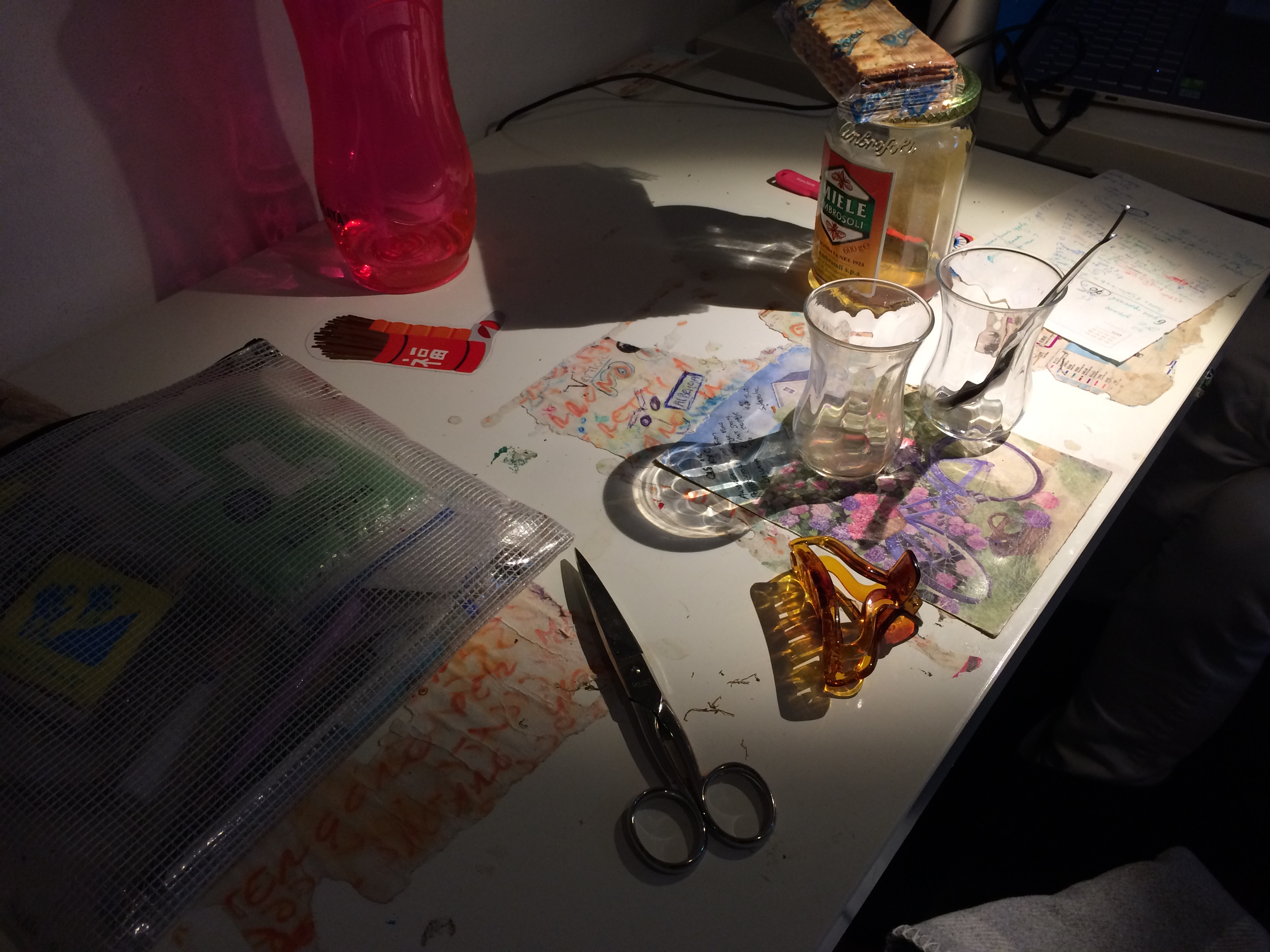
In Tuscany, the artists stayed with Ron, a photographer, near Pisa. The recording of 7 November begins with the question “What’s the village called?” and the answer: “Filettole. Italy. November 2019. Second floor. Number 131.” The speakers return to the relation between theory and practice. One participant argues that a theoretical system should not serve as a stand for art: these are separate pursuits that can reflect each other. They then test whether a drawn bubble is a thing, a sign of speech or an action. Here, September’s confidence that conversation is already work meets an objection about transmission: if what was said has disappeared, in what form can another person encounter it? They consider writing it down on paper, memory, oral transmission. The speakers propose preserving the object and its development alongside one another, but do not declare them to be the same thing.
Authorial Comment
— So if you’ve put it down on paper, you can pass it on. — Well, or if you can remember it. If there’s a culture of this kind of oral transmission. […] — Well, probably it should just be like parallel worlds that exist together, but in parallel. I mean, there’s the bubble, and there’s the development of the bubble. And this should be represented. Both the one and the other.
Marika Krasina and Anton Kryvulia, conversation in Filettole on 7 November 2019, part II.
History
On 9 November, they wait for a train to Pisa at Ripafratta station. Walking through a field instead of taking a bus stretches experienced time; a rubber outline found on the road enters the conversation as a thing seen along the way. Conversations, drawings, found objects and recordings do not form a single predetermined form here: the artists discuss what can be passed on from what they have experienced and what remains a circumstance of the conversation itself.
Here, the journey gives the research a test of preservation rather than an illustrative background. The conversation will end, the train will come, the found thing will move or remain on the road. Drawing, recording and memory preserve different aspects of the event. To take them as complete equivalents would be to remove the very difficulty the speakers are discussing.
In Recollection, this question takes the form of a separate project: what is filmed while travelling is to return as a projection into the room where the artists live. The room, the journey and the file become parts of a single return to what has been experienced.
December. Work under the bed and people to write to
Three December recordings were given the collective title “Conversations about How to Work”. The printed collection is labelled “Moscow–Durykino • 2019 12”. On 5 December, the task is defined as creating their own political space of dialogue. The correction “not in front of a viewer, but in front of a person” refines September’s question of the future viewer: the person in question can now leave the role of observer and enter the conversation during the action itself. The speakers discuss “prepared unpreparedness”: working before the event so that, at the moment of encounter, the question is not replaced with a ready-made programme. At the end, they propose beginning by saying “Hi”, telling the story of the day, reading or playing excerpts from recorded conversations. The earlier conversation between two artists is thus considered as possible material for a public action.
Authorial Comment
— What we like about performance is that it’s a state where you’re right in front of the viewer. — Not in front of the viewer, but in front of a person. A viewer is just something like… But a person is right in front of you, not some obscure masses you can’t see, but here in front of you is a person, and you’re talking directly to them. This is precisely where something political could be born. Something real could be born in this.
Marika Krasina and Anton Kryvulia, conversation of 5 December 2019.
History
On 19 December, an attempt is made to describe the very object of the ongoing work: if the conversations are imagined as lines, their intersection outlines an object that is difficult to define in a single phrase. The other speaker objects that it is hard to call this an object. The argument then moves to the material level: what will remain if the artists themselves are removed? Files are named in response. They are considered as the concrete matter of the work, and cataloguing as a possible artistic action. One participant compares the catalogue of Bubble Opera, which they consider already formed and closed to additions, with the folder The Best, which, they say, has been growing for about three years: files continue to be added to it. This is already an active artistic form for selecting found fragments, now presented on the website as *Shreds vol.1 (the Best)*. In 2026, the artists describe a portable pink folder containing selected paper scraps, tickets and other things collected on journeys. What matters in the December conversation is the difference between a completed catalogue and an ongoing selection.
Conversation of 19 December 2019; The artists on *Shreds*, 2026.
Authorial Comment
— […] If you imagine that all our conversations create a kind of topology in space, then you’ll see that these conversations, they intersect, and at the point of intersection this object emerges. — Well, as for some kind of object — it’s hard to say.
Marika Krasina and Anton Kryvulia, conversation of 19 December 2019.
[…] what is our medium, after all. By medium I mean, if you remove us, well, if we just up and disappear, what remains. […] I think we need to take a more interested look at this, at what a file is. […] Because a file is material — it is matter. […]
Marika Krasina and Anton Kryvulia, conversation of 19 December 2019.
[…] Or what’s happening with our “The Best” folder. This is ideal work with a folder; we’ve been working with one folder for three years now. And this work is very productive and very alive. All we do is add new files to it. And this folder lives its own life and this is very interesting and very valuable. […]
Marika Krasina and Anton Kryvulia, conversation of 19 December 2019.
History
The same conversation draws an important boundary between the internal form of the work and practical communication with the outside. The file structure is called a “brand book”. The idea of sending letters with a logo and a common identity is then discussed; an objection is raised that it is better to approach people in the artists’ own names, rather than on behalf of “some outfit”. The conversation states: “Communication should not turn into an art object” — a practical contact risks becoming a fictitious game. January’s idea of branding a space with Nonknowledge does not automatically resolve this December objection: the distinction between an artistic operation and the responsibility of an actual approach to someone remains.
The conversation about the file makes the question of preservation concrete: what remains is not only the two people’s memory, but also a carrier accessible to someone else. Yet a carrier requires selection, form and an addressee. An ongoing folder and a completed catalogue offer different answers to the question of what counts as a whole and when the work ends.
On 23 December, the speakers acknowledge that different layers of the work have become mixed together: the free selection of material, its subsequent interpretation and communication about it to the outside require different modes of attention. A provisional three-part model is proposed: Chaos selects and combines materials without prior justification; Sense develops a concept that protects them; a third position translates this into messages, letters and exhibition organisation. The question of how many people there will be in each group is answered with “two in each”; this brings laughter and a total of six. This plays out a division of functions within the work of two people. What matters is the unresolved task itself: how to convey freely selected material to others without requiring the artists to select, provide a theoretical rationale and communicate externally in one and the same mode.
The reason for this division appears in a domestic moment within the recording itself. A pause occurs during the explanation: “Anton is looking for his notebook.” A few turns later, they say of the collages: “They’re lying here under our bed — no one sees them.” The free choice of material does not yet ensure its appearance before another person. For this, they have to change their position in relation to their own work: to select, formulate and communicate about it in different modes.
The distinction between Chaos and Sense does not remove artistic arbitrariness. At the end of the conversation, the Chaos group is again given the right to take drawings, photographs of exhibitions and even concepts as material, combine them and “punch a hole”. The protective concept is needed precisely because artistic choice is not derived from it as the execution of an instruction. Addressing the outside remains the responsibility of real people: the concern about turning a letter into a game played on behalf of an imaginary outfit is retained.
Mänttä. Dedicating time, setting aside premises
In a conversation on 9 January at Serlachius, the artists discuss why they have chosen their own trainers for the work: these are things that happened to be at hand. The question of the nearest object thus continues.
At the Finnish residency, the conversation about an institution undergoes a material test. On 19 January 2020, the artists describe the “first office of Nonknowledge” they have already set up: they have installed a television displaying Nonknowledge?, listen to music, work with documents, arrive at eleven. One participant proposes not rushing into a complex explanation; the other says that the name and daily use of this place institutionalise their presence at the residency.
Authorial Comment
— […] We’re having this interesting experience now — we’ve made this first office of Nonknowledge. I mean, we arrived, put the television there, it says — Nonknowledge? We listen to music, and work here with our documents. — We come here every day. For eleven.
Marika Krasina and Anton Kryvulia, conversation of 19 January 2020.
History
In the January recording, the abstract need for a place of their own acquires a daily routine: a television, documents, music, arriving at eleven every day. Conversations and statements now take place in a room set aside for them. The Office becomes a way of occupying the residency’s time, as well as a name for the process.
Another line from December develops in the same conversation: why free and unpredictable work needs a protective form. The artists discuss branding Nonknowledge as a shell that allows an object, a place and even a period of residence to be designated without assigning them a final content. One voice proposes naming and setting aside the premises as an “Office”, and dedicating the residency’s time to work with Nonknowledge. In this account, “anti-branding” should keep the place open and not bind it to an owner. This proposal sits alongside December’s concern about speaking to people on behalf of an imaginary outfit. The place and the daily routine already exist; the relation of an artistic name to external communication is still under discussion.
At the beginning, one participant describes the need for a structure that would protect the practice’s unpredictability and implicit nature. The answer is brief: “A kind of shell — a seashell.” The shell should not fill the work with content in advance. It should allow it to continue and enter into relations with the outside world.
In the same conversation, space itself becomes a suitable thing. It can be singled out, named and dedicated to Nonknowledge in the same way as an object; the time of the stay can also be specifically given to this work. The formulation of “anti-branding” radicalises the task: the marked place is to be protected from belonging to anyone. The institutional question thus arises within a room already in use: what, precisely, does its name keep open?
Authorial Comment
“We want to turn branding into anti-branding — what we brand belongs to no one. […] We fence off a part of the world from the intrusion of property. Someone’s property. We make this place no one’s.”
Marika Krasina and Anton Kryvulia, conversation of 19 January 2020.
History
The wall. From modes of work to a place for whatever
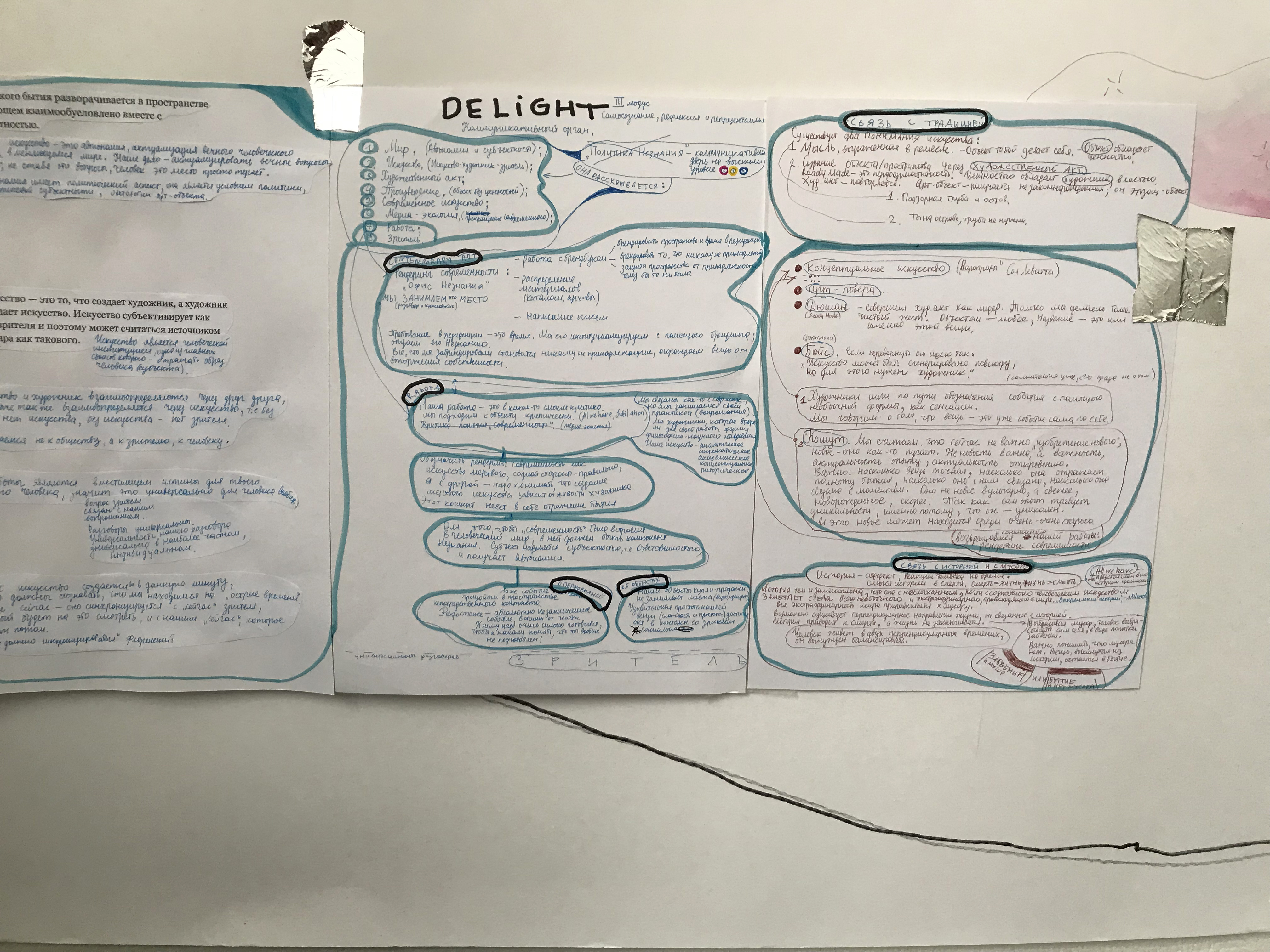
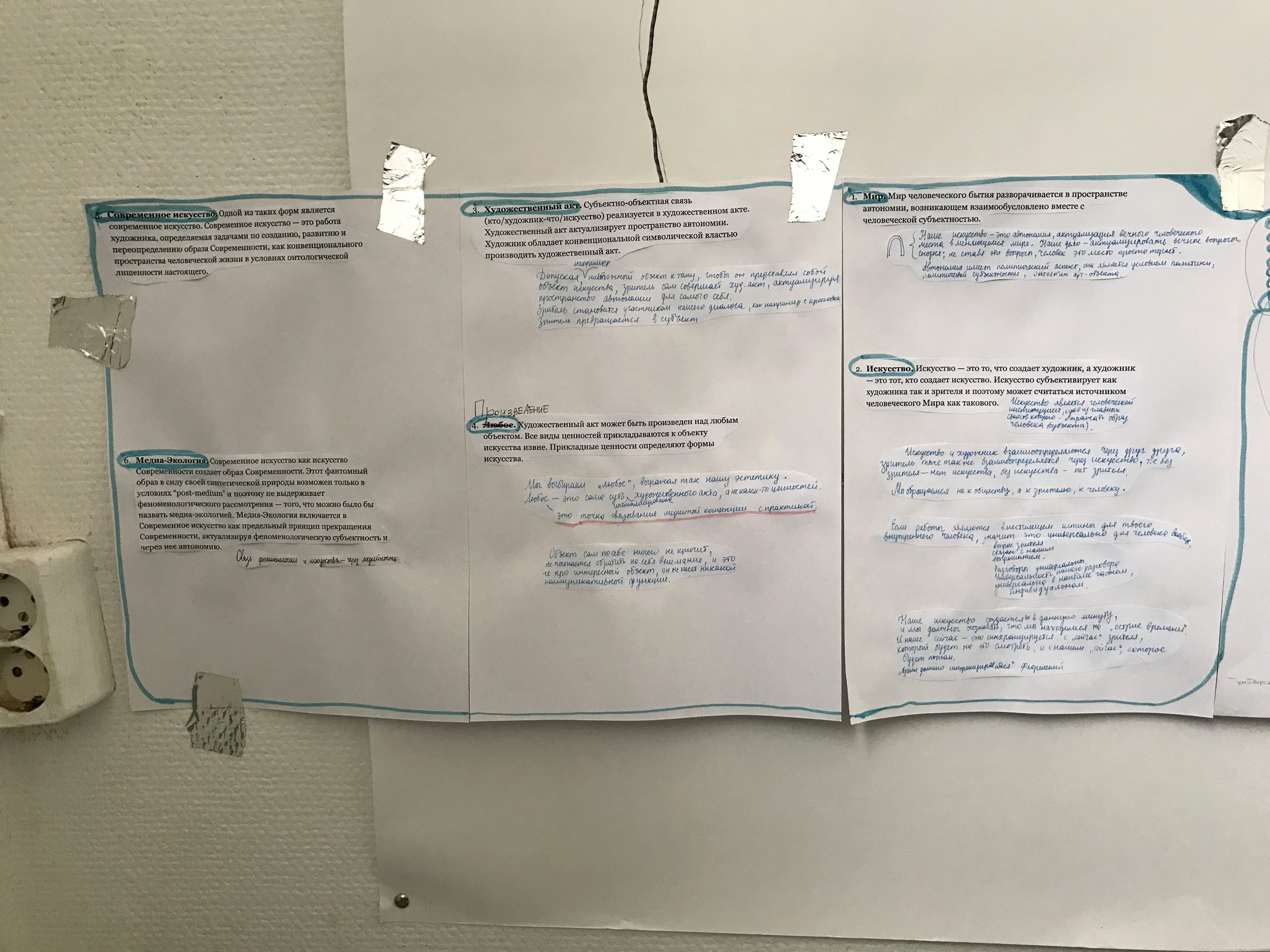
The wall preserves the development in a state of superimposition and correction. The overall diagram is assembled from areas of paper, coloured inserts, arrows, outlines and printed pages. Above the large composition is written “NONKNOWLEDGE AS THE ONE”; below are OBJECTS, Rabota, OPUS, OPERA, WE, “Ethics”, “Autonomy”. These photographs were taken on 23 February 2020, the day of the first presentation of Whatever.
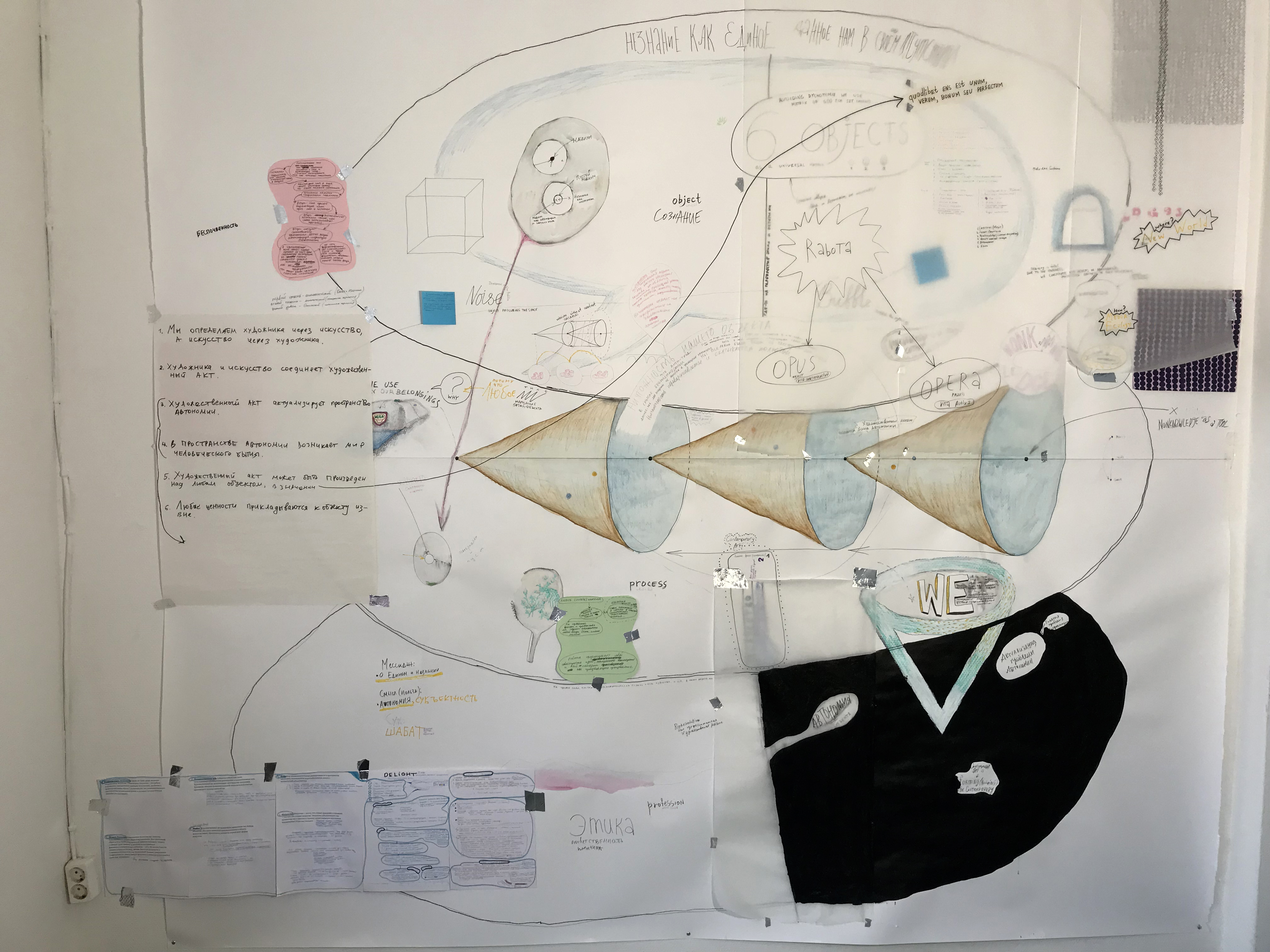
The separate sheets CHAOS and SENSE return to December’s distinction between modes of work. One has numbered ovals, transitions and crossings-out; on the other, “Aesthetics of Nonknowledge”, “Media Inversion”, “Endowing a Thing with Subjecthood” and “Turning an Object into an Art Object” are legible. The distinction made in conversation can now be surveyed spatially: it can be revisited, its elements compared, a connection crossed out.
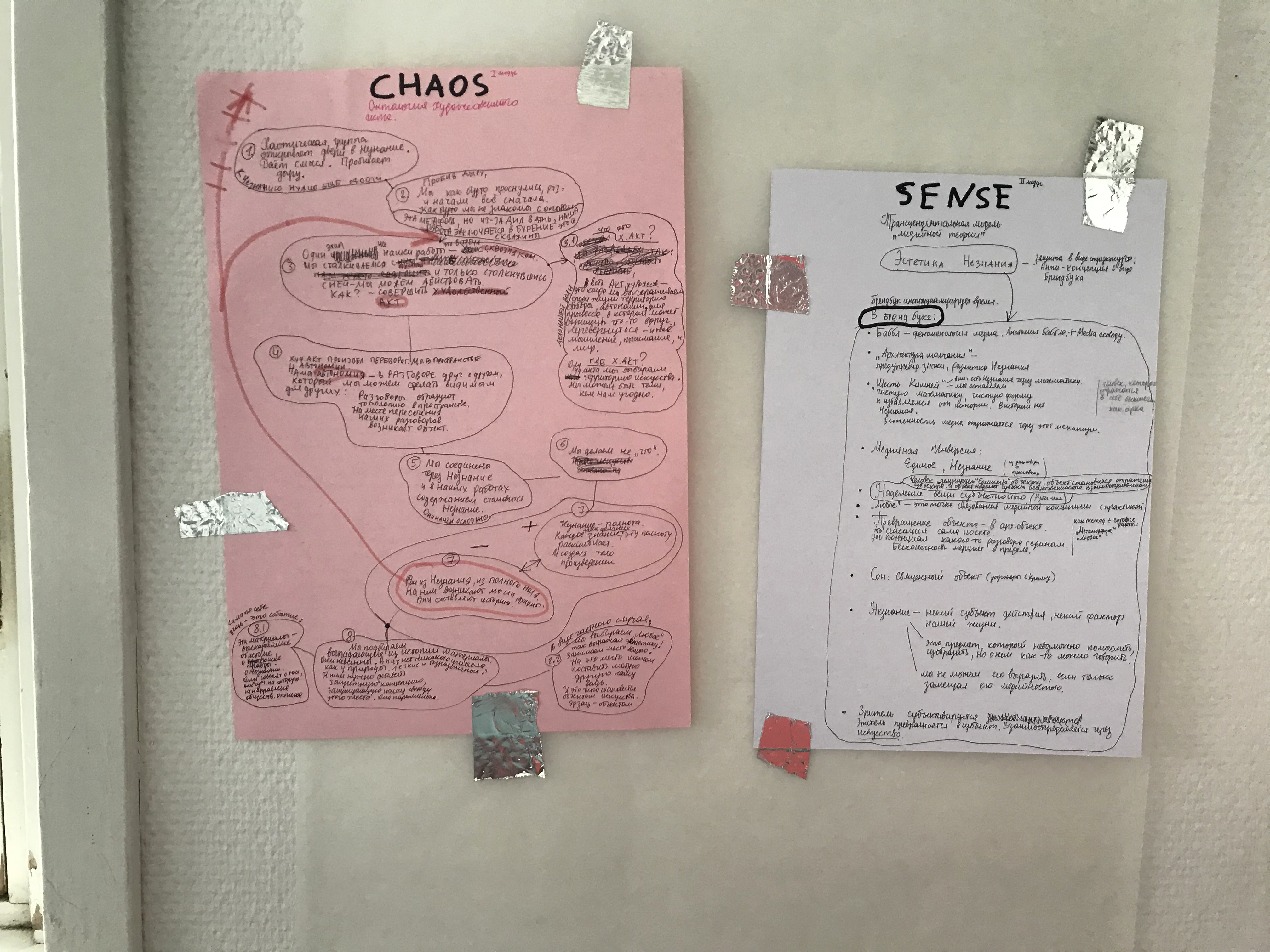
The pink sheet makes more definite that around which these actions are organised. One oval reads: “The One is given to us in the form of its absence which we will call Nonknowledge.” This is followed by: “Nonknowledge is the general medium.” Further arrows lead to things, their nesting within media and the artistic act. The inscription “Groundlessness” is nearby, on a white area. Here, absence is already formulated.
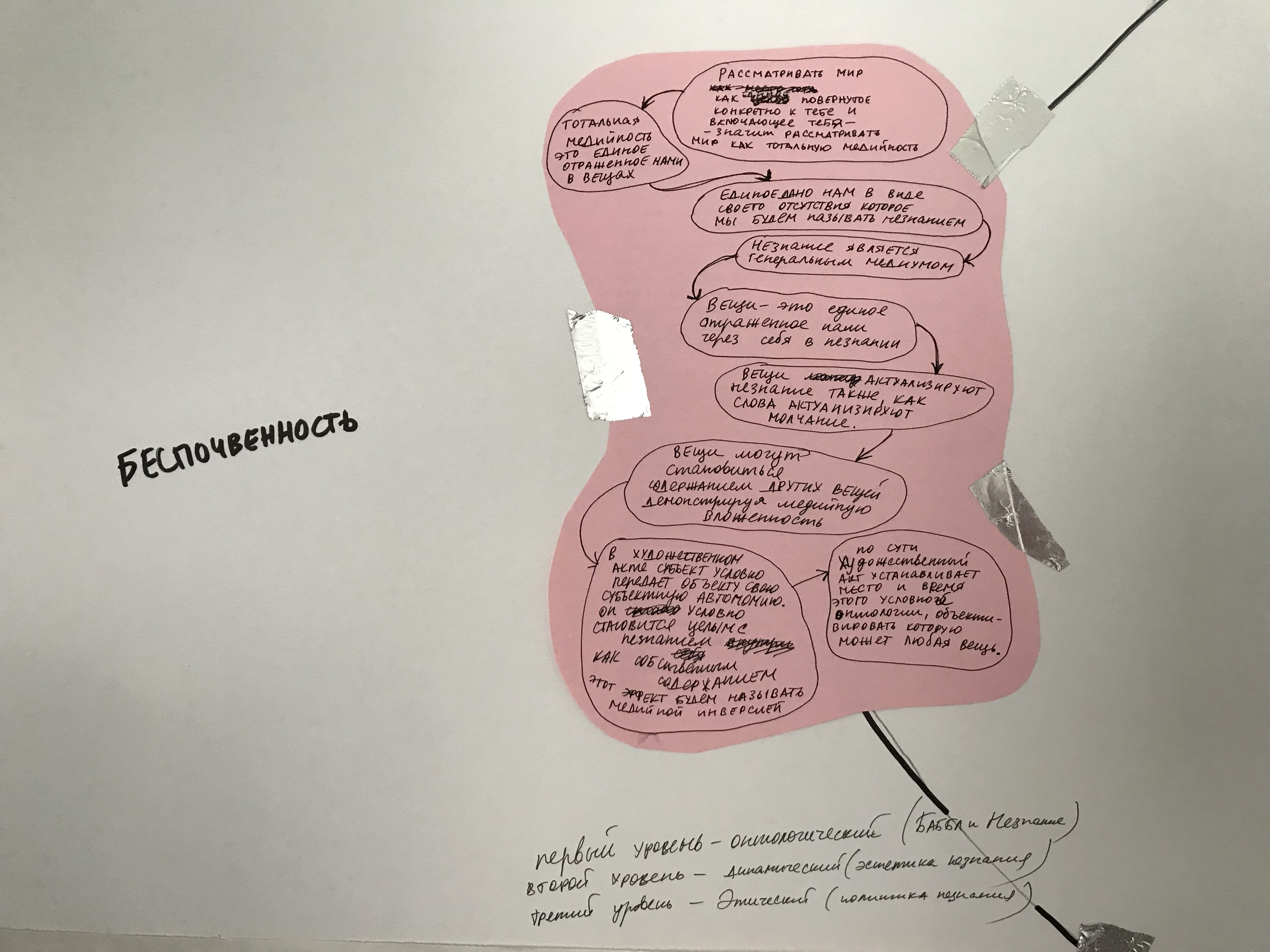
The sequence does not end with absence. It returns to how a thing can make this absence perceptible: things “actualise Nonknowledge just as words actualise silence”. A passage before “actualise” is crossed out. The relation at issue is that of something determinate to what it does not exhaust. Within this relation, any object may prove necessary, although none will be the final content of the whole.
Another sheet brings handwritten connections between DELIGHT and “Politics of Nonknowledge” together with printed statements. The document begun before the Office is present here as material for work on presentation.
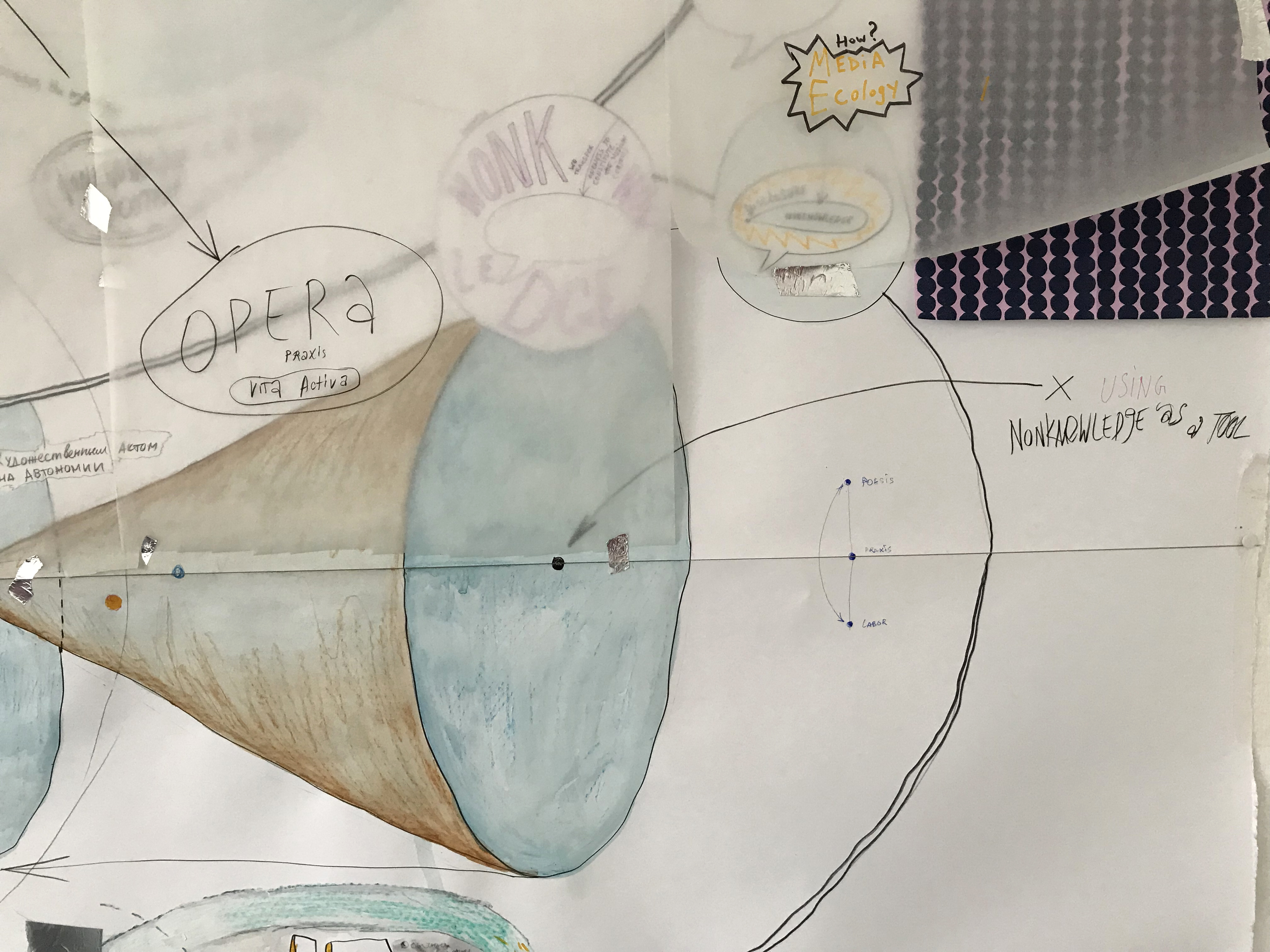
In the right-hand part of the large diagram, OPERA, PRAXIS, Vita Activa, WORK, MEDIA Ecology and USING NONKNOWLEDGE AS A TOOL are placed alongside each other; a small axis distinguishes POESIS, PRAXIS and LABOR. The diagram holds work, life and the media conditions of their presentation alongside each other. What matters is that an attempt is being made to bring the mode of work under discussion into view without reducing it to a single textual definition.
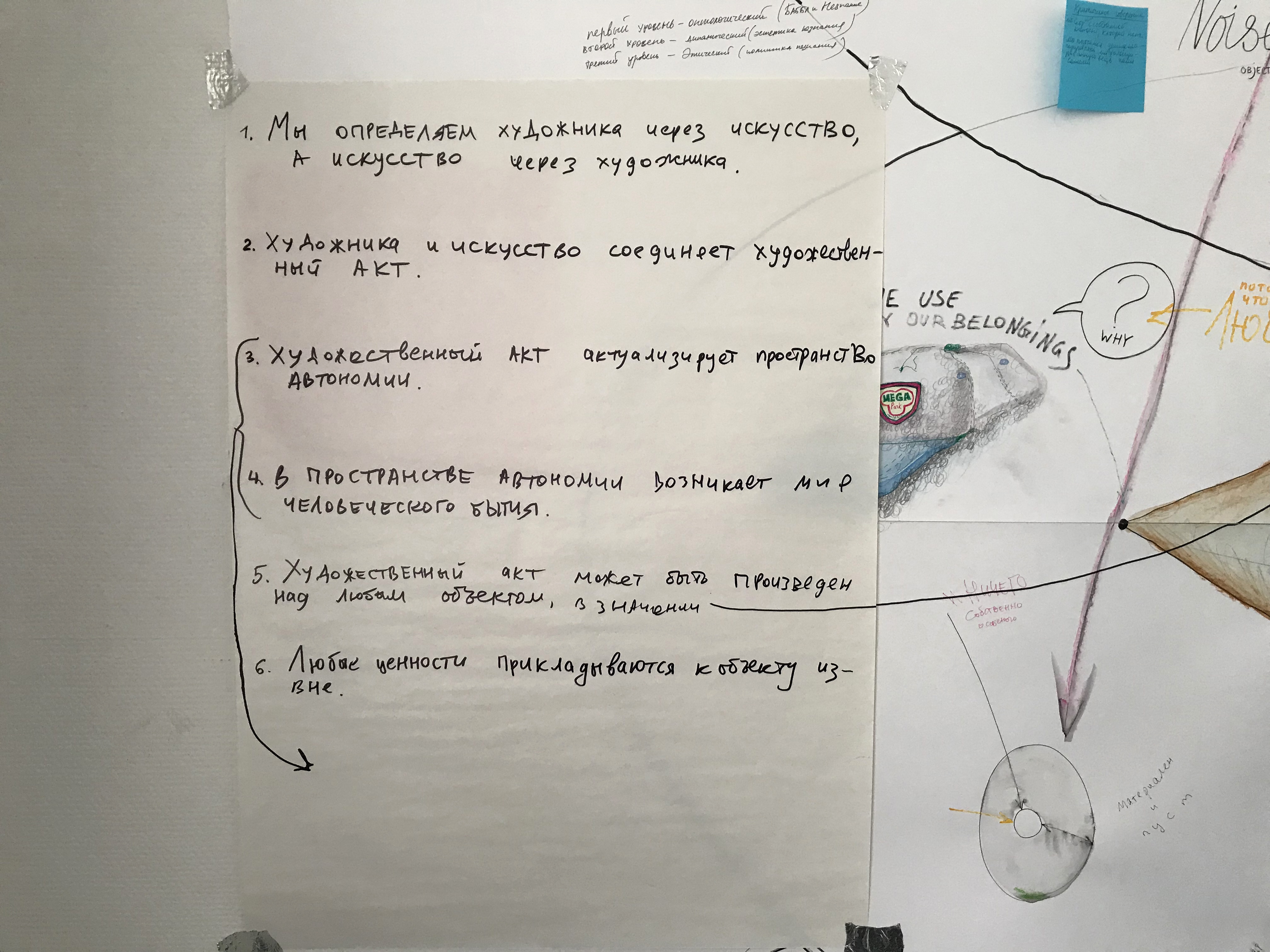
A separate handwritten sheet contains six numbered statements on art, the artistic act, autonomy, the world and the possibility of any object.
Printed propositions are attached to the lower part of the wall. On three pages, six points are arranged in pairs: “World” and “Art”; “Artistic Act” and “Whatever”; “Contemporary Art” and “Media Ecology”. “Work” is written above “Whatever”. The printed statement reads: “An artistic act can be performed on any object.” The handwritten renaming leaves the revision of the title and its relation to the whole visible: “Whatever” and “Work” are tested alongside the statement about an artistic act performed on any object.
On the green sheet, the heading “ЛЮБОЕ (ЛЮБОВЬ) WHATEVER” — “WHATEVER (LOVE)” — connects the installation’s title with the question of subjectivity and the thing. It does not replace the renaming on the printed sheet: both traces remain side by side on the wall.
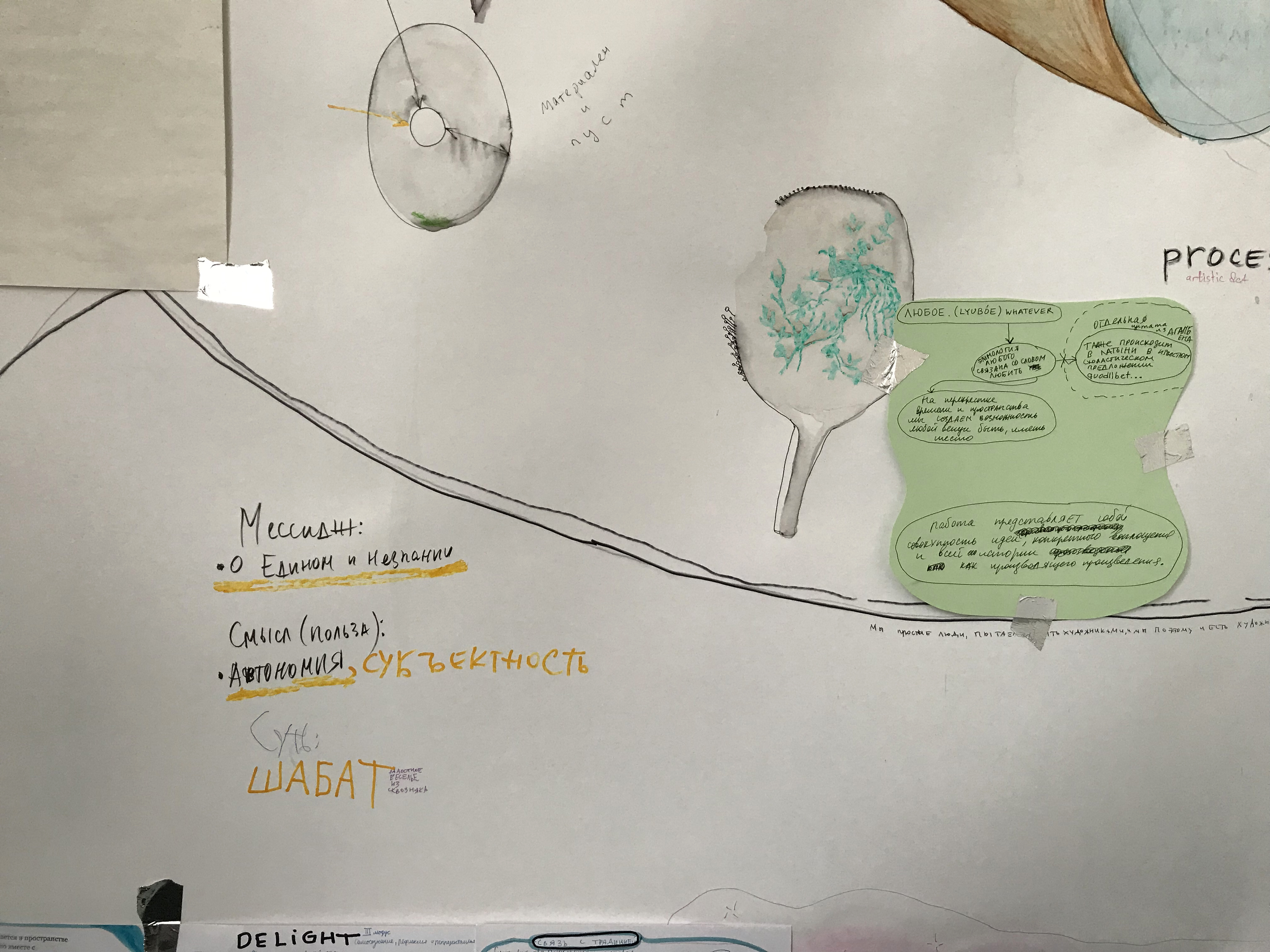
The wall thus shows several stages of formulation at once: the division of modes of labour, absence as a condition, the thing as a means of actualisation, the artistic act and the possibility of any object. What is before us is no longer only an idea that needs explaining: a place for work has been occupied, time dedicated to it, formulations can be revised on the wall.
Manifesto of an empty place. Whatever, 23 February
The first realisation of Whatever has few material components: a dedicated room, a plinth, ordinary footwear, a text. September’s dispute about how to notice a glass now receives a publicly established condition; January’s conversation about setting aside a space receives a concrete place.
Authorial Comment
“In "Whatever" we are presenting a blank spot. Now this place is occupied by Anton's boots, next time it will be something else — it could be whatever.”
Marika Krasina and Anton Kryvulia, post of 23 February 2020.
History
The word “empty” does not mean that there is nothing on the plinth. It defines a place that does not belong definitively to what currently fills it. The boots are a determinate thing: they have an owner, a form, wear and a life beyond the presentation. But the work preserves the possibility of replacing them. It can therefore acquire a history of different embodiments while retaining the one place it establishes.
The same post formulates this directly: what remains constant is the place produced by the artistic act; the work includes this conditional place, a particular embodiment and the entire history of subsequent embodiments. Its condition is the removal of applied expectations from the object: narrative, image and skill should not close the question of the difference between an ordinary thing and a work of art.
Authorial Comment
“The blank place produced by the artistic act remains the only constant of all the subsequent objectification of this work. Finally, the artwork is the summation of a conditional blank place, a particular embodiment, as well as its entire history as a self-generating work.”
Marika Krasina and Anton Kryvulia, post of 23 February 2020.
History
In the undated text 2 Whatever, this function is named still more precisely. For the place not to be lost, fall from memory or merge with the totality of Nonknowledge, something has to occupy it. The thing becomes an ersatz art object whose task is to point to the place and create the material conditions for its storage and presentation.
Authorial Comment
“The thing that actualizes the work acquires the sense of an ersatz art object, the only task of which is to point to the empty place, to create material circumstances for its storage and representation.”
History
“Ersatz” names the boots’ substitutive function. The thing points to what cannot be exhibited as a final object: an open place for whatever. The artistic action consists in establishing and maintaining it. The boots give it visibility and duration; all their everyday specificity remains a concrete circumstance of this embodiment.
The word lyuboye (“whatever”) is therefore not equivalent to simple indifference. In the contemporaneous post, the authors connect Whatever with the Russian любое (lyuboye, “whatever”), любовь (lyubov’, “love”) and Agamben’s Quodlibet. The object’s replaceability does not cancel attention to exactly what it is now. September’s worn shoes and February’s boots meet at the level of this question: how to single out a thing temporarily without exhausting it through its instrumental or artistic function.
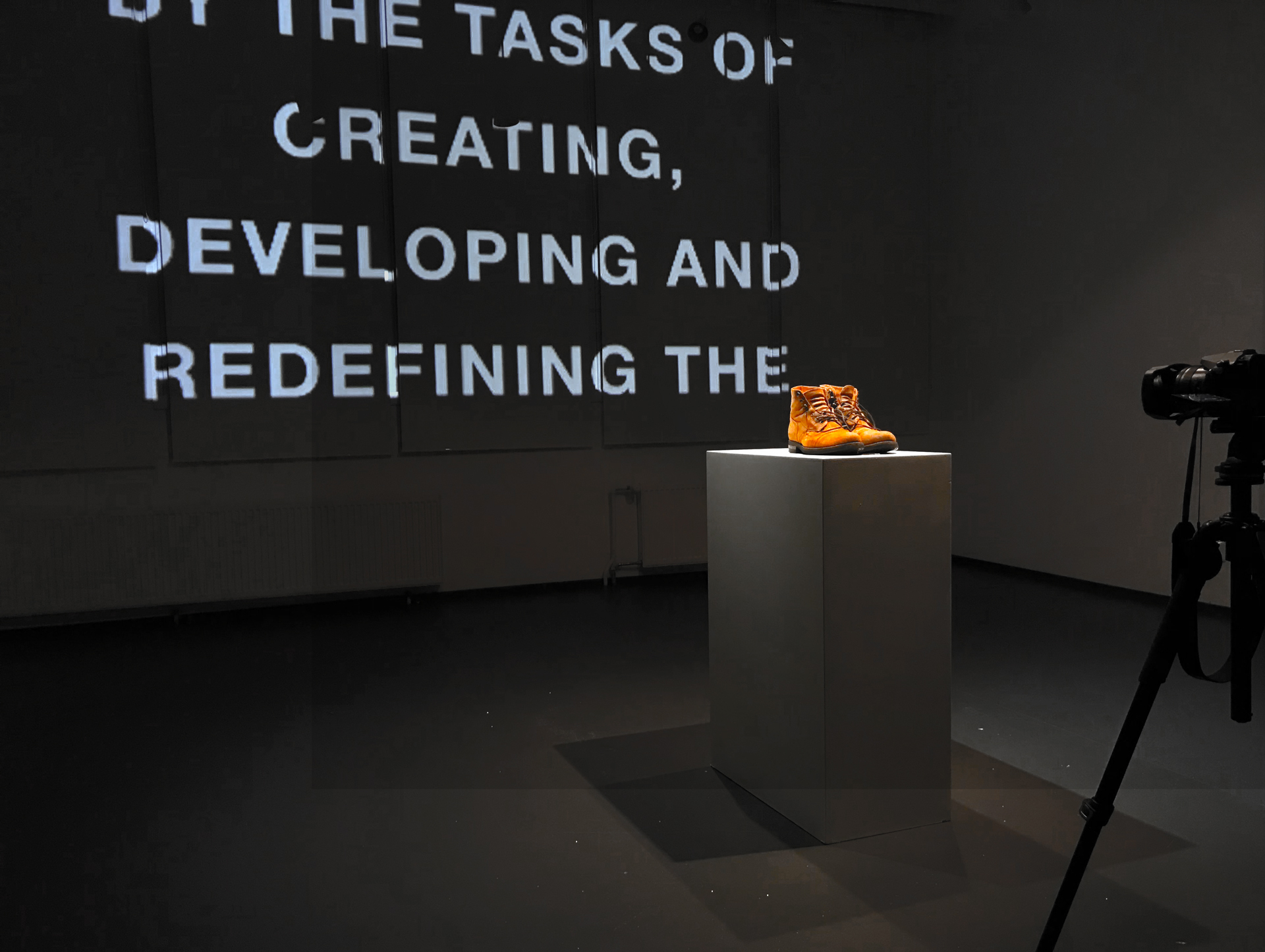
The text in the room is part of the presentation: it states what relation is being proposed for the viewer to see in ordinary footwear. The projection consists of six numbered statements.
Authorial Comment
1. Art is what the artist creates; an artist is the one who creates art. Art subjectifies both the artist and the viewer and therefore could be considered the source of the human world as such. 2. The subject-object relationship (who/artist — what/art) is revealing in the artistic act. The artistic act establishes the space of autonomy. The artist has a conventional symbolic power to produce an artistic act. 3. An artistic act could be performed on any object. All kinds of values are applied to the art object from the outside. 4. Applied values define art forms. One of these forms is contemporary art. Contemporary art is the artist’s work, determined by the tasks of creating, developing and redefining the image of contemporary as an ersatz space for human life in the conditions of an ontological deprivation of the present tense. 5. Politics is a constant effort of the autonomous subject to restore the present time, to recollect himself and reassemble the world. 6. The world of human existence unfolds in the space of autonomy, arising interdependently along with human subjectivity in the present.
*Six statements — text projection, Mänttä, 2020* · Projection layout.
History
The statements form a sequence: art and the artistic act; any object and applied values; an image of the Contemporary; the political effort to restore the present; the world as a space of human subjectivity. The video Whatever, Sequence #1 shows all six statements passing behind the boots on the plinth; the projection video shows the separate stream of moving text without the boots or the room.
The propositions continue to be developed in the later publication Six Statements.
One working day. The video Office of Nonknowledge
The film *Office of Nonknowledge* is dated 7 March 2020. In the first frame, a person sits at a desk in a dark room, a desk lamp is on, and the screen behind displays the word Nonknowledge. The film lasts approximately 28 minutes. Its description speaks of two months of filming the working process edited into a single working day; secondary elements of the process receive the camera’s attention. This is a separate realisation of April’s thought about work as content.
April’s shift of attention from the object of research to the course of the work acquires a temporal arrangement of its own. Two months are brought into a day; the accumulated material becomes a form of duration. This is another way of making the process accessible to another person, with an independent result. The film sits alongside Whatever.
A room, a camera, potatoes. Whatever #2
During quarantine, the place has to be established through broadcasting. The broadcast from the room begins with an announcement of the start and a proposal to peel potatoes. The next turn reports that the start has been delayed for four hours; the participants have experienced an emotional breakdown, Anton has had to change his hairstyle, and there is no agreement about the medium of live broadcasting. Should they simply turn on the camera in the room or launch a random montage of accumulated recordings? The uncertainty is not resolved before the start: it becomes the spoken content of the broadcast itself.
Authorial Comment
— Beginning! — let’s start talking, I'll peel the potatoes.
Marika Krasina and Anton Kryvulia, *Whatever #2*, conversation during the broadcast.
History
Two strands ran simultaneously: the artists speak and act before the camera in the room, while a programme selects audio and video fragments from an array of approximately one terabyte and continuously assembles a separate stream. In it, thousands of recordings of travel and everyday life are shown again in the present. One participant says that what they see looks like a requiem; the other points out that this is live broadcasting, a reconsideration of the past. Here, the archive is no longer only what remains after an action: it becomes the material of something new taking place.
The camera in the room does not become a transparent intermediary. It interferes with the conversation: another person can reply, while the camera is simply there beside them. An attempt to speak about viewers in the third person is interrupted by a correction: “You”, the person being addressed now as “you”. The authors’ argument about subjectification immediately meets a message from a listener: “Stop subjectifying me as a spectator!” In response, it is noted that the listener can turn off the broadcast. The dispute concerns the possibility of connection.
September’s question of how another person will encounter a private conversation returns in a changed form. The speakers try to use the camera as a tool of dialogue and discover its resistance. Instead of a final definition, they show a situation: a room, people, potatoes, soup, a camera, a person behind another screen. Everyday life constantly distracts them from the medium while giving it content. One turn asserts that broadcasting is necessary for a conversation about broadcasting; the next asks where the towels have gone.
Here, too, the empty place is not equivalent to a physically empty frame. It is connected with the possibility of establishing a political place of one’s own and a connection with another person without a shared, predetermined subject. But the broadcast does not leave even this formulation undisturbed: a desire arises to tell a story, show the sunset, make what is happening interesting. The urge to fill the place becomes part of the test of its openness.
The second realisation of Whatever takes place on 24–25 March 2020. In the conversation about it, December’s question returns: how can an encounter with a person take place if one stream shows the action in the room while another simultaneously reassembles recordings made earlier?
At the end, the conversation returns to the impossibility of treating the camera as an unnoticed part of life. Then a spoon, metal dishes and water can be heard. The question “What do you want?” is followed by “Switch it off”. Finally: “This couldn’t go on forever”. The broadcast ends. This ending leaves visible the condition of the entire course of research: openness requires a concrete arrangement, presence and duration; the arrangement can be switched on, sustained and switched off.
In Mänttä, that arrangement consisted of a designated space, boots and a text. During quarantine, it consisted of two simultaneous streams, one of which reassembled the archive. In both cases, the simplicity of the artistic action is sustained through a concrete carrier. The empty place becomes accessible through what temporarily occupies it.
An institution around an empty place
The artists now describe the museum as an arrangement built around emptiness. This present-day connection allows the early situations to be read again: the question is how to give absence a place and make it possible to return to it through a determinate thing, conversation, document or presentation. On the pink sheet from February 2020, the One is described as given in the form of its absence, and things as that through which Nonknowledge is actualised.
Yet the work continues to change across January’s Office, February’s Whatever and the later MUSEUM. By early 2020, premises, a protective shell and dedicated time are already being discussed; in autumn and December, storage, self-observation and the curatorial transmission of the practice will be formulated separately. The installation makes one condition explicit: in this realisation, the boots make the place visible; the next object can occupy it while preserving the possibility of further replacement.