History
A presentation before an invitation
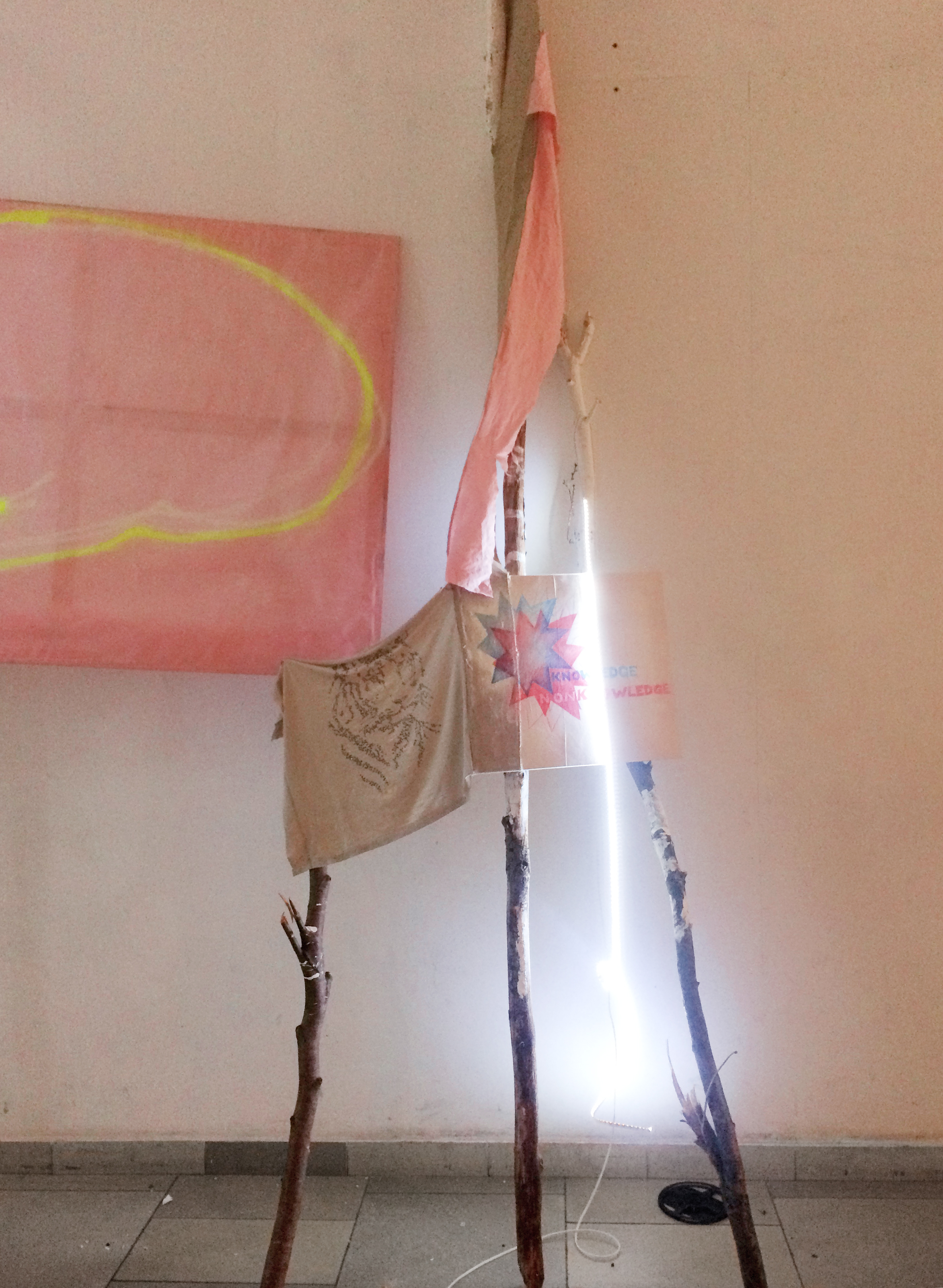
On 21 June 2017, the artists assembled a presentation in the Academy from drawings, branches, objects and improvised supports. Large sheets met the floor and walls; a towel hung between sticks; light and projection equipment shared the space with things brought into the building. Their practice was already taking up space before the Academy had assigned them a formal position.
Authorial Comment
Our invasion there began well before Axel Heil registered us as students. First we invaded the Academy and made a presentation there with sticks. The video Karlsruhe Academy Invasion shows this. Afterwards Axel Heil invited us to take part in the summer exhibition and, for that purpose, arranged Guest Student documents for us. That was the order in which it happened. The point was not to become students. We arrived there as tourists, complete outsiders, without any institutional status and without any information about how the place was organised. During the exhibition, we were in Germany illegally. We were interested in how we, as people “from nowhere,” could act institutionally simply by carrying out a blind institutional incursion in order to reveal the institution’s structures.
It was a kind of “reconnaissance in force”: to reveal the disposition, you push straight ahead and see what happens, then reconstruct the system of coordinates from the reaction. We kept moving forward, simply pushing our way ahead, to see how everything was organised.
History
The diagram and the towel
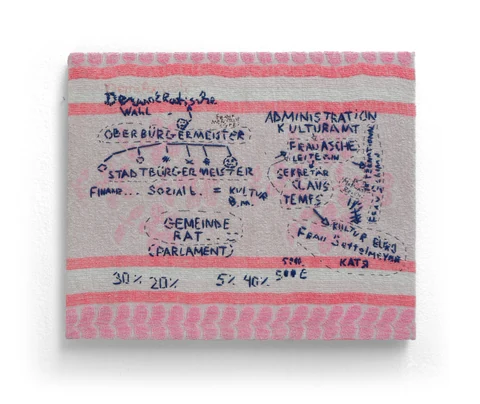
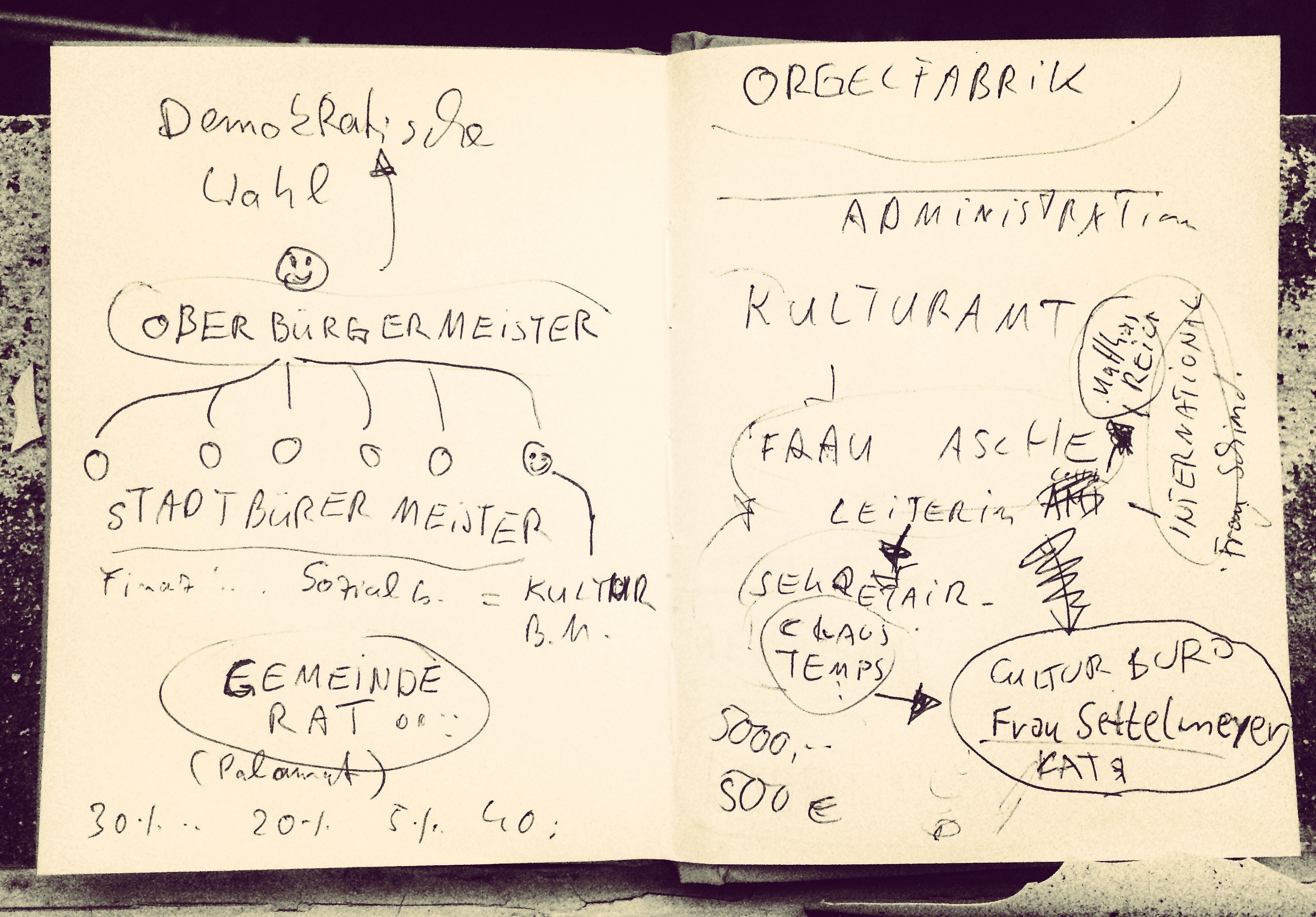
One of the things in the presentation already carried an encounter with Karlsruhe’s cultural administration. **170526**, dated 26 May 2017, reproduces a diagram of municipal cultural funding in embroidery. The diagram concerned the city’s distribution of resources; it did not describe the Academy’s internal organisation. A friend’s explanation had become a drawing, then a textile, and now a part of the presentation.
Authorial Comment
A scheme of the administrative structure of Karlsruhe is embroidered on a towel as an explanation, of how the art projects are financed by the government of the city. An impenetrable wall of institutionality has the passages inside: “Institutions are people.” Axel Heil figured it out as a response to the idea of using the Karlsruhe municipal cultural system as an artistic medium. “Ok, let us see,”: thought Marika and Anton, and soon a plan of intervention in the ZKM museum ripened. Having taken detailed instruction from friend Joachim who drew a diagram that outlined the ways of financing art projects and a scheme of the cultural department officials distributing money for art projects, M&A reckoned with his advice, and the diagram became the subject of a picture that Marika embroidered on a towel; the towel was given by Joachim when artists first arrived in Karlsruhe.
From *Strategy*. Text.
History
The towel retained the history of hospitality as it carried a diagram of public funding. Its display returned that explanation to an institutional setting in a form that could be handled, hung and looked at. In Strategies and Anecdotes of the Rabota Group, the artists add that one of the officials represented in the diagram later saw the embroidered picture and bought it.
Axel Heil’s phrase “Institutions are people” belongs to this wider account of working with Karlsruhe’s cultural system. Within the Academy encounter, its practical significance becomes visible in his response to the first presentation. He invited the artists to the summer exhibition and arranged Guest Student documents for that purpose. His response changed what they could do next. The temporary affiliation became an instrument for continuing the work.
A room becomes part of the action
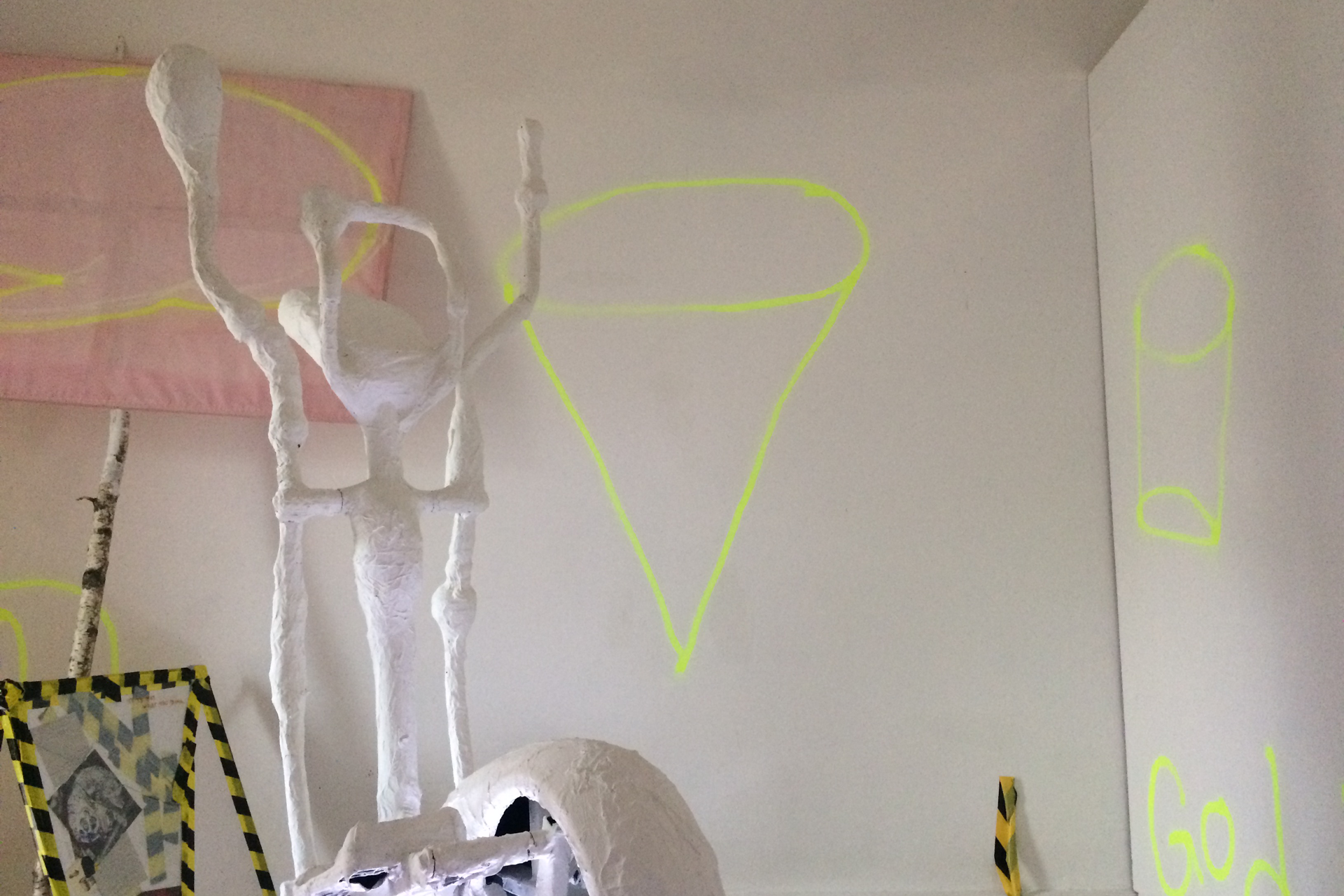
For the second act, the artists occupied one of the Academy’s rooms and removed its doors. The room became the environment **170716**. A modified exercise bike stood among branches, panels, collaged surfaces, translucent material and drawings extending across the walls. The doorway itself entered the construction.
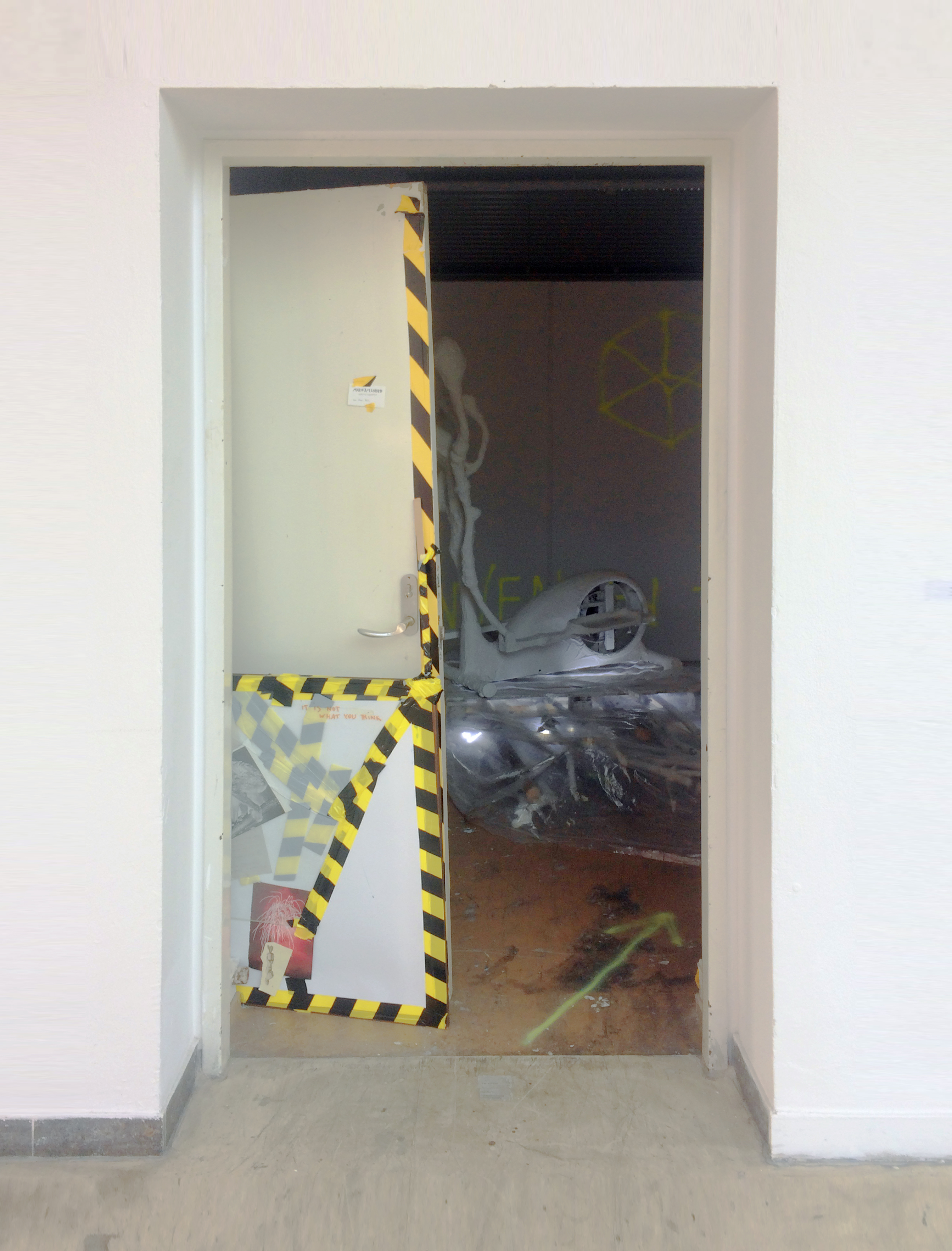
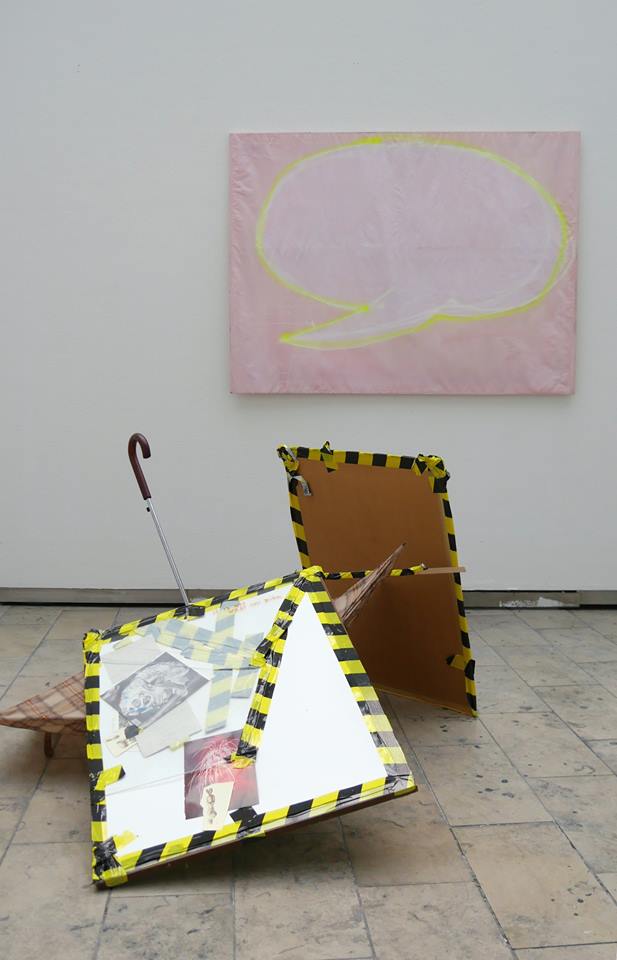
Admission now had a spatial consequence. The artists worked with the room’s surfaces, its means of entry and the way a visitor encountered what was inside.
Communication takes hold
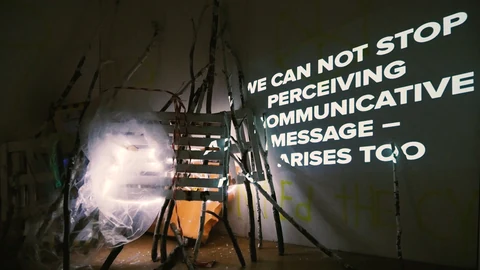
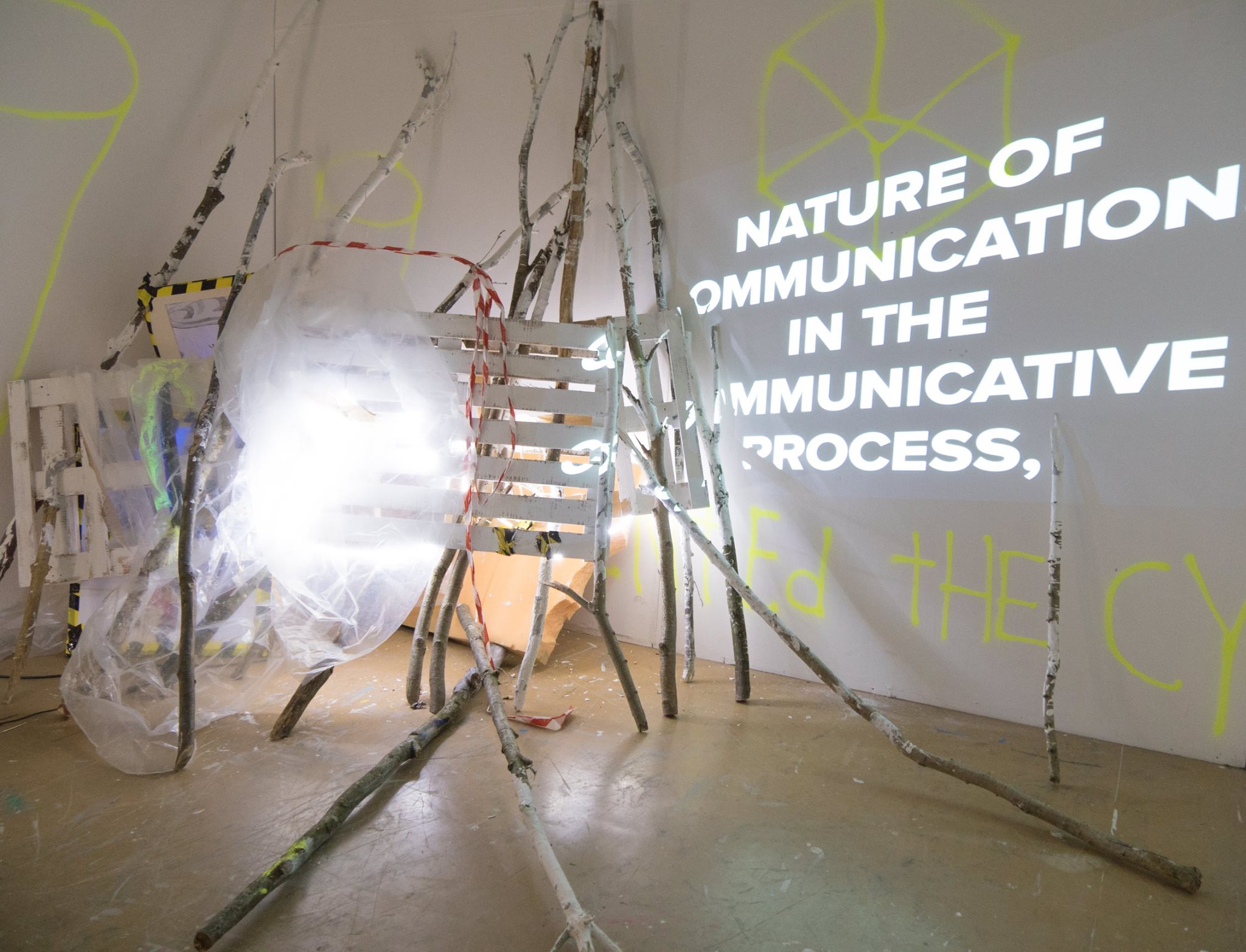
The room also contained **170715**, made and filmed within this environment and dated 15 July 2017. Its projected text crossed the same branches, sheets and surfaces through which the visitor encountered the installation. Speech and perception became physical parts of the room.
Authorial Comment
We can not resist the ultimate and peremptory nature of communication. In the communicative process, part of our attention is alienated and tightly adheres to the object, forming a single organ alienated from us, which no longer obeys us, but enjoins us. In conversation, our throat, the air through which sound waves pass and the ears of the listener form an organic unity that has some kind of autonomy. We are not able to break this unity at the level at which it occurs. We can not stop perceiving a communicative message — it arises too quick, so that we can decide to see or not see, hear or not hear, understand or not. We use each other's communicative organs as our own, we just take your eyes right now at our control to convey this message to you.
Marika Krasina and Anton Kryvulia, *About Communication*, 2017. Text.
History
The text addresses someone who is already receiving it. It describes an encounter whose material conditions — a throat, air, ears, projected light — exceed the separate intentions of speaker and listener. Placed inside the Academy intervention, it gives the institutional encounter a bodily scale. Entry, attention and participation are things that happen between people and through an arrangement of materials.
“Keep going!”
The summer-exhibition opening on 16 July brought another invitation: the artists who had entered from outside asked visitors to participate.
Authorial Comment
During the presentation of the object at the opening of the summer exhibition, the artists sat naked astride the art object and turned the pedals, inviting the audience to take part as well. When the Academy rector, Professor Caramelle, entered the room, he looked at it and said approvingly, <!-- voice: authorial -->
“Keep going!” Then he left.
History
A gift at the entrance
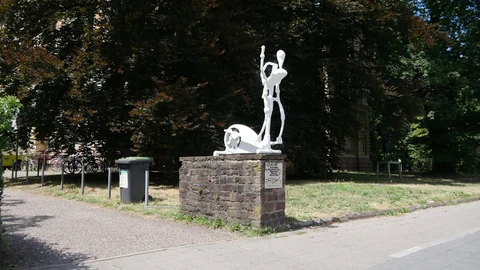
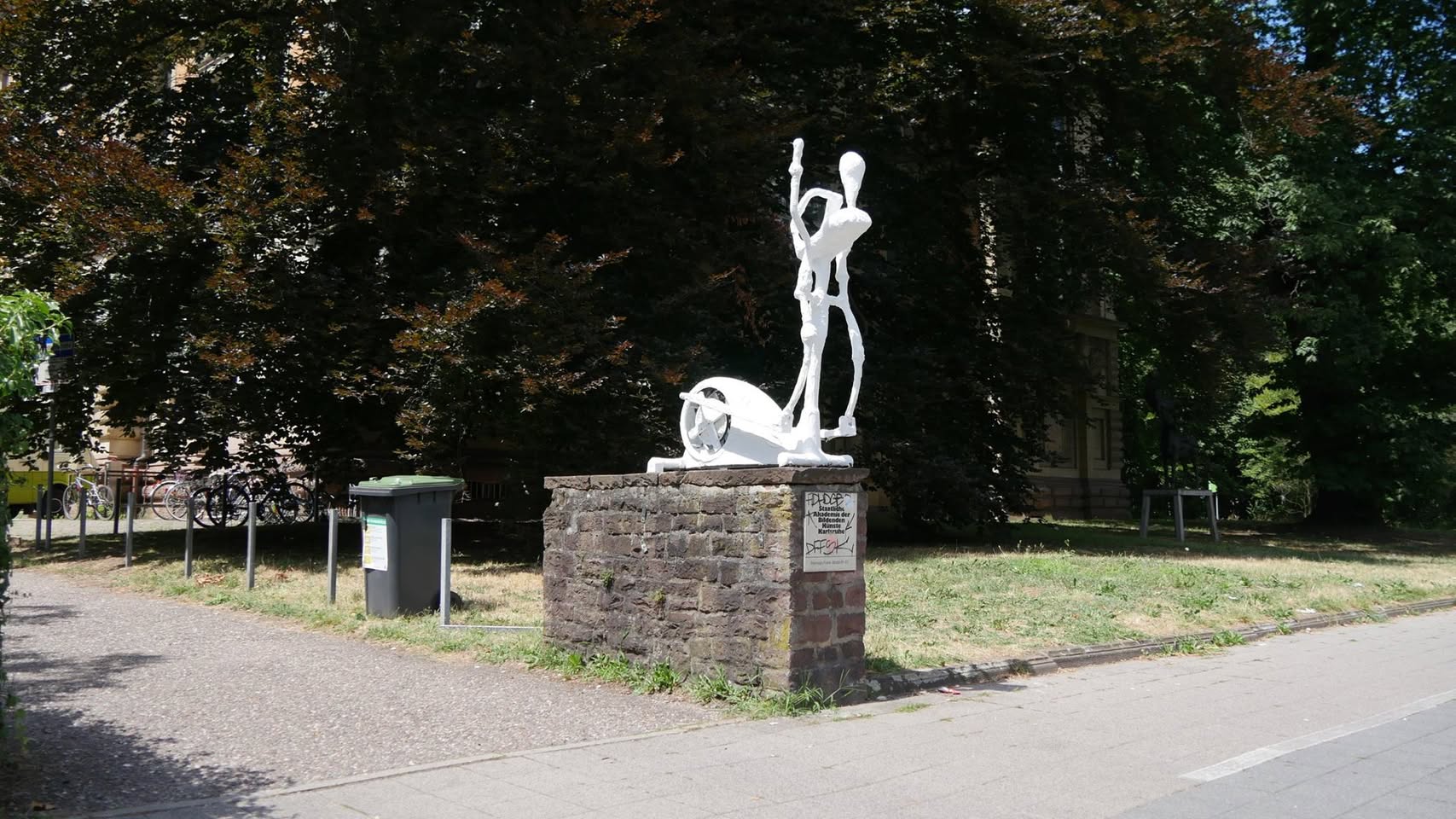
The construction also appeared outside, on the empty stone pedestal at the Academy entrance. A discarded exercise bike had become an object to ride, an element of an exhibition room and a sculpture encountered from the street. On the pedestal it shared a support with the sign bearing the Academy’s name and address.
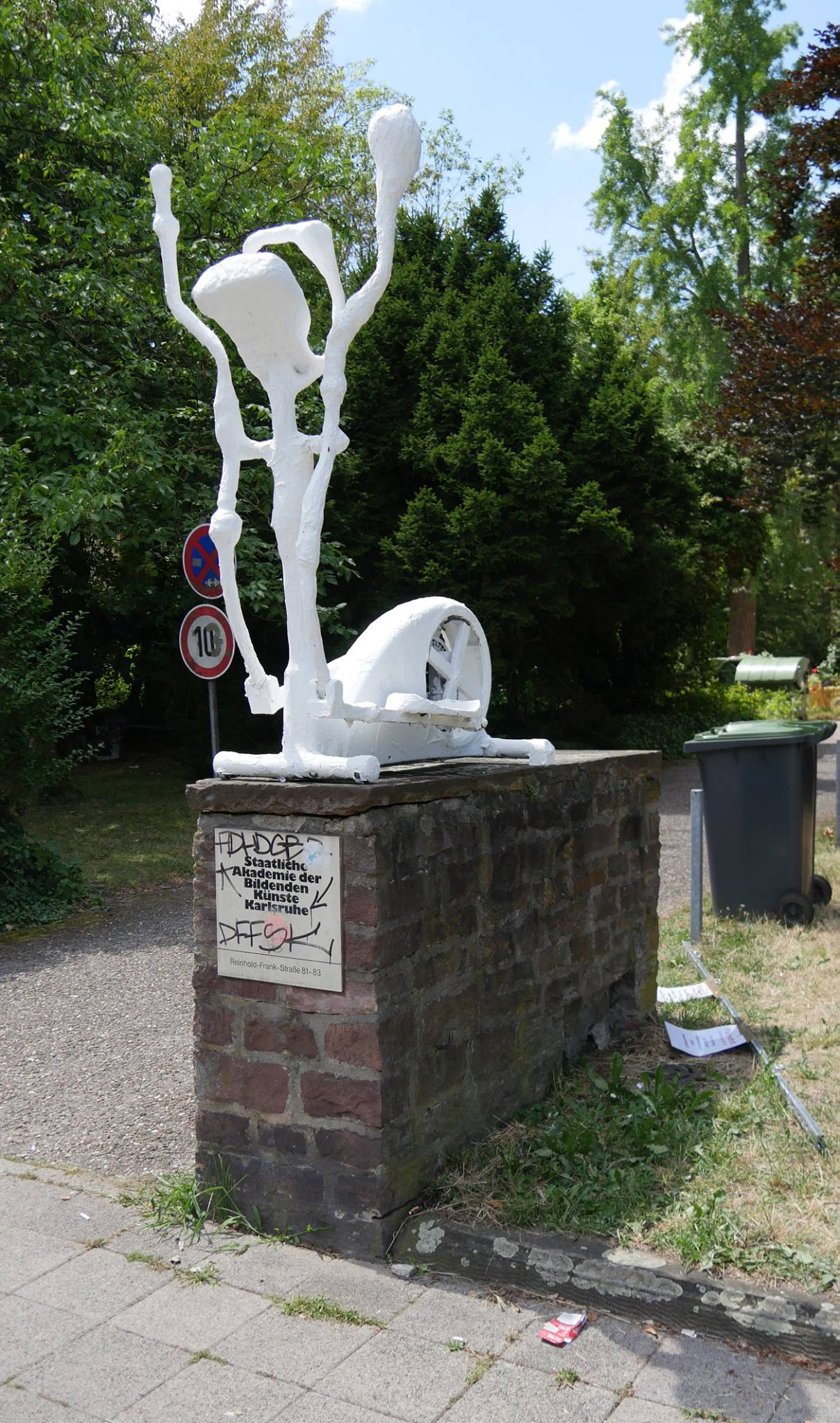
The placement brought the intervention into the institution’s everyday presentation of itself. The machine still promised movement while remaining in place. The artists called it a gift to the city.
Authorial Comment
The Bike that rides nowhere is our gift for the Karlsruhe – a city where the bicycle was invented.
Marika Krasina and Anton Kryvulia, *Rabota Booty Art*, page 14. Portfolio.
Related Works