History
One contract
On 2 December 2021, Marika discusses employment at HfBK Dresden: hours, pay and a student assistant contract. Her interlocutor is interested in her proposals, in developing a concept and in sustained collaboration. Marika explains how she and Anton work: they talk, research, develop ideas and bring different skills together. At a certain point, the conversation turns to whom this form of employment can actually accommodate.
The problem is that I can actually only enter into a contract with you, not with your husband.
Marika’s interlocutor, 2 December 2021. Conversation.
The proposed contract provides for one person. The practice Marika describes takes shape between two. Interest in the initiative and the limits of the contractual form become apparent in the same encounter. Subsequent proposals return to this mismatch: how can they participate in the academy with the whole arrangement of their work, including what cannot fit into an individual post?
The academy as an assumption
In a note, Marika and Anton explain their choice of the academy. For many years, they had worked with their own lives as a source and a place of art. Now they need “an environment with depth and a connection to society”. They call the academy an ark and compare it with monasteries that preserved and transmitted knowledge. The same note raises questions of earning a living: after moving, they are losing the connections with Moscow design studios on which their practice depended. A single approach brings together an artistic question and the conditions for continuing their lives.
Their choice of environment depends on the work that needs support. In Why Not the Academy?, the artists describe a daily, largely invisible activity of reassembling the world and themselves. For it to continue, they need time, a place and a witness—another person with whom the work can enter into a relation. In a 2020 conversation about scholē, they connect Nonknowledge with a pause and a delay in which the outcome is not yet determined. They are interested in the academy as a way to give this work a place in society.
Why Not the Academy? — text; conversation about scholē, 28 June 2020.
On 7 January 2022, they discuss this need as a construction of hooks, knots and points of contact. They need to be able to live in Dresden, a workplace, curators and people with whom they can talk about what is happening. They describe their approach to the academy as reconnaissance: finding out where its own interest arises, where compromise is possible and where assistance would remain charity. The artists already have tools developed for their own practice; they want to test whether the academy might have a use for them.
Authorial Comment
We don’t know what an academy is. We’re making an assumption.
History
The assumption also concerns the form of collaboration itself. Discussing possible employment, they consider specific positions—head of a design department, art director. The name Nonknowledge Institution already appears in the conversation; the question remains how a shared practice could be present inside another institution. It takes a very practical form: “But can they create a place they don’t have?”
The frame and what happens within it
In their January presentation Chaos Sense Delight for HfBK, the artists propose considering the academy as an interaction between a social institution and the artistic process. The social institution has rules, hierarchy, tasks and reporting obligations; it is required to be clear. The artistic process remains unpredictable and may go for a long time without presenting anything that can be separated from the artist as a finished result. In their proposal, the academy sustains the interaction between these two elements. A clear, functioning framework for communication should allow the artistic process to remain free, unpredictable and imperfect.
The academy first meets its visitor as a building. The next object in the presentation is a rubbish container in the courtyard after the summer exhibition. Remnants of works, failures and material for possible new worlds lie together inside it. This transition identifies the proposal’s practical difficulty: making the academy’s life visible while preserving its unfinished state, disorder and capacity to change.
An organ of the academy
On 24 January 2022, the artists draw up a proposal titled “An Offer He Can't Refuse”, an allusion to Vito Corleone's line in The Godfather: “I'm gonna make him an offer he can't refuse.” Its outline is headed “Working in the institution as one of its organs”.
Authorial Comment
We see our role as helping the academy to be a utopia. We are a little utopian wind. A breeze of utopia in the academy.
History
The proposed structure would work on “connecting everyone with everyone through media tools”. An Annual Report is proposed as a way to be the academy’s eyes: walking through its three faculties, photographing what happens and bringing it together for the summer exhibition. Short videos could be sent to screens, continuously forming a film and accumulating an archive. Conversations with students, professors and staff could return to their participants as stories, jokes and a phrase of the month at the entrance. A student platform would bring these records together with works, thoughts, images and announcements.
For the academy’s sounds, they propose an object suspended from a string. One version is a piece of wooden pallet that may be struck with an enormous rubber mallet only once an hour. Students could contribute recordings themselves. The life gathered in this way would acquire duration, sound and a form of shared use.
Another scenario begins with the rector’s desk in Dresden. All the things on it could be listed and the list sent to Rome. A curator in Rome would assemble the same entries from local objects; Riga or Budapest could then continue the list. The artists thus propose a method for relations between the EU4ART academies that they had already used when sending an inventory of their own belongings to the curators of a festival in Turku. Sending the list replaces transporting the things, and each receiving participant decides anew what will give it material form.
The document ends with the conditions for carrying this out: they need to live in Dresden; could the academy or EU4ART employ Anton or invite him as an artist? The proposed function requires the presence of those who will perform it. In the preparatory text Strategie Weippert for 1 February, Marika explains again: under the contract she works alone, but in practice they always work together. The question now also concerns the scope of the work—carrying out individual tasks within allocated hours or helping to organise communication as a whole.
Authorial Comment
One way or another, we will have to create a system. For you, or just for our own work.
History
The corridor
In February 2022, Anton takes part in the entrance examination at the Faculty of Art and Design at UJEP in Ústí nad Labem. According to his account published in MOLD, he decides to turn the presentation of his examination work into a live performance. He calls on the admissions panel to leave the office and join the students and applicants who have been waiting all day in a draughty corridor, and reads Why Not the Academy? to Kovanda, the students and the applicants.
The subject of the reading coincides with the place and circumstances of the encounter. The academy is described as a space for artists, teachers and students to work together; the audience consists of people whose participation in it is being decided at that moment. Anton presents his work by changing the way it is presented. The question of the academy’s purpose finds a specific audience and enters the procedure on which his own admission depends.
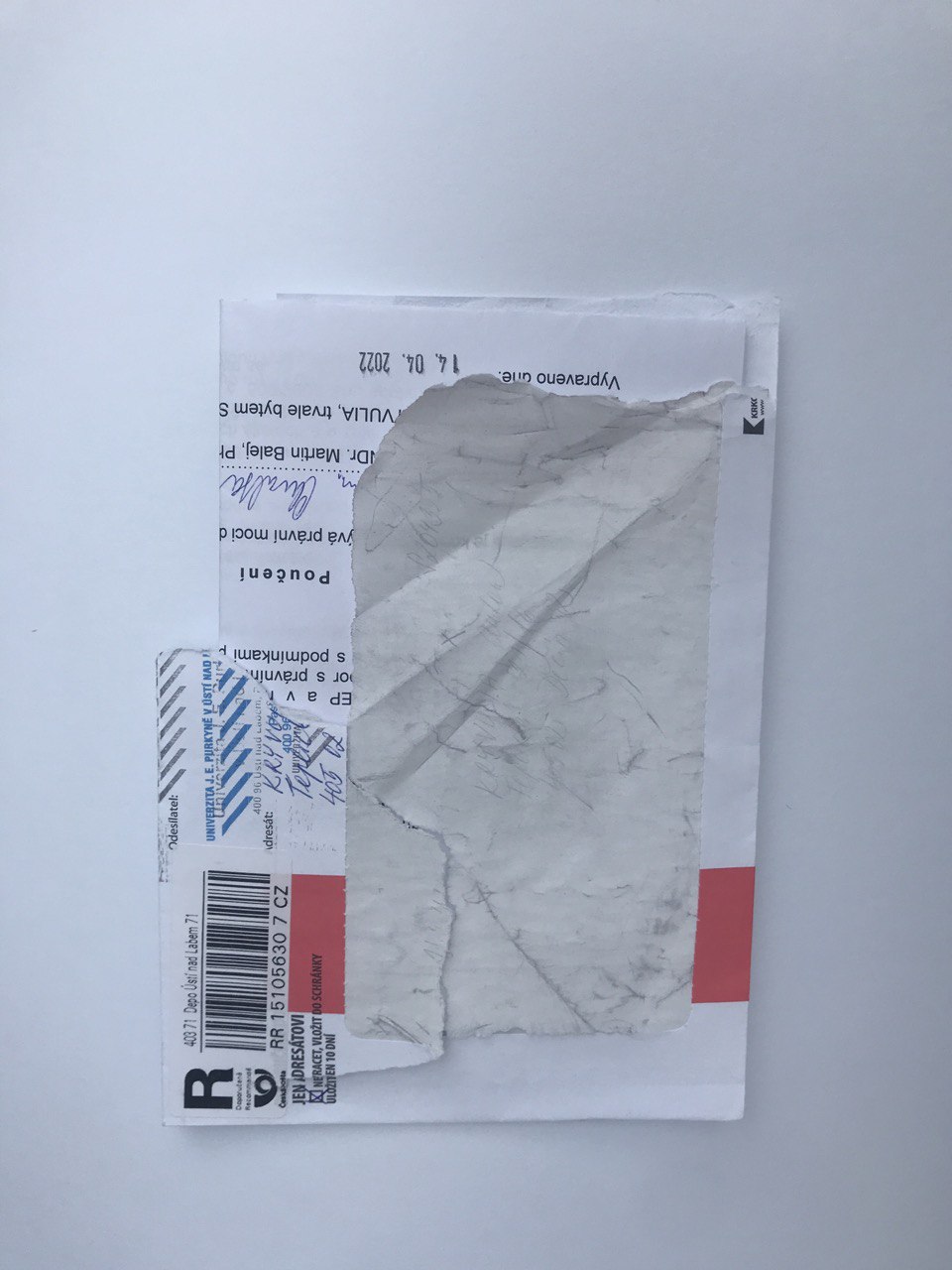
In a subsequent letter, Jiří Kovanda acknowledges the strength of Anton’s position, his education and the extent of his work. He writes that Anton could already teach younger colleagues. At the same time, Kovanda points out that he did not respond to the examination tasks: the work appeared to have been prepared in advance and presented regardless of the brief. The letter also suggests that Anton needs the university to regularise his stay in Czechia and directs him towards other ways of resolving this problem.
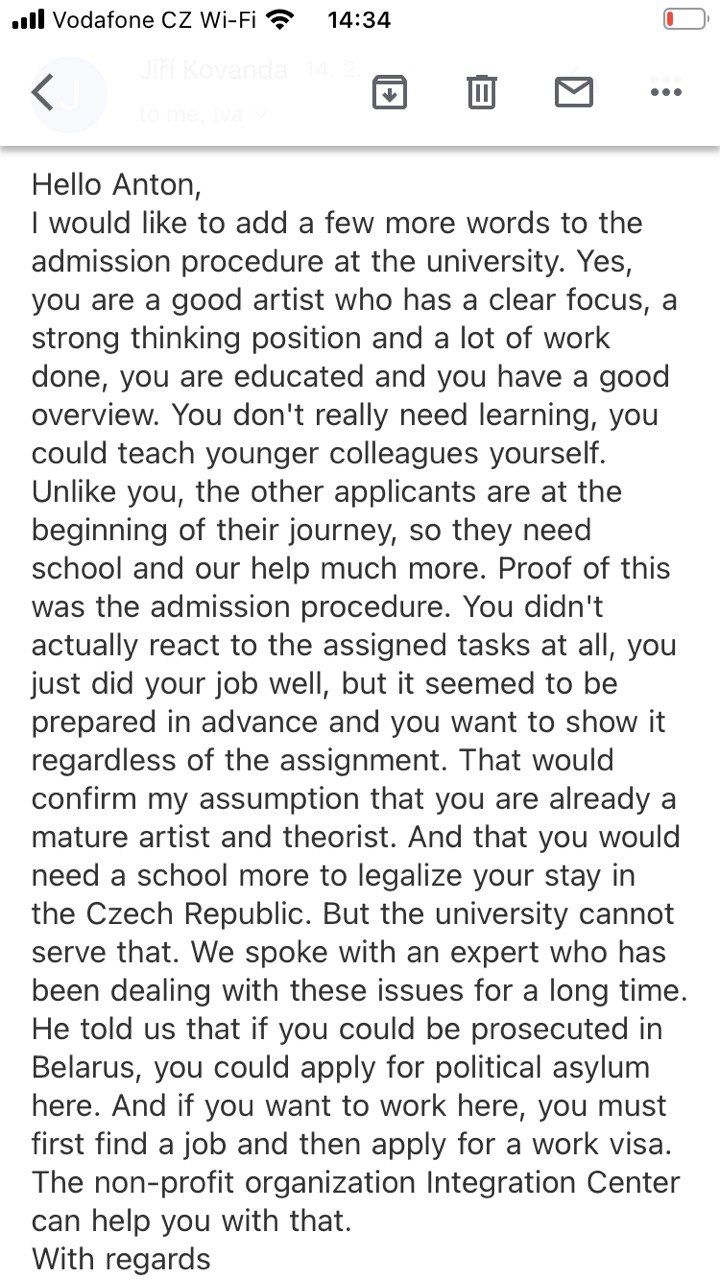
The participants understand differently what this encounter is testing. For Kovanda, what matters is the response to the examination task and the applicant’s need for education. Anton proposes considering the artistic work already taking place and its possibility of continuing among other people. Professional maturity acquires opposing meanings: in the letter, it explains why others need the school more; in the artist’s proposal, it allows him to participate in the academy with his own practice. This mismatch remains visible in the published exchange.
The letter becomes a magazine
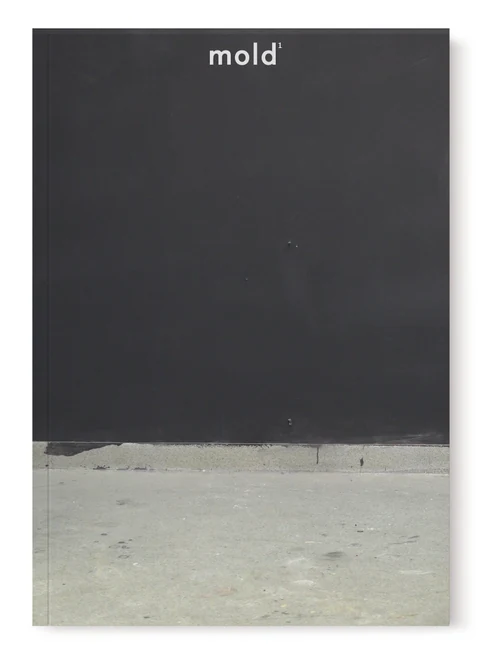
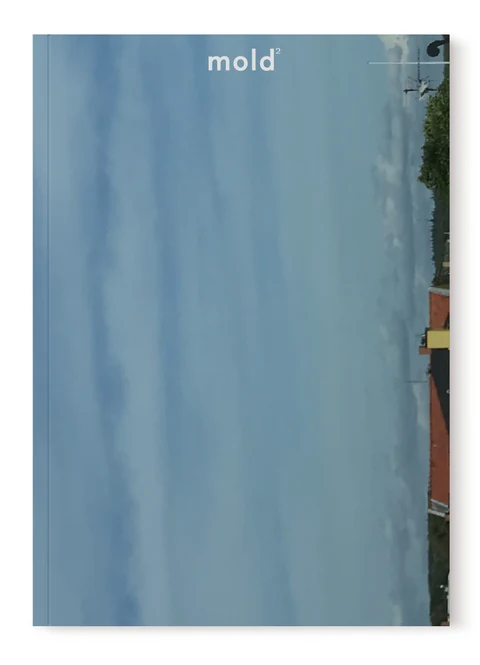
MOLD was conceived as a shared creative space between UJEP and HfBK Dresden. The introduction to the first issue describes its method as a combination of utopian development and practical performative intervention. It is followed by Anton’s appeal to Mrkus and Kovanda, dated 10 February 2022. The account of the entrance examination is already becoming part of the artistic work that the document presents to its addressees.
Towards the end of the issue, Kovanda’s letter is published, followed by individual points from it and the artist’s replies. To the assertion that he no longer needs to study, Anton responds with the need for continuous discussion and a professional environment. He connects the academy’s purpose with protecting the artist, the artistic process and culture. To the suggestion about regularising his stay, he responds with a demand that his professional qualifications and motivation be assessed. The reader encounters both lines of argument in a single sequence.
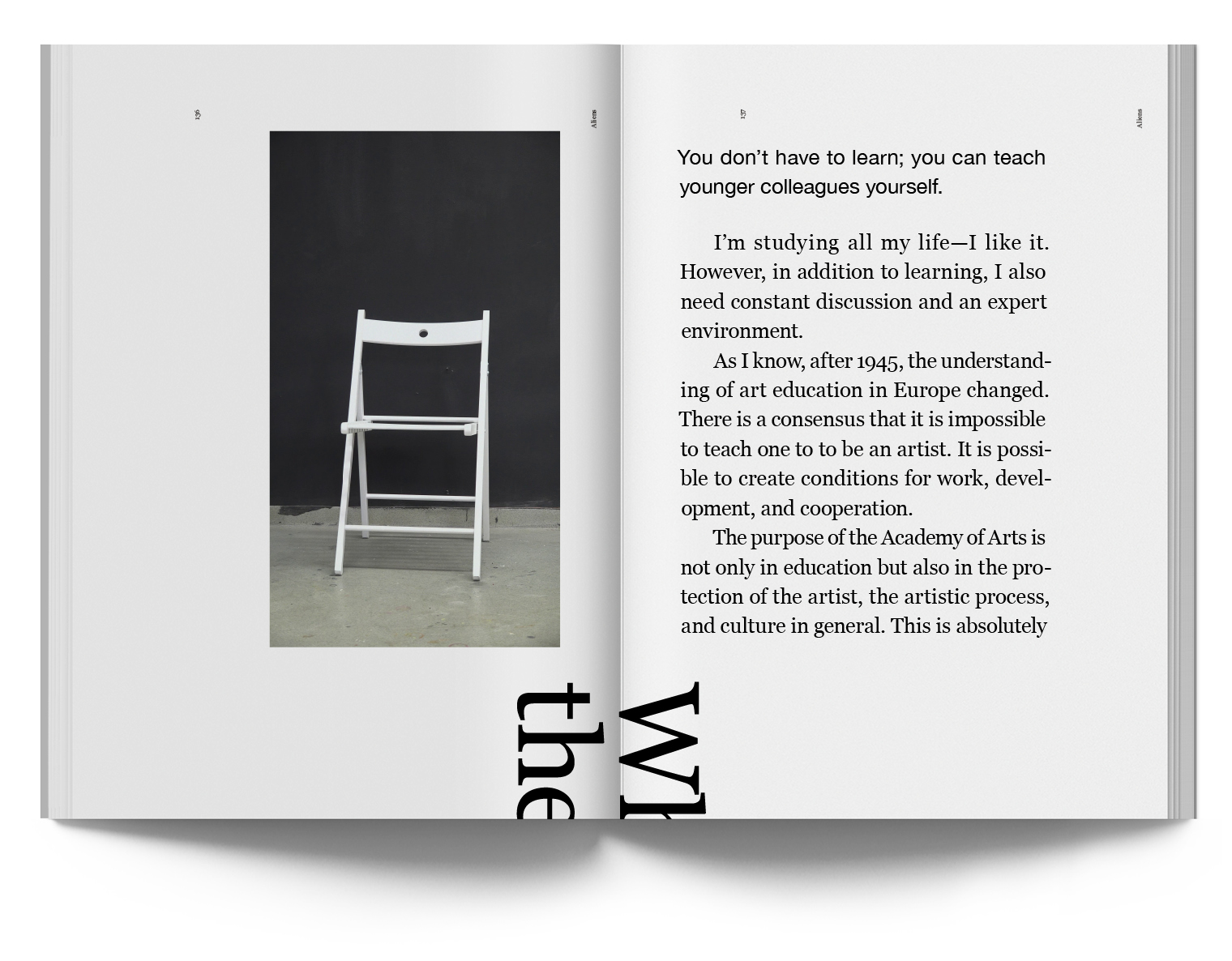
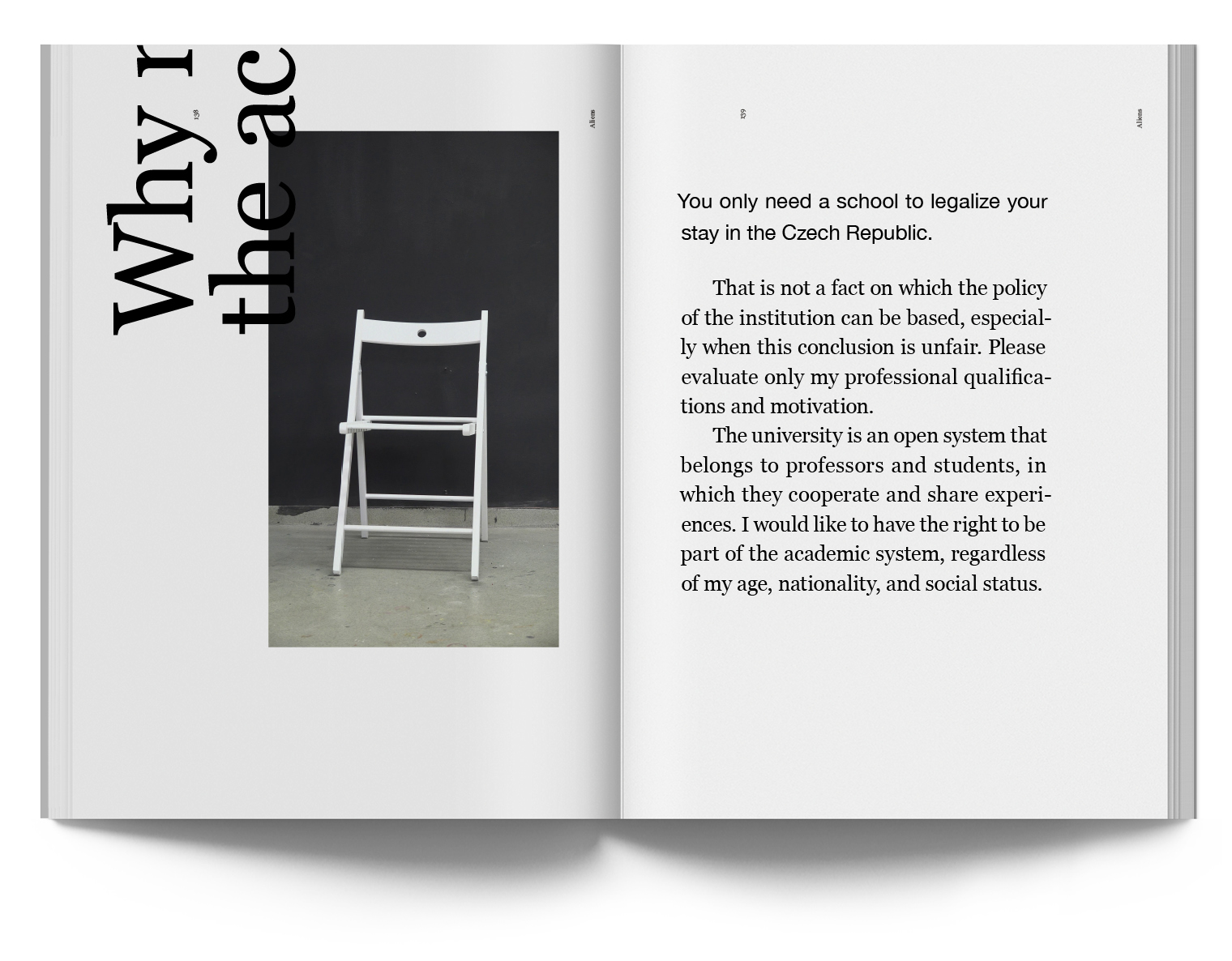
The magazine itself carries out part of the proposed work: it makes relations visible, allows the responses to be read and keeps them available for further discussion. The academy enters its content through the way it responds to the approach. The idea of a platform for collaboration changes as it incorporates the difficulty of that collaboration.
The appeal does not, however, change the outcome of the application. On the last page of the issue, Anton reports that UJEP’s response was negative.
Two chairs
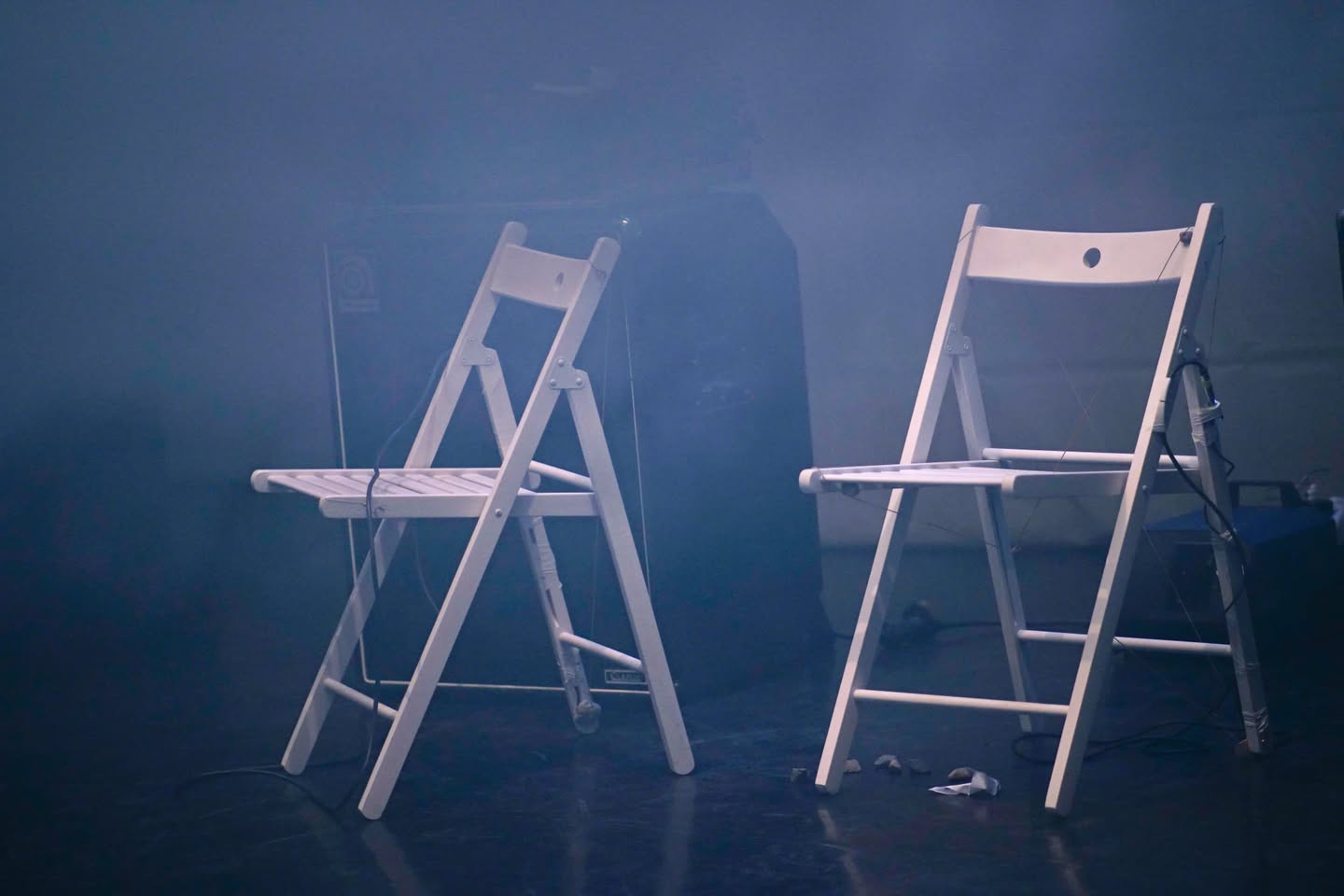
The white folding chair in the MOLD spreads has its own history of use. In one photograph, Anton sits on it; in another, the chair stands alone. Anton recalls using the same chairs for the Prague performance Nonknowledge Zones: Now. One of the chairs is also connected with Marika’s workplace.
Authorial Comment
Marika used this chair at her academy. It was hanging there at her workplace.
Anton Kryvulia, 22 October 2026.
History
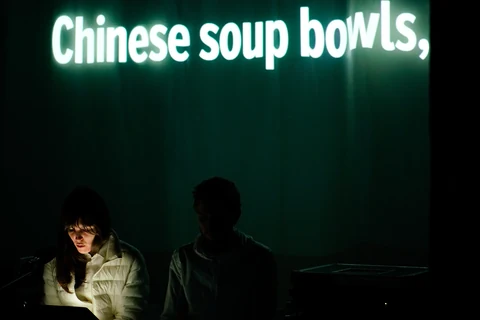
Now took place at Studio ALTA in Prague on 13 December 2021. In Anežka Medová’s photograph, two chairs stand in smoke, with strings and wires attached to them. They are part of a sound work before the January proposal to the academy and before the letters are published. In the magazine, one of them appears beside the question of an artist’s right to be inside an institution. The thing moves between different uses and ways of being presented.
On 6 July 2022, Marika and Anton discuss what has happened to their attempt. The conversation begins with the assertion that circumstances and problems can change the form of the practice by becoming its subject.
Authorial Comment
— We invented our practice in such a way that outside events would affect only its form, while its essence would stay the same. We invented it that way on purpose. So neither circumstances nor problems can stop it, destroy it. They just become its subject.
History
They describe the hypothesis of collaboration with the academy as having failed. Instead of the free time they expected, they encounter a timetable set by others; after the episode with Kovanda, the very idea of turning their practice towards society is called into question. They discuss the need to stop pulling old techniques out of the suitcase and begin with what is there. In these circumstances, a proposal for the summer exhibition emerges.
Authorial Comment
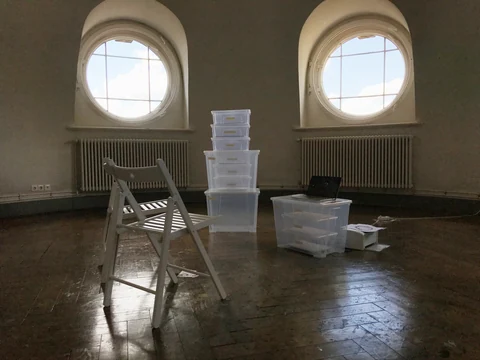
The academy we write about—it doesn’t exist yet, or no longer exists. Two empty chairs and a text for the summer exhibition. Two artists’ chairs in the Void of the institution. Good work.
Conversation about Wolke (Cloud), 6 July 2022. Transcript.
History
Testing their own utopia
The investigation also extends to the initial model of the academy. In her paper on the academy and the medieval monastery, dated 15 August 2022, Marika compares forms of communal life, rules, rhythm, architecture, the transmission of knowledge and social roles. She considers the academy as place and time, protection and leisure, communication and discourse, including as a possible refuge for adult artists. The paper also discusses the threat of bureaucratic normalisation, through which an institution may forget its own purpose.
Phenomenological analysis of an art academy and a medieval monastery, pp. 1–2, 10.
In the conclusion, Marika acknowledges that the external analogies between the two institutions are strained. What remains significant for her is their relation to questions that cannot be settled once and for all: questions of God and of art. The study revises the image of the ark with which their approach to the academy began. A protective space must preserve the possibility of questioning; the artists’ own utopia must also be tested.
In Anton’s present reading, this experience forms part of the foundations of Absent Institution. He assesses the academic mechanism from a distance of four years.
Authorial Comment
Well, I have to say that the academic system did end up pushing us aside. It turned out that it doesn’t recognise its role, that’s what—that the academy, in a sense, doesn’t recognise the role we see for it. It doesn’t see it, and it resists working that way. Although, somehow, at the level of individual high-ranking officials—rectors, professors—there is understanding. But it seems to me that in Germany, at least, this mechanism, it’s swallowed up by bureaucracy. Bureaucracy as power, this hypostatised state—it sucks the function of the university into this negative ontology of its own.
Anton Kryvulia, 22 October 2026.
History
The mirror of institutionality
As early as 1 August 2022, while discussing the arrangement of their own institution, the artists return to the academic experience as a way of acting. “We took the academy as an element, as an object of research” follows a proposal to show people in institutions what an institution is through their own example. In discussing their own institution, they connect functional specificity with an artistic task: its arrangement should make it possible to see exactly how it works.
Authorial Comment
— By the way, a purely institutional USP: showing people in institutions what an institution is through our own example. — But not doing it directly. Doing it artistically. — So that people who come into contact with our institution see a mirror, and in that mirror see institutionality as such, artistic institutionality.
History
The artists themselves remain within this test—with their need for support and a utopia that has to be reconsidered.
In the same August conversation, they call for irony, self-irony and lightness from their own institution. The way of showing institutionality must also act upon those who create it. The task is formulated as an address both to themselves and to others.
Authorial Comment
The work exists to remind ourselves, as an institution, and others what an institution is, why it’s worth doing this and why it matters.
Related Works