Work Text
Rabota is an easy word to introduce ourselves. We are not a group of artists or a curatorial collective: we are not a collective at all. Rabota is a tension between us; it is our world, it makes us wake up, recall, and remount ourselves and everything around again and again. We consider such a constant recollection as our artistic practice. Such work is inevitably immaterial, invisible from the outside; such art-in-itself is problematic. If no one can notice it, read, evaluate, tell about it, store it or buy it, such art does not exist, or such art does not have a product. We have created curators and theorists from ourselves to materialize and render the practice, then to grow a discursive shell for our invisible work to overcome this situation of invisibility. Our imaginary colleagues have profound privileges. They connected with our consciousness, and they are our constant witnesses. This circus configuration constitutes the institutionality of what we have been calling MUSEUM, the Floating Institution.
Marika Krasina and Anton Kryvulia. Exhibition catalogue, p. 2; existing English text.
History
The exhibition in the apartment
The Russian presentation describes a mobile place for the practice, able to appear online and in physical space. It invites visits by appointment to the apartment on Rabochaya Street and presents an online exhibition in six sections. The artists’ conversation of 6 December 2020 asks how an archive becomes a museum, and how the observer can give their own work a place from which to be seen.
The catalogue subsequently records that the offline exhibition never opened because both artists became ill. A working introduction describes the same situation from inside the apartment:
We got the Covid-19 and are locked on the 19th floor on Rabochaya Street in Moscow. For not to be a victim of circumstances, we have opened the exhibition at home. The MUSEUM. No one, of course, will be able to come and see it live, but the exhibition is open, and even works from it are being sold. The exhibition is quite material: photographs, objects and videos. In addition to the exhibition catalog, we created a parallel online exhibition that is closely intertwined with the material exhibition. We are resisting. We resist disease. We resist the desperate situation into which circumstances have thrown us. We resist isolation, the destruction of connections and the collapse of the interhuman space. We are opening up.
Marika Krasina and Anton Kryvulia. MUSEUM working introduction; existing English text, undated.
The catalogue records that the offline exhibition never opened. The announcement of 31 December 2020 calls the exhibition open and materially present, while also stating that no one can visit it. These accounts retain their different descriptions of opening. The exhibition was installed and documented; the announced encounter with visitors could not take place. The catalogue, online arrangement and circulation of works gave the exhibition other forms of access. The artists’ statement records sales, although the recovered catalogue does not identify prices or individual transactions.
Objects in the exhibition
The catalogue records fourteen entries. Their materials retain different kinds of time: a stone carried from an expedition, possessions listed in a room, a photograph carried through travel and underground storage, a filmed departure. The accounts below follow the catalogue’s sequence and distinguish the objects presented in Moscow from the earlier situations they recall.
Detail
Observe the Observer
Two stones, each 1 × 1 × 1 cm. 2016.
Marika and Anton found the two stones on the bank of the Danube in Budapest in spring 2016. A short note from that year begins with the stones lying together on a palm: they are roughly the same colour and size, and seem to point towards one another. From their interaction, the artists describe a third object appearing above them—another stone. The material pair becomes a way to notice a relation that is produced in the act of looking.
In Strategies and Anecdotes, they return to this encounter:
Our thing is simple and strange; a certain complexity can arise in this strangeness. Once in Budapest we found two stones on the bank of the Danube. We watched how they interacted, playing with meaning and number. We discovered that stones come in three kinds: stones, things resembling stones, and things not resembling stones.
Marika Krasina and Anton Kryvulia. Strategies and Anecdotes of Rabota.
The later development of this thinking leads to a matrix in which “stone” names a position that another object can occupy. The Moscow catalogue brings the original pair back into view. In its photograph, the two tiny stones lie near the centre of a broad dark field in a frame. This arrangement gives the viewer room to attend to their relation and to the activity of observing it. The history of the work begins with an encounter that changes the observer's position.
Detail
Luxury Problems
Stones and plastic containers, 41 × 33.5 × 28 cm. 2018–2020.
The object brings together three white stones collected during the Archaeological Committee expedition in 2016 and plastic containers used during the artists’ shelter from quarantine measures in spring–summer 2020. The stones had already been kept for several years when the two histories met in the Moscow exhibition.
The Archaeological Committee was a travelling institution the artists appointed themselves to. During their journey through Crimea and southern Russia, they registered insignificant things in the landscape as cultural monuments for future archaeologists. That practice supplies the background to the act of finding and keeping these stones. The catalogue does not identify their precise finding places.
The photograph shows transparent storage boxes stacked and nested: stones are enclosed within containers, while the containers themselves become the visible structure of the object. The catalogue calls it a phenomenological puzzle. The ordinary act of keeping something is made available to inspection through successive walls of translucent plastic. Equipment used to sustain a life under quarantine becomes a small apparatus for holding and displaying earlier finds.
The work brings the museum's operations—selection, containment, preservation and looking—into the scale of things carried and used by two people. Its components retain both those practical histories.
Detail
the Tunnel
Performative expedition documentary, 13′03″. 2020.
The departure begins in Moscow in March 2020. The catalogue describes closing borders and approaching lockdown as a threat to the artists’ ability to continue living and working together, with Anton’s position as a foreigner adding another difficulty. They leave before the full lockdown and try to find a way to remain together beyond its control.
The wider history unfolds on Meganom through the spring and summer. Their dwelling consists of a tent, a two-person kayak and places in the landscape given the functions of rooms. In the June conversation One Room, the bedroom is on the mountain, the bathroom by the sea and the office near the lighthouse, where a mobile connection can be found. The “apartment” extends across five kilometres. Reading, making tea and talking continue through the work of making this dwelling possible.
The thirteen-minute documentary gives an audience access to an expedition whose medium includes these circumstances of life. Its exhibition in Moscow introduces another situation: the artists are now inside an apartment they cannot open to visitors. The film carries the earlier movement into that confinement. Across both situations, sustaining a shared life is an operative condition of the work.
Detail
Common Body
Index, paper, black-and-white office printing. Nine pages, 210 × 297 mm, as listed in the exhibition catalogue. 2015.
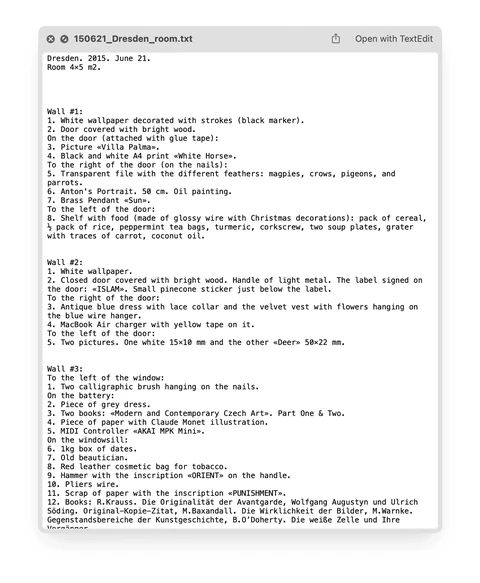
On 21 June 2015, Marika and Anton made a list of everything in the Dresden office where they were living. Their later account describes renting a room on condition that they would not live there, moving in with their parrot and eventually occupying the whole floor. Making the list becomes a moment of recognition: they understand that it means something and call the work Common Body.
The inventory moves through the room wall by wall, then across its surfaces and contents. Pictures, instruments and working materials appear beside food, clothes, chargers and household things. Their shared life acquires a second body made of names. The list can be read elsewhere while the things continue to exist and be used in the room.
Common Body is itself the artwork. Its function is that of an imprint of the dwelling: writing renders the room again and gives its collection of things a form that can circulate. The artists subsequently return to the condition of this common body through other inventories. In MUSEUM, the printed work brings the Dresden room into the Moscow apartment and into the reader's imagination. The nine-page extent belongs to this exhibition’s catalogue description.
Detail
25.12.2018 Bankrut Thailand
Photograph, print series of 20, 20 × 27 cm. Catalogue year: 2019; date in the title: 25 December 2018.
The photograph records the artists’ belongings while they were staying in a rural healer’s house in Thailand. Their accounts of that stay describe reaching a village near an enormous empty beach, running out of money and being fed with rice and fruit brought by the healer’s patients. An apparent stop in the journey becomes a sustained period of living and talking together.
The quantity and arrangement of their possessions acquire particular importance in this situation. Elsewhere in the account of the Thai stay, the artists describe recording eighty-three things as everything they owned; that separate inventory and photographic project, All We Have, shows how closely the observation of possessions belonged to the work of this period. The Moscow print preserves one particular view, with its own dated title.
These things form a temporary household under conditions that offer little certainty about what will happen next. The photograph gives that material condition a form that can outlast the stay. Once presented as a print series, a view of everything close at hand can enter another person's room and another exchange. The exhibition retains the tension between having very little and giving this limited common body sustained attention.
Detail
the Fid
Wood, earth, mold and paint, 41 × 22 × 22 cm. 2016.
A Fid is a tool that creates holes in the ground equal to itself.
Fid. Existing authorial definition.
The artists’ text traces the series to a prototype encountered during the expedition of 2016. Its instrumental function interested them: an object enters the ground and, when removed, leaves a hollow corresponding to its own form. The object and the absence it makes can each become the subject of attention. Related pegs and their punctures were presented in the field at Pyatikhatki during that year’s expedition.
The catalogue identifies the Moscow Fid as the largest and only surviving object of the series. It was stored underground from autumn 2018 to summer 2019. Moisture and microorganisms changed its surface; earth and mold appear among its listed materials. The attempt to preserve the object has become part of its visible history.
In the exhibition, the Fid brings two kinds of relation to the ground together: its capacity to produce a hole, and the ground’s capacity to act back upon it. Its meaning remains tied to this exchange between a definite form and a place made through its absence. The damaged survivor also gives that apparently simple operation a history of duration, exposure and material loss.
Detail
Asian Drift Display
Various media, 50 × 40 cm. 2019.
The display was assembled from material traces of the artists’ six-month drift through Southeast Asia in 2018–2019. Their journey moves through Vietnam, Laos and Thailand before continuing to Seoul. Tickets, small papers and found things survive the practical situations in which they first mattered and are brought into one shallow display.
A later authorial account identifies a dried flower from Ha Long, a 500-kip note, a train ticket, a cookie napkin, Korean visa photographs, a Bangkok shopping list, a Seoul map, a bird’s feather and an island ticket captioned “Quan Lan”. These are different kinds of evidence: a border-crossing document, the remains of eating, a means of travel, something picked up and kept. The display holds them together without turning them into a continuous travel diary.
In 2024 the artists return to this object as the cover of The Music of Nonknowledge. That later use extends its life beyond the Moscow exhibition: a visual arrangement of the journey becomes the face of a sound publication. Within MUSEUM, it offers a compact material counterpart to the photographs and conversations of the same drift. The journey can be approached through the small things that remained after it.
Detail
Bed in Cadaques
Photo object in a flea-market frame, 25 × 20 cm. 2016–2019.
The photograph was made during the Catalan drift near Cadaqués. A place to sleep belongs to the same work of making a dwelling that recurs throughout the artists’ journeys. In Strategies and Anecdotes they describe finding the same place wherever they can speak and think together: a forest, a room, a boat or a night road. Here that recurring experience is held in one particular image.
The print subsequently underwent prolonged underground storage and was damaged when it was dried. These changes are part of the object listed in the Moscow catalogue. The photograph has two histories: the situation once exposed to the camera and the later life of the piece of material that carries the image. The flea-market frame brings both into the exhibition.
The work makes the fragile continuity between dwelling and remembering tangible. The artists keep an image of a place where they slept; keeping it exposes the print to further conditions of their life. What reaches the museum includes the effects of this passage. The object’s changed surface carries time alongside the scene it depicts.
Detail
it is not a claim to power, it is power
Black-and-white office printing in a flea-market frame, 45 × 38 cm. 2020.
The object recalls the presentation of Whatever at the Serlachius Museum in Mänttä in February 2020. Anton’s ordinary boots stood on a plinth in an empty hall. The catalogue preserves the accompanying statement:
We are installing a blank space. Now this place is occupied by Anton’s boots, next time it will be something else, it could be whatever.
Whatever, quoted in the MUSEUM catalogue.
The boots provisionally give a place to the work. In the artists’ account of Whatever, an object holds an empty position so that it can be remembered, transmitted and met by someone else. Its occupation can change while the position remains available.
The Moscow exhibition presents a further material act: black-and-white office printing inside a flea-market frame. This object carries the earlier installation into another room and makes its declaration available again. Its title locates power in the act being performed—the capacity to establish a place from which something can appear as work. The print, its economical means of production and its reused frame are the concrete form of that claim within MUSEUM.
Detail
26.03.2019 Seoul
Photograph, print series of 20, 20 × 27 cm. 2019.
The photograph records the artists’ belongings during their stay in Seoul. The move to the residency followed their period in Thailand and required a transition from tropical heat to winter. In the account preserved with All We Have, the artists remember buying warm second-hand shoes in Bangkok with a budget that also had to cover food, then flying to Seoul separately. A change of place changes what has to be carried and what those things make possible.
The Seoul inventory from the same period records objects with their individual histories: a repaired umbrella found near a subway entrance, a fan from a festival in Vientiane, bowls from Hanoi and the keys to the studio and dormitory. It provides a wider account of the travelling household of which this dated photograph is one visual record.
Alongside the Thailand print, the Seoul photograph allows two material configurations of life to be encountered at the same scale. A household persists through changes in shelter, climate, means and possessions. The work attends to that continuity through a bounded arrangement of things. Its date remains 26 March 2019, independently of the dates of the related inventories.
Detail
07.07.2015 Haven of Barcelona, we used to forsake these things on the bench when we woke up.
Photo object in a flea-market frame, 30 × 24 cm. 2015.
The title remembers an ordinary action from the Catalan drift: waking in the harbour and leaving things on a bench. Its phrasing retains repetition—“we used to”—within a dated photograph. Possessions make a temporary place for sleeping and gathering oneself before the next movement through the city.
The catalogue records the later underground storage of the print. The thing shown in the exhibition is therefore an image of a temporary arrangement that has itself had to be moved and kept. A flea-market frame holds this surviving piece of the journey inside the Moscow apartment.
The work gives the practical organisation of a life the duration of an image. The title restores an action to the arrangement of things: they have been put down, used and left, and the artists have woken beside them. Their wider account calls such possessions a common body. Here that body is dispersed across a public place and then recollected through the photograph. The print’s own storage history adds another layer to the question of how a place and its things can be retained.
Detail
Inbetween, sequence #1
Photo object, 20 × 15 cm. 2015.
The photograph belongs to a series made while Marika and Anton were cycling towards the Universität der Künste in Berlin in summer 2015. The camera travels with them. In the catalogue image, the bicycle, a fragment of a body, roadway and trees are caught in motion; blur carries the movement into the still photograph.
The print also presents its own surface. Pale patches, splashes and interruptions cross the image, bringing the material object into view at the same time as the represented street. The separate Inbetween presentation describes the work as an inclusion of one medium within another that exposes the material presence of media. Its photographs and magazine fragments had been damaged during the artists’ continual travel.
This object therefore asks for two simultaneous kinds of looking: into a remembered passage through Berlin, and at the altered piece of material through which that passage remains visible. The surface prevents the photograph from becoming a transparent window. Travel is present both as the movement recorded by the camera and as a condition of the things that carry its images.
Detail
Inbetween
Photo-object sequence, 20 × 15 cm. 2015.
The next catalogue entry presents the whole sequence. Six images on the page return to the moving bicycle, pavement, trees and roadside barriers. Their changing viewpoints hold a short passage through the city in separate frames. The selected image shown on the preceding page appears again as part of this arrangement.
The prints carry different interruptions and changes of surface. Seen together, they make the relation between photographic sequence and material object more explicit: movement links the images, while each print remains a separate thing with a particular appearance. The catalogue lets the reader move between the close encounter with one object and this view of their succession.
Inbetween’s own description places the work between images, their supports and other media. The Moscow arrangement gives this operation a small, inspectable form. A sequence can preserve continuity through separation, just as the artists’ accounts of travelling life return to a shared world across discontinuous places. The two catalogue entries preserve these different scales of encountering the same body of work.
Detail
07.10.2015 Cadaques
Photo object, 10 × 10 cm. 2015.
The catalogue locates the photograph on the boat moorage in Cadaqués and identifies the objects as the artists’ remaining possessions after the robbery at Barcelona Zoo. Their account of the robbery describes a night when they were treating scabies on a lawn, were soaked by an irrigation system and hung their belongings out to dry. While they became absorbed in drawing on a roll of paper, other people carried their things away.
The later image records a radically reduced household. The artists’ writing returns to this loss as an event that continued to set the scale of their practice: the burden with which a person identifies can be taken away, while the work of finding and reassembling a world continues. The photograph gives the remainder a definite material form.
At ten centimetres square, the object concentrates attention on what is still there. It is a record of survival and a way of looking at the things that can still constitute a shared body. The date-bearing title remains exactly as printed in the exhibition catalogue; the separate chronology of the robbery is retained in the sources.